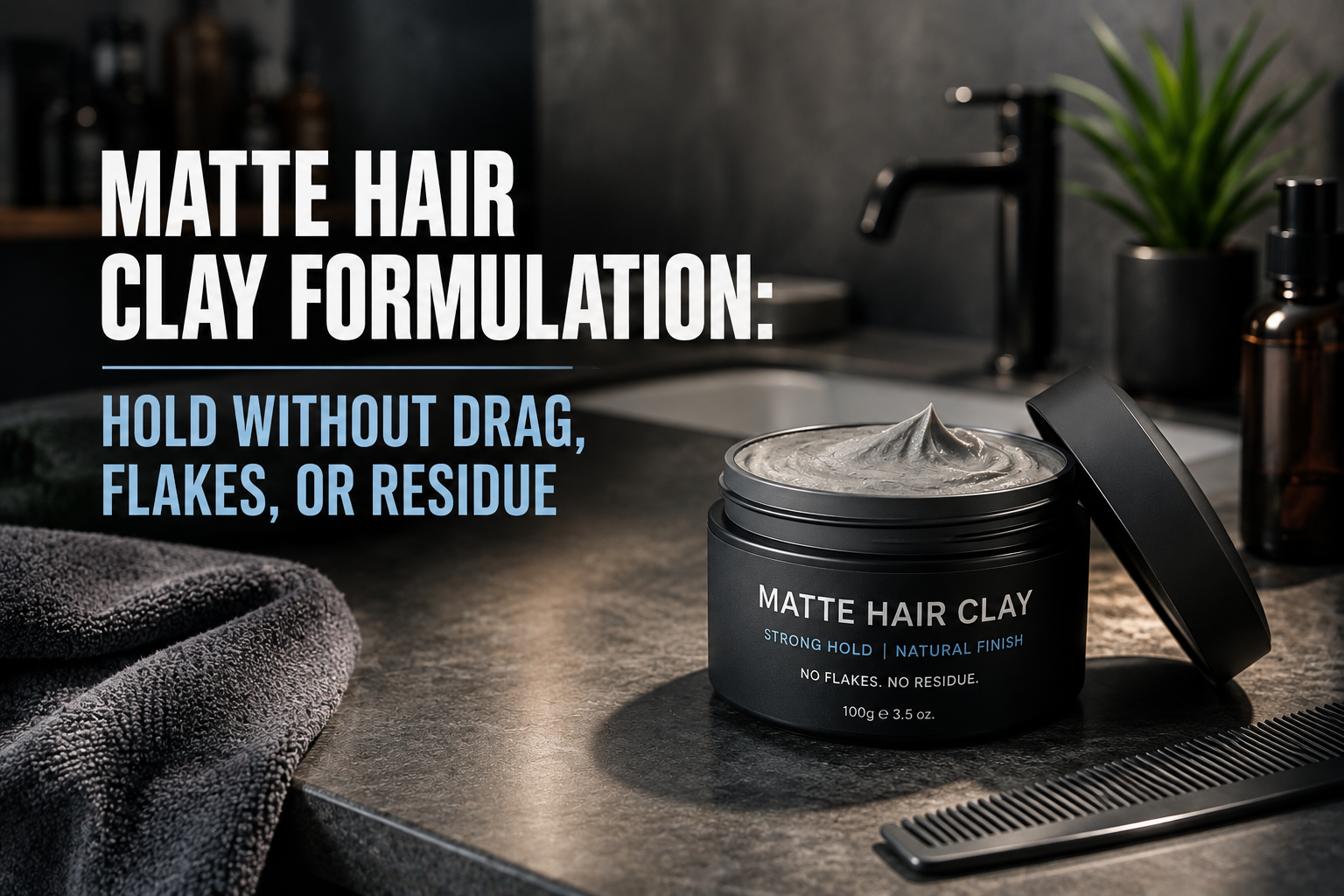
A matte hair clay sounds simple on paper. Give it strong hold, remove the shine and make sure it washes out. Done.
Then the first samples arrive.
One feels like dragging cold candle wax through the hair. Another applies nicely but loses hold before lunch. A third creates great texture, yet leaves pale crumbs on dark hair. It looks less like premium styling and more like surprise dandruff. Not ideal.
These problems usually come from the same basic mistake: treating “matte clay” as a single ingredient story. It is actually a full system. Clays and powders create grip and absorb oil. Waxes build structure. Styling polymers support shape. Emollients provide slip. Emulsifiers, rheology modifiers and preservatives keep a water-based product usable and stable.
Change one part and the others move too. A bit like adjusting one leg of a wobbly table.
This guide is for grooming brands, product developers and sourcing teams working with a men’s grooming product development partner. It explains how to turn hold, drag, flakes and residue into a clear formulation and testing brief.
TL;DR
- Adding more clay usually backfires; matte strong hold is a material system, not a clay dose.
- Define the target product (finish, hold, spreadability) before choosing ingredients.
- Test the prototype like a customer; manufacturing and stability can change the result – turn strategy into a better OEM/ODM brief.
Why Adding More Clay Is Usually the Wrong Strategy

Kaolin or bentonite can increase grip, texture and oil absorption. That does not mean more clay automatically creates better hold.
Too much absorbent powder can make a formula dry, chalky and difficult to distribute. The user applies more pressure, pulls more hairs and ends up with uneven deposits. Those deposits may later appear as white specks.
It also helps to separate three different meanings of “hold”:
- Application grip: the resistance felt while working the product through the hair.
- Initial styling hold: how well the hair forms the desired shape.
- Hold endurance: how much of that shape remains after time, movement and humidity.
A product can have fierce application grip and weak endurance. Users experience plenty of tugging, then watch the style collapse two hours later. That is a bad trade, frankly.
The development goal is not maximum dryness. It is useful friction combined with even distribution, flexible structure and a clean-looking finish.
What Counts as a Matte Hair Clay?
Hair clay, paste, wax and pomade are marketing categories, not tightly controlled scientific definitions. Two products called “matte clay” may use very different structures.
Compared with a classic pomade, a clay normally offers lower shine, more separation and a drier feel. Compared with a paste, it often has more mineral grip and denser texture. Compared with a wax, it may create more volume and less gloss.
Still, the name on the jar tells you less than the formula architecture.
| System | Advantages | Common risks | Typical fit |
| Anhydrous wax-and-oil clay | Concentrated feel, strong structure, no water phase | Hard scoop, drag, buildup and difficult washout | Short or thick hair; highly textured styles |
| Water-based emulsion clay | Creamier application, broad distribution and easier shampoo removal | Preservation, emulsion stability and polymer flaking | Daily-use retail products and wider hair-type coverage |
| Hybrid or low-water clay paste | Can balance grip, flexibility and conditioning | More complicated processing and compatibility work | Premium, flexible-hold positioning |
An anhydrous product is not automatically stronger. A water-based product is not automatically clean-rinsing. Performance depends on the complete formula, raw-material grades and manufacturing process.
Define the Target Product Before Choosing Ingredients
“Strong, matte and natural” is not a usable development brief. It sounds good in a meeting, sure, but every person in the room may imagine a different product.

Start with the user and hairstyle:
- Fine, oily hair needing root lift
- Thick, coarse hair needing control
- Straight hair needing separation
- Wavy or curly hair needing definition without excessive expansion
- A short textured crop
- A quiff exposed to humidity
- Medium-length hair that must remain reworkable
Next, turn commercial language into observable criteria.
| Marketing request | Development question | Possible evaluation |
| Strong hold | How much shape remains, and for how long? | Standard hairstyle or tress checked over a defined period |
| Matte finish | Low shine or actively oil-absorbing? | Visual comparison under controlled lighting |
| No residue | Invisible on which hair colors and at what dose? | Dark-, brown- and light-hair panel after application and drying |
| Easy application | How much tug or snagging is acceptable? | Standardized tress application and combing assessment |
| Easy washout | Water rinse, one shampoo or complete removal? | Controlled wash cycle with residue scoring |
| Reworkable | Can the style be changed without flakes? | Finger and comb restyling after several hours |
This target product profile prevents a common sampling loop: sample A is “too dry,” sample B is “too soft,” and nobody records what either description means.
The Material System Behind Matte Hold

Clays and absorbent powders create grip—not the whole style
Kaolin is widely used for oil absorption, body and a soft matte effect. Bentonite can provide stronger swelling, thickening or grip depending on its grade and system. Hectorite grades may support rheology, while silica and starches can add dryness, volume and texture.
The INCI name alone is not enough. Particle size, color, absorption capacity, surface treatment, mineral composition and impurity profile can all change performance.
Powder dispersion matters as well. A well-wetted clay can disappear into a formula. The same material added poorly may create tiny pale clusters that survive mixing and show up in the hair.
Naturally sourced does not mean specification-free. The Cosmetic Ingredient Review’s safety assessment of naturally sourced clays is a useful reminder that clay identity, use and impurity considerations deserve real documentation.
Film formers provide endurance
Styling polymers such as PVP, VP/VA copolymer and selected acrylates can form a film that helps hair retain shape. Their behavior changes with humidity, concentration, neutralization and compatibility with other materials.
A film that is too soft may provide poor endurance. A film that is too brittle can break when the hair moves or is recombed. Those broken pieces may become visible flakes.
Patent literature on hair styling compositions designed to suppress stickiness and flaking shows why formulation must balance initial styling, lasting performance and film behavior. “Add more polymer” is no more reliable than “add more clay.”
Waxes build structure
Beeswax, candelilla wax, carnauba wax, microcrystalline wax, hydrogenated oils and fatty alcohols may contribute body, pickup and hold.
Their melting and crystallization profiles affect the experience inside the jar. A hard wax network can create excellent structure but poor breakdown between the palms. Too much low-melting material may produce sweating, greasiness or weak hot-weather performance.
Cooling is part of the formula, in a way. The same ingredient list processed with a different cooling rate can develop a different crystal structure and texture.
Emollients reduce drag
Light esters, selected hydrocarbons, oils and silicones can improve slip and powder wetting. They help the product travel through the hair instead of stopping at the first few strands.
But there is a limit. Excess slip can lower grip, reduce volume and introduce shine. The best emollient is not simply the least greasy material on a supplier sheet. It must work with the wax, polymer, powder and target hair type.
Water-based systems need more supporting work
An emulsion clay also needs suitable emulsifiers, rheology control and microbial protection. The powder must stay evenly distributed, and the product must survive repeated finger contact in a jar.
This is where a pretty first sample can be misleading. Day-one texture is nice. Month-six stability is the business.
Troubleshooting Drag, Flakes and Residue

When the clay tugs and pulls
Application drag commonly comes from excessive absorbent solids, a hard wax network, poor powder wetting, insufficient slip or styling polymer that becomes tacky too early.
Hair condition matters too. A product developed on short, oily hair may feel brutal on longer, bleached or very dry hair.
Possible correction paths include:
- Reducing or changing the powder blend rather than removing all grip
- Rebalancing hard and soft structuring materials
- Improving powder wetting and dispersion
- Adding controlled slip without pushing the finish into visible shine
- Reviewing polymer selection and timing of tack
- Testing smaller applications layered through the hair
Application instructions can help, but they cannot rescue a fundamentally unpleasant formula. “Rub harder” is not premium product design.
When white flakes appear
White flakes can come from at least three different sources.
First, a brittle styling film may fracture when the hair bends, is touched or recombed. Second, undispersed powder or wax particles may remain visible from the start. Third, the user may have genuine scalp scaling or irritation unrelated to the product film.
These should not be treated as one problem. Consumer discussions often describe hair sticking together and producing white particles after the dried product is disturbed, as seen in this real-world flaking discussion. That language is useful for test design, but it is not a medical diagnosis.
For formula-related flaking, review:
- Film-former level and flexibility
- Compatibility among polymers, clays, salts and conditioning materials
- Powder dispersion and agglomeration
- Product dose and drying behavior
- Layering with sea-salt spray, dry shampoo, hair oil or another prestyler
- Water loss or product drying inside the jar
If the scalp becomes itchy, red or persistently flaky, the correct advice is to stop using the product and seek suitable professional guidance. A brand should not casually call every white speck “dandruff.”
When the product leaves a dusty cast
Visible residue is especially unforgiving on black and dark-brown hair. High levels of pale powder, incomplete rub-out and poor dispersion can make the hair look grey.
Residue can also be waxy rather than powdery. In that case the hair may feel coated, heavy or dirty instead of visibly white.
Useful fixes include changing the clay or powder grade, reducing agglomerates, improving wetting, lowering the use level, adjusting the application dose and evaluating the formula on multiple hair colors. Testing only on a blond tress can hide a very obvious commercial problem.
When hold disappears too quickly
Short endurance may come from humidity sensitivity, excess emollient, an underbuilt film-former system, product weight or poor distribution at the roots.
Adding harder wax may increase jar firmness without improving the style. Before changing the formula, define how hold is being measured and whether the benchmark was applied at the same dose.
When the jar dries, sweats or turns grainy
Drying can indicate volatile or water loss through the package. Sweating may reflect oil migration or temperature stress. Graininess often relates to wax or butter crystallization, though emulsion instability can create its own strange textures.
Check the fill temperature, cooling curve, headspace, seal, liner and storage cycle. Packaging is part of the formulation system, not decoration added at the end.
Match the Formula to the User

Fine or oily hair often benefits from low weight, controlled absorbency and root lift. Thick or coarse hair needs enough application slip to distribute the product before the grip takes over.
Wavy and curly hair can become rough or overexpanded when a very dry product separates every strand. A slightly more flexible, conditioned clay may create a better shape even if a laboratory score calls it less matte.
For dark hair, the visible-residue threshold should be strict. For grey hair, an ultra-dry product can make the style look duller than intended. For medium-length flow styles, reworkability may matter more than maximum initial hold.
Channel also changes the brief. Barbers can control dose and technique. Amazon customers may use a large scoop without reading instructions. A gym or travel product sits through temperature swings. Salon retail may need a strong demonstration effect in one use.
The formula has to survive its real customer, not the careful chemist applying 0.37 grams in a lab.
Test the Prototype Like a Customer Will Use It
A single panel comment—“sample three feels best”—is not enough to lock a commercial formula.
| Test | What it reveals | What to record |
| Scoop and palm breakdown | Jar structure and rub-out | Force, crumbs, uniformity and warming time |
| Hair-tress application | Drag and distribution | Strokes, snagging and root-to-tip coverage |
| Dark-hair residue check | White cast and agglomerates | Visibility immediately and after drying |
| Comb-through test | Film brittleness | Particles released after repeated combing |
| Humidity hold test | Endurance | Shape change under defined time and conditions |
| Washout test | Buildup | Removal with water and a controlled shampoo cycle |
| Layering test | Compatibility | Changes with common prestylers and hair oils |
| Stability and pack test | Commercial robustness | Heat, cold, cycling, drying, leakage and odor change |
Published patent methods provide a useful practical idea: apply the product, comb the treated hair repeatedly and inspect both hair and comb for visible residue. One example describes this type of comb-through residue assessment.
Use a signed golden sample and measurable finished-product specifications. Appearance, odor, pH where relevant, viscosity or penetration, fill weight and microbiological limits may all be part of release criteria.
Testing should include more than one hair type and more than one evaluator. Hair density, damage, natural oil and application style can change the result quite a lot.
Manufacturing and Stability Can Change the Result
Scale-up is not merely a bigger beaker.
Powder addition order, mixing energy, temperature, hold time and cooling rate can affect dispersion, viscosity and wax structure. A bulk batch may also cool much more slowly than a laboratory sample.
For water-containing clay, preservation deserves particular attention. ISO 11930 provides a reference approach for evaluating antimicrobial protection where applicable. A jar repeatedly opened and touched by wet fingers creates a realistic contamination route.
ISO 22716 cosmetic GMP covers production, control, storage and shipment practices. Brands should still define product-specific specifications, sampling plans, retained samples, deviation handling and change control with the manufacturer.
If you are comparing broader hair and scalp formats, BunJoin’s private label men’s hair styling guide provides related category context. BunJoin’s manufacturing background is also outlined on the About page.
Turn the Strategy Into a Better OEM/ODM Brief
A useful matte-clay brief should include:
- Target customer, hair type and hairstyle
- Desired hold, finish, texture and reworkability
- Maximum acceptable drag and residue
- Benchmark products and what you dislike about each one
- Preferred formula architecture, if known
- Ingredient restrictions and target claims
- Fragrance direction
- Pack type, fill size and application method
- Target markets and required documents
- Stability, performance and microbial test expectations
- Target cost, MOQ and launch timing
Send every prototype back with structured scores and photographs under similar lighting. Record the application dose. Otherwise, the factory may change three variables to fix one vague comment and create a new problem somewhere else.
For a wider view of supplier selection, documentation and production planning, see the private label men’s grooming manufacturer guide.
Safety, Standards and Claims Still Apply
Matte hair clay is generally regulated as a cosmetic when its purpose is styling or changing appearance. Claims can change that picture. “Adds texture” is different from “treats dandruff” or “regrows hair.”
In the United States, MoCRA requires responsible persons to maintain records supporting adequate safety substantiation, among other obligations. FDA explains that safety data should come from scientifically robust methods in its current MoCRA overview.
Products placed on the EU market must follow the applicable cosmetic framework, including the Responsible Person and safety-assessment requirements described by the European Commission.
Request specifications, COAs and safety data for clays, powders, fragrance and other raw materials. Review impurities and allergens where relevant. Substantiate objective claims such as “24-hour hold,” “no visible flakes” or “one-wash removal” with a method that matches the wording.
“No flakes” based on one employee trying the sample on Tuesday is not very sturdy evidence.
Conclusion: Strong Hold Is a System
A good matte clay does not win by being the driest or hardest product in the room. It wins by creating enough grip to shape the hair, enough structure to keep it there and enough slip to apply without a small wrestling match.
Define the target user first. Choose an appropriate formula architecture. Balance powder, polymer, wax and emollient as one system. Then test the exact defects customers notice: tugging, white cast, crumbling, weak endurance, buildup and difficult washout.
Most importantly, lock the approved sample, specifications, process and packaging before mass production. That is how a nice laboratory jar becomes a repeatable commercial product.
If you have a benchmark, target hair type and performance brief, you can discuss a custom matte clay project with BunJoin.
Frequently Asked Questions
1. What ingredient gives matte hair clay its hold?
No single ingredient creates the full effect. Clays and powders add grip and texture. Waxes provide structure. Styling polymers can improve shape retention. Their balance determines the actual hold.
2. Is kaolin or bentonite better for hair clay?
Neither is universally better. Kaolin often gives controlled oil absorption and a softer matte feel. Bentonite may provide stronger thickening or grip. Grade, processing and the rest of the formula matter more than the ingredient name alone.
3. Why does matte hair clay pull during application?
Common causes include too much absorbent powder, a hard wax network, insufficient slip, poor powder wetting or early polymer tack. Hair length, dryness and the applied dose also affect drag.
4. Why does hair clay leave white flakes?
The styling film may be too brittle, powders may be poorly dispersed or the product may be overdosed or layered with an incompatible prestyler. Scalp scaling is a separate issue and should not be assumed to be product flaking.
5. How can a formula reduce residue on dark hair?
Improve powder wetting and dispersion, screen clay grades, control the total pale-powder load and test realistic doses on black and dark-brown hair. The wax and polymer system should also break down evenly.
6. Can a matte clay have strong hold without drying the hair?
Yes. The formulator can balance absorbent powders with flexible film formers, suitable waxes and controlled slip. Strong hold does not require an aggressively dry sensory profile.
7. Is water-based or oil-based clay easier to wash out?
Water-based emulsions are often easier to shampoo out, but not always. High polymer, wax or powder loads can still leave buildup. A well-designed anhydrous clay may also wash out reasonably well.
8. How should hold and residue be tested?
Use standardized doses on suitable hair tresses or panelists. Record initial shape, timed hold, humidity response, comb-through flakes, visible residue on dark hair and washout under controlled conditions.
9. Does water-based hair clay need preservation testing?
Most water-containing products need a microbiological risk assessment and an appropriate preservation strategy. Preservation-efficacy testing may be required depending on the formula, packaging, manufacturing process and target market.
10. What should a brand send to a hair-clay manufacturer?
Send the target user, hairstyle, hold and finish goals, benchmark products, disliked defects, ingredient restrictions, packaging, markets, test requirements, target cost, MOQ and launch date. Specific feedback creates better samples.
Ready to build this under your own brand?
BunJoin develops and manufactures private label men’s grooming & skincare — formula, packaging, MOQ and compliance (MoCRA/FDA) handled end to end.
Frequently asked questions
What is the typical MOQ for private label hair styling products?
Wax, clay, spray and cream usually start at 1,000–5,000 units per SKU depending on format and packaging.
Can you customize hold, finish and fragrance?
Yes — we tune hold, matte versus shine finish, wash-out and scent to your brief, then verify with samples.
How long does hair product production take?
Samples 1–3 weeks, production 3–6 weeks after approval, plus shipping.