Hair Powder vs Sea Salt Spray: Which Should Your Brand Launch First?
Hair powder vs sea salt spray is the first product-line decision most grooming brands face once they move beyond a single hero SKU. Both promise effortless texture, but they solve different hair problems, demand different manufacturing, and fit different price and cross-sell strategies — and for most new brands, texture powder is the safer first SKU. This guide gives founders and product managers a side-by-side framework for choosing a first texture SKU, plus a decision matrix for which brand profile should launch which product first.
We write this from the bench, not the catalog. As a private-label manufacturer we have taken both formats from brief to stable production batch, and the trade-offs below are the ones that actually show up in teardowns, pilot runs, and first-year returns data.
TL;DR — which should your brand launch first?
- Launch texture powder first in most cases. It has the lowest manufacturing risk, the strongest margin, and it directly solves the most common customer need: thin, flat hair.
- Choose sea salt spray first only if your brand is explicitly beach-wave, thick-hair, or a premium texture system where a “beach texture” story justifies the higher unit cost.
- Both cross-sell into clays and creams. Most successful lines carry both within the first year, with the first SKU feeding the second through cross-sell.
- Decide SKU two with data. Request samples of both formats and let real audience testing, not guesswork, pick the follow-up product.
At a glance: hair powder vs sea salt spray
The fastest way to frame the texture powder vs sea salt spray decision is a single comparison table. Read this first, then use the deeper sections to justify the call for your specific brand.
| Attribute | Texture powder (hair powder) | Sea salt spray |
|---|---|---|
| Best hair type | Fine, thin, flat hair that collapses | Medium to thick, naturally wavy hair |
| Volume / lift | Strong, physical root lift | Soft, airy body and separation |
| Hold / finish | Strong, matte, dry | Light, flexible, lived-in |
| How to use | Shake into dry roots, massage | Mist on damp or dry hair |
| Packaging | Shaker or tube, low risk | Pump bottle, corrosion-qualified |
| Production risk | Low | Higher: clog, residue, corrosion |
| Price / margin | Low cost, high margin | Higher cost, premium price |
| Cross-sell | Pairs with clays and creams | Anchors a spray-plus-clay system |
What each product actually is
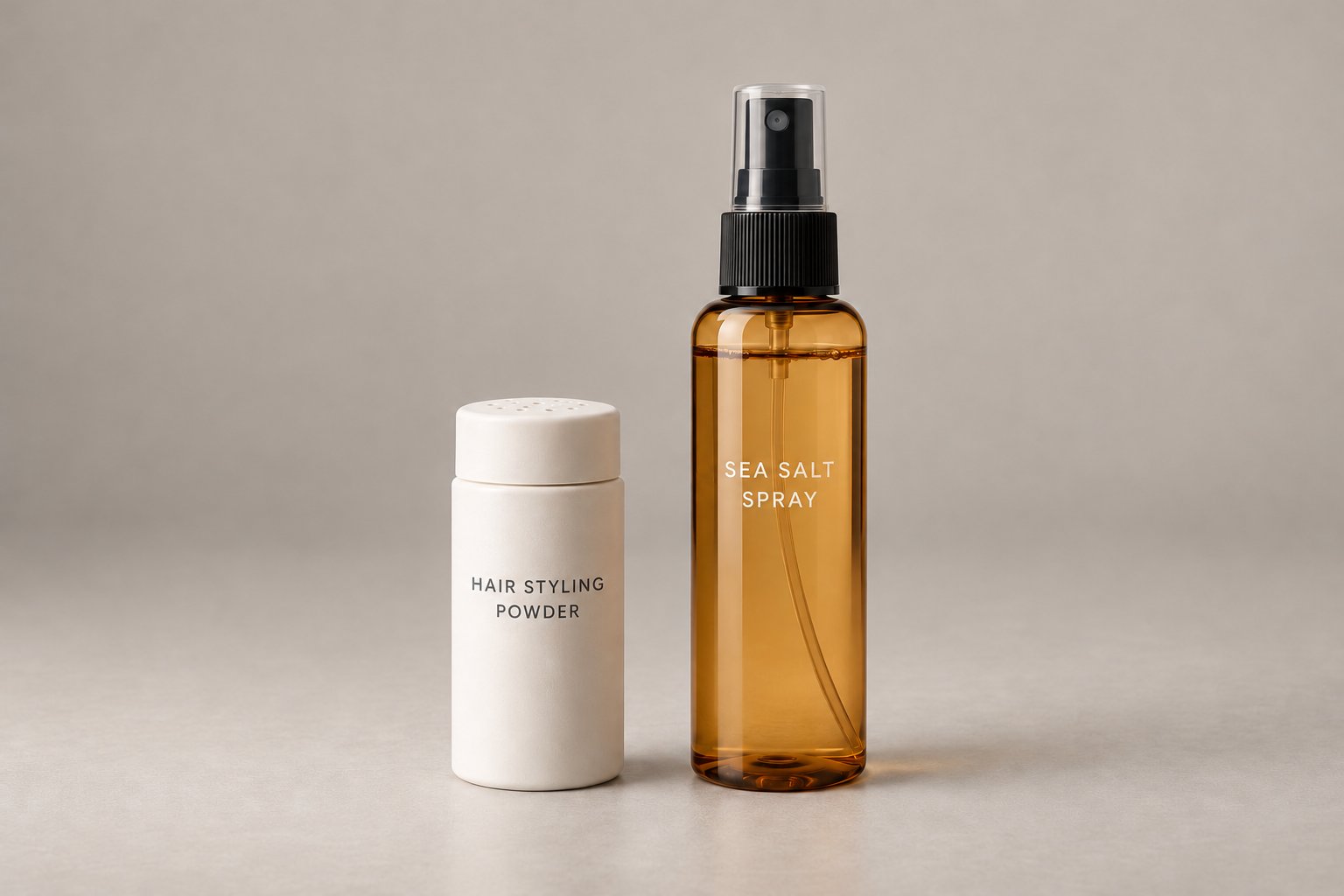
Texture powder — often called hair powder or hair styling powder — is a loose, silica- or starch-based powder that you shake or puff into dry hair. It builds instant grip and volume at the root, then mattifies the surface. A modern texture powder is usually a dry formulation in a shaker bottle or a squeeze tube, sometimes with a minor styling polymer for hold.
Sea salt spray is a water-based mist of dissolved salts, humectants, and film formers delivered through a pump or trigger sprayer. It mimics the gritty, beachy texture hair gets after swimming in the sea. The salt roughens the cuticle and adds weight and separation, while the humectant keeps the film from feeling brittle.
In plain terms, hair powder vs sea salt spray is a dry-versus-wet question. One is a powder you apply to dry hair for lift; the other is a liquid you mist on damp or dry hair for lived-in wave and grip. The fundamentals of how pump and aerosol sprays atomize explain why the spray format carries extra engineering that the powder does not.
Hair powder vs sea salt spray: which hair type wins
Texture powder is the stronger pick for fine, thin, or flat hair that collapses under its own weight. The powder adds friction at the root, so strands stand apart and the style holds without looking greasy. It also revives second-day hair that has lost shape.
Sea salt spray suits medium to thick hair that already has some wave or body. It enhances natural texture and adds separation, but on very fine hair it can weigh strands down or look crunchy once dry. Coarse or curly hair tolerates it well for definition.
If your customer avatar is a person with thinning hair who wants density, hair powder vs sea salt spray is not close: powder wins. If your audience is beach-wave volume for thick hair, the spray is the natural hero.
Volume and lift: where powder dominates
On the question of volume, hair powder vs sea salt spray splits clearly in favor of powder. A small amount worked into the crown creates visible height that lasts most of the day, because the effect is physical friction and bulk rather than chemical. This is the single biggest reason fine-hair brands choose powder first.
Sea salt spray adds body and a fuller look, but its lift is softer and more diffuse. It thickens the overall silhouette and adds airy separation rather than rigid height. For a relaxed, undone look it is ideal; for “I need my hair to look thicker” it under-delivers.
Hold and finish: matte versus lived-in
For hold and finish, hair powder vs sea salt spray serve different jobs. Texture powder delivers a strong, dry, matte hold. It is rebuildable: rub more in midday and the style resets. The finish is flat and modern, which matches the current men’s grooming aesthetic.
Sea salt spray gives a light, flexible hold with a slightly textured, non-shiny finish. It rarely offers all-day rigidity on its own; most users layer it under a paste or clay for lasting structure. On its own it is a prep-and-texture step, not a final hold.
How customers actually use them
In daily use, hair powder vs sea salt spray both aim at effortless texture, but the margins differ. Powder use is fast: shake a little into the roots, massage with fingertips, style. It is forgiving and needs no water. The only real risk is over-application, which reads as white residue — a training point we build into every product card.
Spray use is also simple but timing-sensitive: mist onto damp hair before air-drying or diffusing for beach wave, or onto dry hair for instant grit. Over-spraying causes stiffness and visible salt. Application guidance matters more for the spray because the margin for error is narrower.
Packaging and format
Powder ships in a shaker bottle, a squeeze tube, or a puffer. The format is low-risk: no pump, no corrosion concern, no spray-pattern validation. Closure and liner choices are straightforward and cheap.
Spray needs a qualified pump or trigger and a bottle that resists chloride corrosion, because salt is aggressive to metal springs. Packaging qualification — spring material, liner, and seal — is a real line item that powder simply does not carry.

Production difficulty and manufacturing risk
Texture powder is the easier first SKU to manufacture. Blending is low-temperature and low-risk, fill weights are tolerant, and there is no emulsion or aerosol step. Scale-up is predictable and capital-light.
Sea salt spray carries the failure modes we documented in our sea salt spray formulation guide: nozzle clogging from salt recrystallization, white residue on hair, tackiness, uneven atomization, and chloride corrosion of the pump spring. Each needs its own test protocol and a qualified pump.
For a first-time brand working with a contract manufacturer, hair powder vs sea salt spray on manufacturing risk is decisive: powder lets you launch and learn, while spray forces you to solve pump and corrosion problems before it ever reaches the shelf.
Price structure and margin
On price, hair powder vs sea salt spray again favors powder. Powder has a low bill of materials and simple packaging, so it supports healthy margins even at an accessible retail price. A 20–30 g unit can sit at a sharp price point and still pay for itself.
Spray costs more to land: the pump and corrosion-qualified bottle add unit cost, and the formula testing adds development spend. Retail price is typically higher, which can slow trial for a new brand without proof.
If margin defense and a low entry price are strategic priorities, the powder-first path is the safer economics. If you can command a premium for a beach-texture story, spray can justify its higher cost.
Cross-selling and line logic
Powder is a natural gateway: customers who buy texture powder often add a matte clay or a fiber cream to finish. It pairs with almost every other styling SKU and rarely cannibalizes them.
Spray is a prep product that pulls in clays, pastes, and creams used on top. It anchors a texture-system narrative — spray for base, clay for hold — which is a strong story for bundles and subscriptions.
Either way, the second SKU should be the finishing product. Launching hair powder vs sea salt spray first mainly changes which finishing product you lead with next.
Decision matrix: which brand should launch which first
Use this matrix to map your brand profile to a first texture SKU. It is the fastest way to turn the comparison above into a concrete decision rather than a debate.
| Brand profile | Recommended first SKU | Why |
|---|---|---|
| New DTC men’s brand, thin-hair focus | Texture powder | Lowest manufacturing risk, best margin, solves the thinning-hair need directly |
| Beach-wave lifestyle brand, thick-hair audience | Sea salt spray | Matches the hero texture story and supports a premium price |
| Salon or barber private label | Texture powder | Barbers use powder daily for root lift and it is easy to demo live |
| Premium unisex texture system | Sea salt spray | Anchors a spray-plus-clay bundle and a subscription model |
| Budget or mass-market entry | Texture powder | Cheapest to land, sharp price point, forgiving formula |
| Established line adding texture | Match your audience | Lead with what existing buyers already want; add the other as SKU two |
Hair powder vs sea salt spray: the bottom line
For most first-time grooming brands, texture powder is the better first SKU: lower manufacturing risk, stronger margin, and a direct answer to the most common customer need, which is thin or flat hair. Choose sea salt spray first only when your brand story and audience are explicitly beach-wave, thick-hair, or premium-system.
The good news is you do not have to choose forever. Most successful lines carry both within the first year, with the first SKU feeding the second through cross-sell. Deciding between hair powder vs sea salt spray is really just a question of which door you open first.
Frequently asked questions
Is texture powder the same as hair powder?
Yes. Texture powder is the precise industry term for this dry, volume-building styling product; “hair powder” is the common shorthand brands and buyers use for the same item. In this article we use the two names interchangeably.
Which should my brand launch first, texture powder or sea salt spray?
Launch texture powder first in most cases: it carries the lowest manufacturing risk, the strongest margin, and it solves the most common customer need, which is thin or flat hair. Choose sea salt spray first only when your brand is explicitly beach-wave, thick-hair, or a premium texture system.
Is hair powder or sea salt spray better for thin hair?
Texture powder is the better choice for thin or fine hair because it builds physical root lift and volume without weighing strands down. Sea salt spray can make fine hair look crunchy or flat once it dries.
Which is cheaper to manufacture, hair powder or sea salt spray?
Texture powder is cheaper to manufacture. It needs no pump, no corrosion-qualified bottle, and no spray or emulsion step, so both the bill of materials and the development testing are lower than for sea salt spray.
Can a brand launch both hair powder and sea salt spray?
Yes. Most lines carry both within the first year. Launch one as the hero, then add the other as a cross-sell SKU once you understand your audience and your channel.
What is the main production risk with sea salt spray?
The main risks are nozzle clogging from salt recrystallization, white residue on hair, and chloride corrosion of the pump spring. Each requires specific pump qualification and stability testing before launch.
Request samples of both and confirm your first SKU
The fastest way to make the call is to feel both formats in your hand. We can send you working samples of our texture powder and our sea salt spray, matched to your target price and finish, so your team can test them against your customer avatar.
Tell us your audience, target retail price, and whether you prefer a matte or beach-texture story, and we will propose a first SKU and a sampling plan. As your private-label manufacturer we will also flag the production risks specific to whichever format you choose before you commit to tooling.
Submit your brief through our sampling inquiry form and we will return a feasibility read and a proposed starting formula for your first texture SKU within a few working days.