Hair Clay Manufacturing: 7 Quality Problems to Test Before Mass Production
Hair clay quality testing is the step most styling brands skip because a clay scoop looks fine on the bench. In reality a clay that feels perfect at room temperature on day one can clump in the jar, leave a white cast on dark hair, weep oil, lose hold, resist washing, soften in a hot warehouse, or drift between batches. This guide walks through the seven failure modes we screen for before mass production, the test methods that actually catch them, and the honest limits of each test. It is written for brands that already have a sample or a complaint, not for teams still choosing a base formula.
TL;DR — what to test before you commit to a clay run
- Hair clay quality testing should cover seven risks: clumping, white cast, separation, weak hold, hard wash-out, heat softening, and batch drift.
- Each problem has a low-cost check (jar test, rub-out, centrifuge, hold panel, wash test, heat storage, duplicate batches) and a record sheet.
- A home demo that “looks fine” is not a substitute for lab verification — temperature, humidity, and storage angle change every result.
- Pass criteria, test conditions, and batch data must be confirmed by your R&D or QA team before sign-off.
- If you already have a failing sample, a structured sample review beats another reformulation guess.
1. Clumping and hard lumps
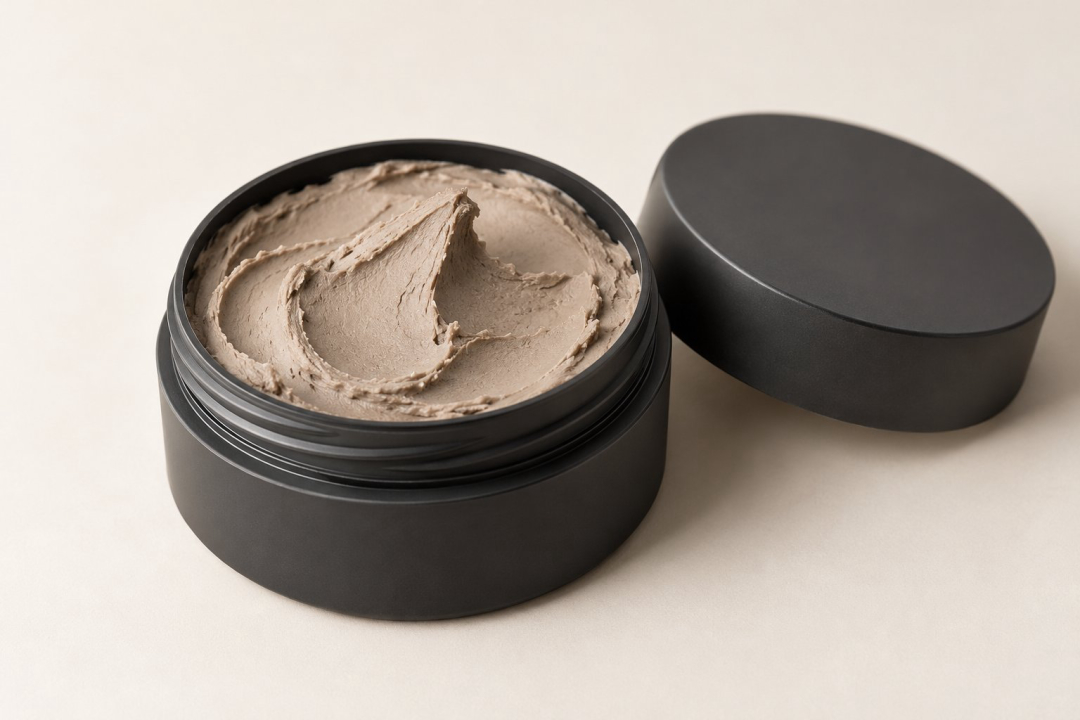
Clumping shows up as gritty grains or a brick-hard layer at the bottom of the jar that will not break down under finger pressure. Customers read it as a contaminated or expired product even when it is technically safe. In a clay this usually traces back to wax or butter recrystallization, filler loading above the dispersion limit, or surface water evaporating and re-setting the binder into a skin.
Our standard check is a three-week jar test at 45°C and 75% relative humidity with weekly finger and spatula grading on a 0 to 5 scale, plus a photographic record of any skin that forms. We also run a freeze-thaw loop (4°C to 40°C) because some clays only seize after the wax network is stressed by temperature swings.
The limit is that a bench rub-out by hand misses early clumping that needs weeks to appear, and a single hot-storage point hides cold-climate stability. A “looks smooth today” demo is not hair clay quality testing; it is a visual glance. We always pair the jar test with a measured penetration test so the result is numeric, not subjective.
2. White cast and residue
White cast is the grey-and-flaky film a clay leaves on dark hair, or the chalky ring it leaves on the jar rim after the water phase dries. It is the single most common reason a matte clay gets returned. It comes from insoluble fillers (talc, silica, clay powders) that sit on the surface, or from a wax that blooms to the surface as the product cools and re-crystallizes.
We score white cast two ways: a rub-out on a black PTFE plate under controlled lighting, graded 0 to 5 for visible powder, and a hair-swatch application on dark strands photographed before and after brushing. We also check wax bloom by storing filled jars at 5°C for a week and inspecting the surface under raking light for a milky film.
The catch is that a swatch has different oil and porosity than live hair, so it understates cast on a real scalp, while a plate overstates it. Humidity shifts the result hard: the same clay that is clean at 50% RH flakes at 30%. Any white-cast claim from a quick hand rub is not hair clay quality testing; it is a glance, and a graded, humidity-controlled check is what actually protects the return rate.
3. Separation and oil sweating
Separation is the oily puddle on top of the tub or the dry, stiff base left underneath. It reads as a quality failure the moment a customer opens the jar. Clays are emulsions or suspensions, and both break when the thickener is under-dosed, the filler is not wetted, or the oil phase is too light for the emulsifier system holding it together.
We run a centrifuge screen (typically 3,000 rpm for 30 minutes) to force the separation a normal shelf would take months to show, and a standing storage check at 40°C and 50°C for up to twelve weeks, measuring the height of any free oil. When an oil-in-water system breaks, the failure is what chemists call an emulsion instability, and the centrifuge is the fastest way to see it.
The limit is that centrifuge stress is harsher than real storage, so it can flag a formula that is actually fine on a shelf, while mild weeping needs the full twelve weeks to surface. A home “I shook it and it looked mixed” observation tells you nothing about six-month stability, which is why hair clay quality testing uses both forced and real-time methods rather than a single glance.
4. Weak hold and poor restylability
Weak hold means the style drops within an hour or will not survive humidity, and poor restylability means it goes crunchy instead of re-workable. For a styling brand this is the core promise failing. Causes include too little film former, an emollient load that plasticizes the network, or a wax blend with the wrong melting point for the target climate.
We measure hold with a controlled panel: standardized hair switches mounted on a rig, styled, and rated for drop over four hours at 50% and 80% RH, plus a re-comb test for restylability. Where equipment allows we add a texture analyzer loop to record the force needed to deform the set style, turning “feels weak” into a reproducible number.
The honest limit is that a panel needs calibration against a known-good benchmark, and sensory tolerance for “weak” varies by market. A bathroom demo where someone “scrunches and it holds” is not hair clay quality testing; humidity, hair type, and application amount all move the result, so we fix the conditions before we trust the score.
5. Hard to wash out
Hard wash-out is the clay that takes three shampoos to leave the hair, or that leaves a waxy film on the scalp. It drives one-star reviews even when hold and finish are good. The usual suspects are high wax or petrolatum load, a strong cationic fixative, or an emollient oil with poor rinseability in normal water.
Our wash test applies a fixed dose to switches, air-dries, then runs a standardized shampoo lather-and-rinse cycle and grades residual feel and shine from 0 to 5. We repeat the cycle up to three times to separate “needs a second wash” from “will not come out.” A grease-cutting surfactant screen tells us which shampoo base the clay resists most.
The limit is that real scalps, water hardness, and shampoo strength vary widely, so a lab switch always over- or under-states the home experience. A “rinses clean in the sink” claim from a quick test is not a qualified result; hair clay quality testing records water hardness and shampoo type so the number actually means something downstream.
6. Heat softening and slump
Heat softening is the tub that arrives melted, or the product that slumps and weeps after a summer in a delivery truck or a warehouse with no climate control. Waxes with low melting points and high oil content are the main cause; the structure simply cannot hold above a transition temperature, and the clay flows before the customer ever opens it.
We qualify heat stability with a storage study at 40°C, 50°C, and sometimes 60°C for up to four weeks, measuring slump height, texture change, and any oil bleed, photographed at each interval. A penetration test before and after heat tells us how much the structure collapsed rather than relying on a glance at the tub.
The limitation is that accelerated heat over-states mild climates and under-states a container that sits at 60°C in a metal truck for a day. A “kept it in my bathroom” home check says nothing about logistics, which is exactly why hair clay quality testing prototypes the worst-case shipping lane, not the best-case shelf.
7. Batch-to-batch variation
Batch drift is the silent killer: batch A holds and washes fine, batch B is greasy and weak, and no one changed the formula. It comes from untracked raw-material lots, mixing-temperature drift, or a process step that depends on operator feel. It is the risk that turns a good product into an unreliable one on the shelf.
We catch it by making three to five replicate batches from the same formula and running the full screen on each, then plotting hold, wash, and stability scores side by side. A tolerance band — not a single pass — is the real acceptance rule. We also audit raw-material certificates and key process temperatures against the batch record to find the drifting input.
The limit is that five batches is still a small sample, and rare lot-to-lot raw swings need more runs to expose. A single “golden batch” that passes everything is not hair clay quality testing; consistency across repeats is what de-risks mass production, and that takes deliberate replication, not luck on one tub.
How to build a hair clay quality testing plan before mass production
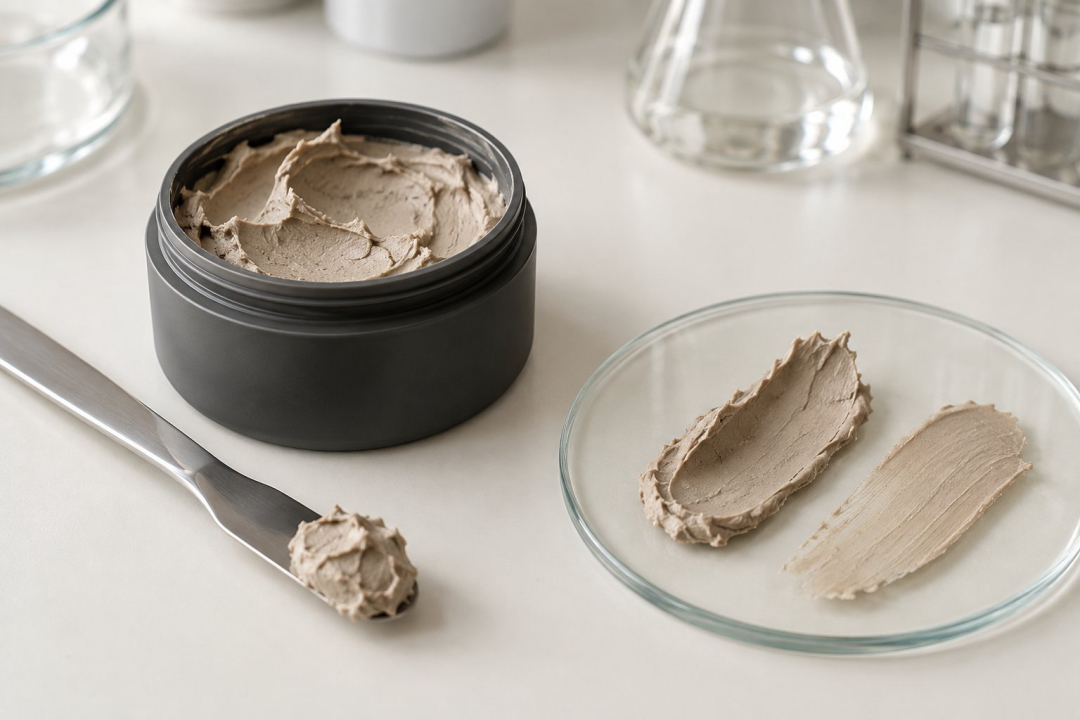
No single test predicts field behavior, so the plan is a battery: jar and freeze-thaw for clumping, rub-out and bloom for white cast, centrifuge and standing storage for separation, hold panel for strength, wash cycle for rinseability, heat storage for slump, and replicate batches for drift. Run them on the same samples where possible to save material, and score every item on a shared 0 to 5 matrix weighted by your brand priorities.
Quick reference: problem, check method, record item
| Problem | Check method | What to record |
|---|---|---|
| Clumping | 45°C / 75% RH jar test + freeze-thaw, penetration grade | Week-by-week lump grade, penetration depth, photo |
| White cast | Black-plate rub-out + dark-swatch brush, 5°C bloom check | Cast grade at 30/50% RH, bloom yes/no, photo |
| Separation | Centrifuge 3,000 rpm 30 min + 40/50°C standing storage | Free-oil height, break type, week of first sign |
| Weak hold | Hold panel at 50/80% RH + texture-analyzer deform force | 4-hour drop grade, restyle score, force (N) |
| Hard wash-out | Standardized shampoo cycle up to 3 passes | Residual feel/shine grade, cycles to clear |
| Heat softening | 40/50/60°C storage up to 4 weeks, slump + penetration | Slump height, oil bleed, texture change |
| Batch drift | 3–5 replicate batches, full screen, tolerance band | Per-batch scores, raw-material lot, process temp |
The through-line is simple: a home demonstration that “looks fine on the bench” is not hair clay quality testing. Temperature, humidity, storage angle, and usage frequency all move the result, and no acceleration factor captures every one of them. Pass criteria, test conditions, and batch results below must be confirmed by your R&D or QA team before any production sign-off — the numbers in this article are a method outline, not an approval to ship.
Request a hair clay sample review
If you already have a sample that clumps, flakes, separates, or simply under-performs — or you want a second opinion before you commit to a run — the fastest path is a concrete brief. Tell us your target effect (matte vs natural, light vs strong hold), the specific sample problem you are seeing, and your estimated order quantity. We will translate that into a test plan and a prioritized fix list.
As a hair clay manufacturer and OEM partner, we build this seven-point screen into every clay development and troubleshooting program. If your issue is spray-based rather than clay-based, our breakdown of sea salt spray formulation problems covers the same failure-mode thinking from a different product angle.
Submit your target effect, sample problem, and estimated quantity through our sample review request, and we will return a feasibility read and a proposed starting point within a few working days.