Custom cosmetic packaging is the decision that quietly sets your launch quantity, unit cost, development time, shelf presence and the amount of inventory you may be left holding if the product or design changes. Choosing packaging for a new grooming or skincare product is not simply a matter of finding a bottle that looks good — the route you pick affects every number in your first order, often before the formula is even finished.
For many private label cosmetics and private label hair products brands, the practical choice in custom cosmetic packaging is not between a completely generic bottle and a fully custom mould. There is a middle ground: start with an existing bottle or jar, then build brand identity through cap color, labels, direct printing, foil details or a folding carton. This guide compares those options, explains the typical cosmetic packaging MOQ behind each one, and shows how to choose a route that fits your first order as well as your longer-term brand plans.
TL;DR — custom cosmetic packaging routes at a glance
- Fast launch or market test: use an in-stock bottle or jar with a well-designed label. At this level custom cosmetic packaging carries the lowest setup burden and the least packaging inventory risk.
- A more distinctive shelf appearance: keep the stock container but add a coordinated cap color, screen print or hot-stamped detail — a more integrated look without paying for a new mould.
- Premium retail or gift presentation: add a printed folding carton. It can make a standard bottle feel like a complete branded product, especially for beard oil, grooming kits and gift sets.
- A proven product with repeat volume: consider a custom-colored component or a new mould only after demand, dimensions and the packaging specification are stable.
- The real test is not the price per piece: the most cost-effective custom cosmetic packaging route is the one that delivers the required brand appearance without creating unnecessary minimums, setup fees or unused stock.

1. What can you customize without creating a new bottle?
Most custom cosmetic packaging projects can be divided into five practical choices. They can be used separately or combined, and the mix you pick decides your minimums, your setup fees and your shelf presence.
1) Stock bottles and jars
A stock component uses an existing mould and a standard size, shape and finish. Common choices include clear PET bottles, amber glass dropper bottles, white or black plastic jars, and standard pump bottles.
Stock packaging is useful when you need to launch quickly, test a new product or keep several SKUs within a manageable budget. The limitation is that other brands may be able to buy the same bottle — so in a custom cosmetic packaging plan built on stock components, your label, cap and overall visual system do more of the branding work.
For example, a 30 ml amber dropper bottle can work for a beard oil launch. The same bottle can also support a different scent or formula if the label and secondary packaging are planned as a consistent product family.
2) Custom cap color
A standard bottle can look substantially different when paired with a coordinated cap, dropper collar or pump actuator. Common finishes include black, white, silver, gold and selected brand colors. There are two different processes that buyers should not confuse:
- Spray coating: an existing cap or component is coated in a selected color. It offers flexibility but requires checks for coating adhesion, scratches and color consistency.
- Moulded-in color: color is added to the plastic material before the component is moulded. It can provide a more integrated finish, but usually requires a larger production run.
Customizing only the cap can be a useful compromise when the bottle shape is already suitable. However, a cap, collar, bulb, pipette and bottle may come from different component suppliers. Confirm the MOQ and color standard for each part rather than assuming one quantity covers the whole assembly.
3) Labels
Labels are often the most flexible way to customize a stock bottle. Digital printing supports smaller runs, multiple versions and faster artwork changes than many direct-print processes. Options include paper labels, waterproof film labels, clear labels, matte finishes and metallic-look details.
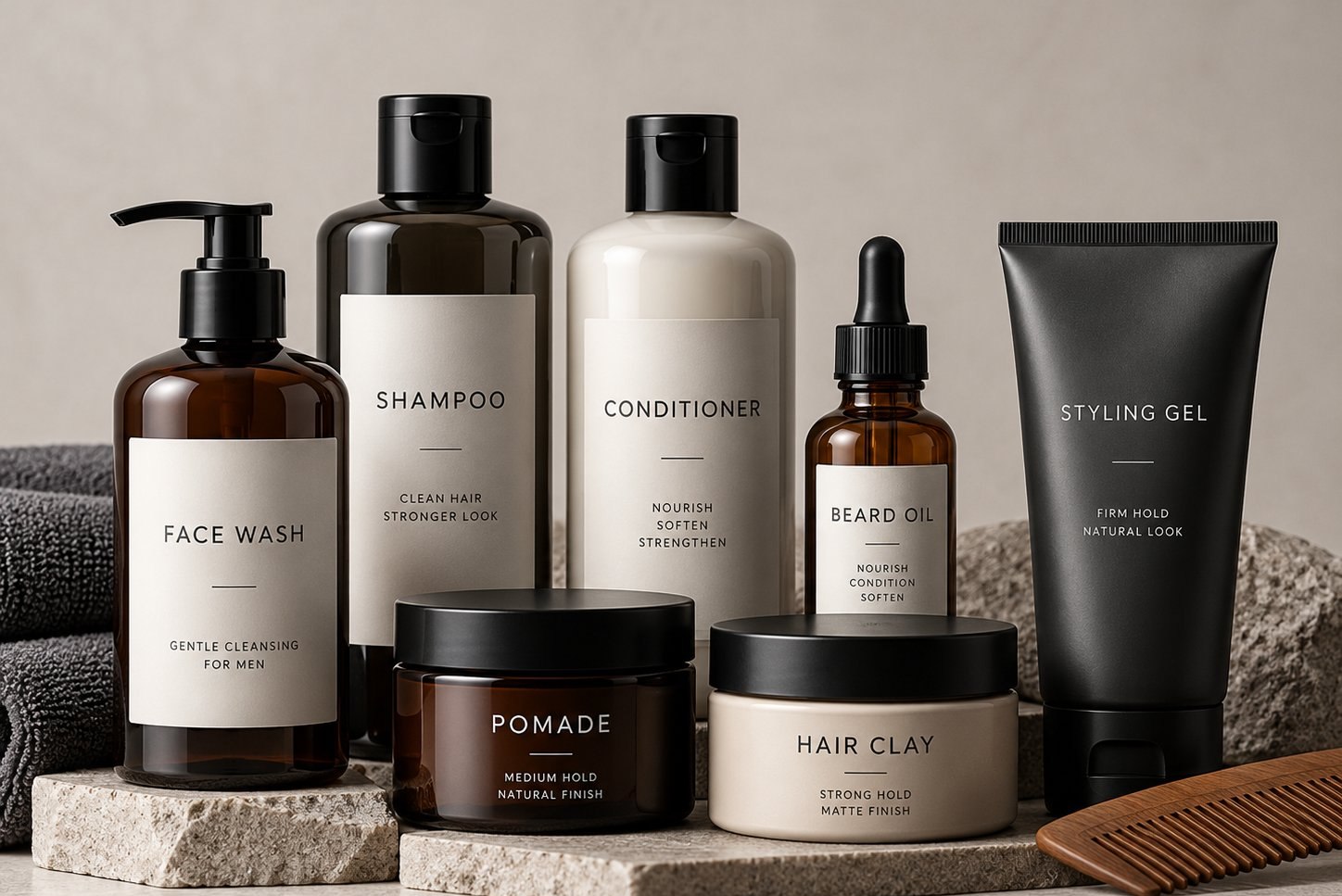
For products used in a bathroom or shower, material selection matters: a label that looks good when dry may wrinkle, lift or lose adhesion after repeated contact with water or oil. For custom beard oil packaging, a clear or amber glass dropper bottle with a carefully sized waterproof label can look premium without requiring a custom bottle. For a hair styling product, a label can also help distinguish matte clay, pomade and styling powder while keeping the container family consistent.
4) Silk screen printing, pad printing and hot stamping
Direct decoration makes the branding feel more integrated because the artwork is applied to the bottle, jar or cap rather than placed on a separate label.
- Silk screen printing is suitable for simple logos, product names and solid-color artwork on compatible surfaces.
- Pad printing is useful for smaller or curved areas where the print needs to transfer onto a more difficult surface.
- Hot stamping applies metallic or pigmented foil, often in gold or silver, for a premium accent.
These processes have setup requirements: screen printing may require a screen for each color, pad printing uses a plate, and hot stamping requires a die. More colors, more print positions and more complex artwork can increase both setup cost and the practical minimum. Direct printing is not automatically better than a label — it is less convenient when artwork changes frequently, and a print defect can make an otherwise usable stock component unsuitable for sale.
5) Individual color boxes
A folding carton adds a second surface for branding, product information and retail presentation. It is especially useful when the product is sold as a gift, positioned at a higher price point or displayed in a retail environment.
A standard folding carton is usually a more economical starting point than a rigid gift box. Digital printing can support smaller quantities; offset printing becomes more practical as the run grows. Foil, embossing, spot UV, special paper and custom inserts add visual impact but also add production steps and approval points.
For a beard oil set, a standard amber bottle can be paired with a dark folding carton and a simple foil detail. The bottle itself stays stock, while the outer box creates a more complete gift-ready presentation — which is why cartons are one of the most under-used tools in custom cosmetic packaging for emerging brands.

2. Typical cosmetic packaging MOQ: practical planning ranges
The table below is intended for early budgeting and supplier discussions. These are indicative industry planning ranges for custom cosmetic packaging, not guaranteed minimums. Actual quantities vary by material, component supplier, production line, decoration area, number of colors and whether the factory has stock available.
| Packaging option | Typical planning range | What usually drives the MOQ |
|---|---|---|
| Stock plastic bottle or jar | 500–3,000 pcs | Stock availability, size, color and component source |
| Stock glass bottle or jar | 1,000–5,000 pcs | Glass supplier’s stock and filling compatibility |
| Digital label | 100–1,000 labels | Label material, size, number of artwork versions |
| Screen or pad printing | 1,000–5,000 pcs | Print line setup, colors and print positions |
| Hot stamping / foil detail | 1,000–5,000+ pcs | Die setup, surface and foil area |
| Spray-coated custom color | 2,000–5,000 pcs per shape | Coating batch and color changeover |
| Moulded-in custom plastic color | 5,000–10,000 pcs | Resin preparation and moulding run |
| Digital-printed folding carton | 300–1,000 pcs | Board, size and printer’s short-run capability |
| Offset-printed folding carton | 1,000–3,000 pcs | Printing plates, board and finishing |
| New custom mould | Usually 10,000+ pcs | Tooling, component design and production economics |
A few practical points matter more than the headline MOQ in any custom cosmetic packaging project:
First, MOQ is often per component, not per finished product. A dropper bottle may involve a glass bottle, cap, collar, bulb and pipette. A pump bottle may involve the bottle, pump mechanism and dip tube. The supplier may quote a different minimum for each part.
Second, packaging MOQ is separate from formula MOQ. A manufacturer may be able to produce a smaller formula batch while the bottle supplier requires a larger run. The higher binding minimum determines the practical first order.
Third, labels and cartons are not automatically included. Ask whether the quote includes the bottle, closure, decoration, label, carton, inserts and any spare components. A single “packaging MOQ” can hide several separate quantities.
For a broader explanation of how formula, packaging, printing and development minimums stack together, read BUNJOIN’s private label MOQ guide. For the packaging layer in detail — one-time fees, unit-price structure and lead times — see our cosmetic packaging MOQ and cost guide.
3. Packaging selection matrix: appearance, cost and risk
A useful comparison should consider more than visual impact. The right custom cosmetic packaging option balances appearance, cost drivers, minimum quantity and the risk of approving a sample that does not match bulk production.
| Option | Visual effect | Main cost factors | Typical MOQ impact | Sampling and production risk |
|---|---|---|---|---|
| Stock bottle / jar | Clean, functional; depends on shape and material | Component price, size, material, freight | Lowest starting point | Low to medium: check dimensions, closure fit and formula compatibility |
| Custom cap color | Stronger brand recognition; coordinated product family | Color matching, coating or resin, separate cap components | Medium; often a separate component MOQ | Medium: color drift, scratches, coating adhesion and mismatch between parts |
| Label | Flexible branding; supports detailed product information | Label material, size, finish, print quantity and application | Low | Medium: adhesion, water/oil resistance, wrinkles and placement |
| Silk screen / pad print | Integrated, clean branding | Screens or plates, number of colors, print area and setup | Medium | Medium: registration, adhesion, rub resistance and curved-surface distortion |
| Hot stamping | Premium metallic or foil accent | Die, foil, print area and surface preparation | Medium | Medium: foil adhesion, fine-detail legibility and wear |
| Individual folding carton | Strong shelf and gift presentation | Board grade, size, print process, finishing and inserts | Low to medium | Medium: color proof, dimensions, fit and transit protection |
| Custom mould | Distinctive shape and ownership of the component design | Tooling, engineering, trials and production volume | Highest | High: tooling revisions, dimensional tolerance, compatibility and obsolete inventory |
Cost levels in this custom cosmetic packaging matrix are relative planning guidance, not quoted prices. A small foil detail may cost less than a large full-color label, while a simple custom cap can become expensive if it requires a dedicated color run.
4. What actually increases packaging cost?
When a packaging quote is higher than expected, the reason is often not the bottle alone. Check these cost drivers before changing the design of your custom cosmetic packaging plan.
Color matching and the number of components
A brand may request the same signature color on the bottle, cap, pump and carton. These parts may use different materials and manufacturing processes, so the same color reference does not guarantee the same visual result. A practical approach is to approve a physical color standard under consistent lighting, and to decide which component needs the closest match and which can use a complementary neutral finish.
Decoration complexity
A one-color logo is simpler than a multi-color wraparound design. Each additional print color or print position can add setup, alignment and inspection work. Combining silk screen printing, hot stamping and spray coating can create a premium result, but it also introduces more points where the sample and bulk run can differ.
Artwork versions and SKU count
Five fragrances with five separate labels may require five artwork approvals and five printed versions. If the bottle and cap are shared, however, the brand may still be able to consolidate the component order.
For a new range, consider using one bottle shape, one cap and one label size across several products. Different label colors or small design changes can distinguish the SKUs without creating a completely separate packaging structure for each one — a habit that keeps custom cosmetic packaging costs and minimums under control.
Box construction and finishing
A folding carton with standard board and a simple print is not the same cost proposition as a rigid box with a custom insert, foil, embossing and specialty paper. Before requesting a premium box, decide whether the product needs gift presentation, extra protection or simply a clean retail-ready outer pack.
5. Sampling risks: what to approve before mass production
A digital mockup is useful for discussing direction, but it cannot confirm how the final package will look or perform. Approve the physical sample against a written specification — the discipline behind every serious custom cosmetic packaging approval.

Color and finish
Check the bottle, cap and carton together under daylight and indoor lighting. Record the approved color reference and finish — gloss, matte, frosted, metallic or soft-touch. A screen image is not a reliable color standard.
Print position and durability
Check logo size, alignment, spacing and readability on the actual curved surface. Rub the printed area and test the label under conditions relevant to the product’s use. For beard oil or other oil-based products, pay particular attention to label adhesive and surface resistance.
Fit, leakage and dispensing
Test the complete assembly, not just the empty bottle. Check thread compatibility, cap torque, dropper fit, pump dosage, spray pattern and leakage. For a spray product, test the actual formula through the selected actuator rather than approving the pump based only on appearance.
Formula and packaging compatibility
A package that looks correct can still fail after contact with the formula. Check for discoloration, swelling, cracking, leakage, odor transfer, label lifting and changes to the dispensing mechanism. The required compatibility protocol depends on the formula, packaging material and intended shelf life.
Bulk consistency
Keep an approved “golden sample” and a signed specification. The specification should record component dimensions, material, color reference, finish, print artwork and position, closure type and any functional requirements. Use it as the comparison standard during incoming inspection and production. BUNJOIN’s sample approval checklist covers the same discipline on the formula side.
For products such as sea salt spray, packaging compatibility deserves particular attention because salt residue can affect spray components. See BUNJOIN’s sea salt spray formulation guide for the formulation-side considerations.
6. Which packaging route works best for grooming products?
The best route depends on the product format and how the customer will use it — the same custom cosmetic packaging decision plays out differently across a grooming range.
Beard oil: stock glass + premium label or foil detail
A 30 ml amber glass dropper bottle is a practical starting point. A waterproof label can carry the product identity, while a black or metallic collar adds a more premium finish. A folding carton is worth considering for gift sets or higher-priced retail positioning.
For brands comparing formats, explore BUNJOIN’s private label beard care products.
Hair styling products: shared jars and bottles across the range
Hair clay, pomade and styling wax can often use a coordinated family of stock jars. A shared jar shape and cap reduce component complexity; labels, print colors and carton design distinguish each product.
For sea salt spray, a stock spray bottle may be suitable, but the pump must be tested with the actual formula. For styling powder, the dispenser and powder flow are as important as the external appearance. See BUNJOIN’s private label hair styling products for relevant product formats.
Grooming kits: coordinate the packaging system
A kit containing beard oil, balm, wash bar and grooming accessories does not need every component to be custom-made. A consistent color palette, coordinated labels and a well-designed outer box can create a unified presentation while keeping individual components practical to source.
7. A lower-risk way to build a branded package
For a first launch, a staged approach to custom cosmetic packaging is usually more sensible than customizing every component at once.
Stage 1 — Validate the product: select an available bottle or jar and test the formula, closure and dispensing performance.
Stage 2 — Build brand identity: add a custom label and, if the order volume supports it, a coordinated cap or direct-print detail.
Stage 3 — Improve retail presentation: introduce a folding carton, foil detail or insert after the core packaging specification is approved.
Stage 4 — Scale proven products: once repeat demand is visible, compare larger-volume color runs, more complex decoration or a custom mould.
This staged custom cosmetic packaging approach protects the first order from unnecessary packaging commitments while leaving room for a more distinctive design later.
8. What to send a supplier for an accurate packaging quote
A useful packaging brief for any custom cosmetic packaging project should include:
1. Product type and formula characteristics (for example, oil, cream, wax, liquid spray or powder).
2. Target fill volume and preferred bottle, jar or dispenser format.
3. First-order quantity per SKU and estimated annual demand.
4. Preferred material, bottle color, cap color and surface finish.
5. Decoration preference: label, silk screen, pad print, hot stamping or spray coating.
6. Whether an individual folding carton, insert or gift box is required.
7. Target market and any packaging or labeling requirements — for example, the EU Cosmetics Regulation sets out mandatory labeling particulars for products sold in the EU, while US labeling rules differ again.
8. Reference images, artwork files and target launch date.
Ask the supplier to quote at three volume levels — for example, the initial MOQ, twice that quantity and five times that quantity. Request a breakdown of the bottle, closure, decoration, label and carton rather than a single combined figure. Also confirm which tooling or setup fees are one-time charges and whether they can be reused for reorders.
Frequently asked questions
What is the MOQ for custom cosmetic packaging?
For custom cosmetic packaging planning, stock plastic bottles and jars commonly fall around 500–3,000 pieces, while stock glass components may be around 1,000–5,000. Digital labels can start at 100–1,000; direct printing often falls around 1,000–5,000; and new moulds commonly require 10,000 pieces or more. These are indicative ranges, not universal supplier commitments.
Is custom printing cheaper than custom bottle colors?
It depends on the process and quantity. A label is usually the most flexible low-volume option. Screen printing or hot stamping adds setup and decoration costs but can create a more integrated look. Custom spray color or moulded-in color often requires a larger component run. Compare the complete cost at the same order quantity.
Can I use stock bottles for private label cosmetics?
Yes. Stock bottles with custom labels are a common custom cosmetic packaging route for launching private label cosmetics without investing in a new mould. You can add a coordinated cap, direct print or folding carton as the product and order volume develop.
Does packaging MOQ include the cap, pump and color box?
Not necessarily. Bottles, caps, droppers, pumps, labels and cartons may be sourced from different suppliers and carry separate minimums. Ask for a component-by-component MOQ breakdown.
When should a brand invest in a custom mould?
A custom mould is most suitable when the product has proven demand, the packaging design is stable, and the expected volume can justify tooling and development time. For many first launches, stock packaging with carefully selected decoration provides a better balance of brand identity and inventory risk.
Choose custom cosmetic packaging that supports the product — and the business
Good packaging does more than make a product look distinctive. It protects the formula, works reliably in daily use, communicates the brand and fits the economics of the launch.
For many emerging grooming brands, stock components combined with a thoughtful label, coordinated cap and well-designed carton are enough to create a professional retail presentation. More complex custom cosmetic packaging upgrades can follow when sales data supports the investment.
Planning a new beard oil, hair styling or skincare line? Share your product format, target quantity and packaging references with BUNJOIN. Our team can help compare stock and customized packaging routes, identify the likely MOQ drivers and map out a practical sampling plan for your first order.