Cosmetic Packaging MOQ and Cost: Stock Bottles vs Custom Packaging
Cosmetic packaging MOQ is the minimum order quantity a component supplier sets before it will run your bottle, jar, pump, or color box — and for most first orders it is the number that decides the launch budget, not the formula. This guide compares the three packaging routes you will be quoted — stock components, dedicated printing on stock containers, and full mould tooling — on the things that actually differ: minimum quantity, one-time fees, unit price structure, lead time, loss exposure, and fit risk. It is written for teams that already hold a formula or a target specification and now need to choose packaging.
If you are still working out the product-side minimums, our private label MOQ guide covers the four stacked minimums behind a full quote. This article goes deeper on the packaging layer, because that is where a first-order budget is usually won or lost.
TL;DR — cosmetic packaging MOQ by route, at a glance
- Stock components carry the lowest cosmetic packaging MOQ — commonly 500–3,000 units for plastic bottles and jars, 1,000–5,000 for glass, 1,000–3,000 for standard pumps and 3,000–10,000 for airless pumps — with no tooling and a 2–4 week lead time after artwork is frozen.
- Dedicated printing on a stock container sits in the middle: digital labels start at 100–1,000, screen or pad printing on containers typically runs 1,000–5,000, and plated direct printing 5,000–10,000 — plus a one-time charge per colour for screens, plates, or dies.
- Mould tooling is the volume route: a new mould commonly means 10,000+ units, a one-time tooling charge, and a 3–6 month timeline — justified only by repeat reorders or genuine differentiation.
- A unit price is a stack, not a number: material, decoration, amortised tooling, QC and loss allowance, packing, and freight. Compare quotes at 1×, 2×, and 5× MOQ — never at a single tier.
- Match the route to the stage, not the ambition: first launch on stock plus label, upgrade decoration after the first reorder, and reserve tooling for SKUs with proven velocity.
What cosmetic packaging MOQ covers — and what it does not
Cosmetic packaging MOQ is set by the component and decoration suppliers, not by the factory that fills your product. A filler may happily blend 500 units while its bottle supplier requires 3,000 of a given component, and the packaging minimum wins — because the filler buys components, it does not blend them. That is why two suppliers quoting the same formula can return minimums an order of magnitude apart: they are describing different packaging routes, not different levels of generosity.
The scope of cosmetic packaging MOQ spans four component families, each with its own logic: bottles (plastic, glass, airless), jars (single- and double-wall), pumps and closures, and secondary packaging such as color boxes and shipping cartons. What it does not cover is the product side — formula batch size, development fees, and testing recovery are separate minimums that stack on top of the packaging floor. Our private label MOQ guide maps that full stack; this article goes deeper on the packaging layer.
One more boundary: cosmetic packaging MOQ is a commercial number, not a quality number. A supplier who accepts a 500-unit minimum is not automatically better than one quoting 3,000, and a quote below every other quote is usually skipping something — a QC allowance, a compatibility check, or a second source. Verify who actually produces your components the same way you verify the filler, using a supplier audit checklist adapted to packaging vendors.
The three packaging routes compared
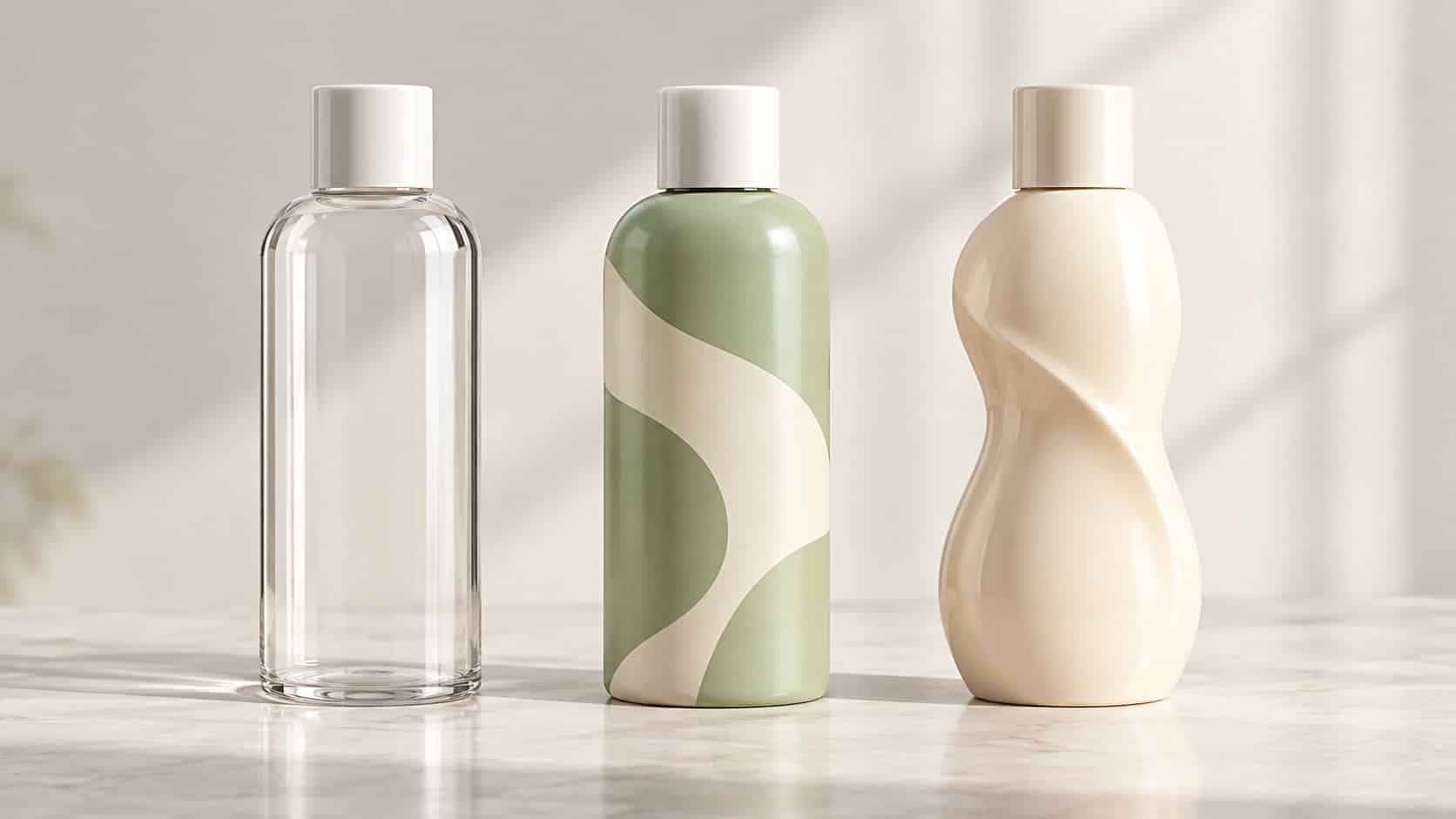
Every cosmetic packaging quote you receive is one of three routes, and the route — not the supplier’s mood — sets the minimum. Stock components come from moulds that already exist and already run. Dedicated printing keeps the stock mould and changes only the decoration. Mould tooling creates a component that belongs to you alone. The table below is the core of this article: use it as a selection sheet before you request a single quote.
| Dimension | Route 1: Stock components | Route 2: Dedicated printing on stock containers | Route 3: Mould tooling / custom components |
|---|---|---|---|
| Typical cosmetic packaging MOQ | 500–3,000 plastic; 1,000–5,000 glass; pumps 1,000–3,000 stock, 3,000–10,000 custom actuator | Labels 100–1,000 digital; screen or pad on container 1,000–5,000; plated direct print 5,000–10,000 | 10,000+ per mould; rigid-box programs 3,000–5,000 with tooling |
| One-time fees | None beyond sample charges; occasional small-run surcharge | Screens, plates, or dies per colour; artwork and proofing; sample charges | Mould tooling (steel, cavity count); plates per print colour; T1 trial samples; possible amortisation into unit price |
| Unit price structure | Fixed tiers by quantity; no amortisation | Component price + decoration price + setup recovery | Material + decoration + tooling recovery; lowest unit at volume, highest at low volume |
| Lead time | 2–4 weeks after artwork freeze | +1–3 weeks for plates and proofs; print adds a pass | 60–90 days tooling, 2–4 weeks samples, then production; 3–6 months total |
| Loss exposure | Low: components reusable across SKUs and reorders | Medium: decorated stock is SKU-specific; artwork errors scrap the run | High: custom components unsellable if design, capacity, or formula changes |
| Fit risk | Limited capacity, colour, and closure choice; standard neck finish | Print registration, adhesion, and colour drift; label placement on curved surfaces | Sample-to-bulk fit, wall thickness, closure torque, filling-line compatibility |
| Best for | First launch, market tests, multi-SKU pilots | Brands that need identity at 1,000–5,000 units | Proven SKUs at 10,000+ with repeat reorders |
Read the table by row, not by column. If your binding constraint is cash, Route 1 dominates everything below roughly 3,000 units. If it is shelf identity, Route 2 buys most of the look for a fraction of Route 3’s commitment. Route 3 wins only when the quantity amortises the tooling and the design is frozen — the route that meets your cosmetic packaging MOQ with the least committed capital is the one to quote first.
Route 1: Stock bottles and jars
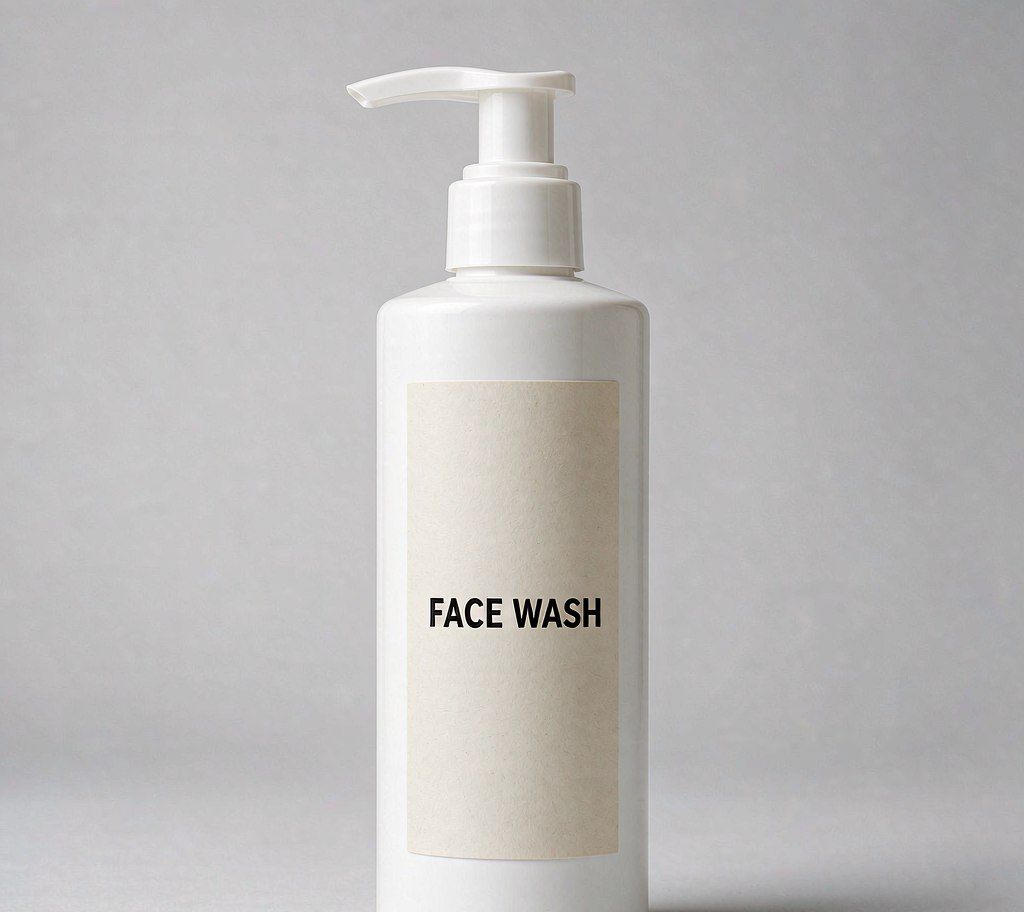
Stock components are the reference point for cosmetic packaging MOQ because everything else is priced against them. The mould exists, the line is running, and the supplier’s minimum simply covers a production run and a material buy. Typical floors: 500–3,000 for plastic bottles, 1,000–5,000 for glass, similar ranges for jars, and 1,000–3,000 for standard lotion pumps. One-time fees are essentially zero, and the unit price is a simple tier table with no amortisation to negotiate.
The trade-offs are choice and identity. You select from a catalogue: existing capacities, existing colours, existing closures. A stock 100 ml PET lotion bottle in clear or standard black is available in weeks; the same bottle in your exact brand colour is not, because custom colour matching is itself a decoration step with its own minimum. Standard neck finishes — the thread geometry the closure screws onto — are whatever the mould was cut for, which limits pump and closure options to matching stock parts.
Consolidation is the cheapest lever on cosmetic packaging MOQ. If a cleanser, a toner, and a serum share one bottle and one closure, you order 3,000 of a single component instead of 1,000 of three — the same shelf variety, one supplier tier, one QC basis, and leftovers that stay usable across the range. Loss exposure is the lowest of the three routes: if a SKU is discontinued, its stock components feed the next one.
Route 2: Dedicated printing on stock containers
Dedicated printing keeps the stock mould and adds your decoration: a custom label, screen or pad printing directly on the container, hot stamping, or a combination. It is the route that answers “how do I get brand identity without a mould?” and its cosmetic packaging MOQ depends almost entirely on the decoration method chosen.
Labels are the low-quantity champion: digital label printing has almost no tooling, so 100–1,000 labels are a normal order, and a stock bottle plus a premium label is the industry-standard first-launch look. Direct decoration on the container is the opposite: screen printing needs a screen per colour, pad printing a plate, hot stamping a die — each a one-time charge, and the resulting minimums typically run 1,000–5,000 for screen or pad work and 5,000–10,000 for multi-colour plated printing. Colour count multiplies the minimum as well as the fee, because every extra colour is another pass and another setup charge.
The cost structure here is component price plus decoration price plus setup recovery, and setup recovery is where cosmetic packaging MOQ quotes diverge. Ask whether plates and screens are charged separately and whether they are reusable on reorders — reusable tooling turns a first-order penalty into an investment, while single-use tooling means every reorder re-buys the setup. Lead time adds one to three weeks for plates and proofs.
The loss profile also changes character: decorated stock is SKU-specific, so an artwork error, a colour mismatch, or a registration problem scraps a finished run rather than a reusable component. Adhesion is material-dependent — decoration on PP or PE often needs pre-treatment or pad printing rather than screen, a detail worth settling before the plate is cut.
Route 3: Mould tooling and custom components
Mould tooling is the route that makes the component yours: a new bottle, jar, or pump shape cut to your specification, with your capacity, your wall thickness, your neck finish, and your closure. It is also the route with the largest cosmetic packaging MOQ — commonly 10,000+ units per mould — because the supplier is amortising steel, machining hours, cavity count, and trial samples across your order.
The one-time fee is the mould itself, and how it is charged matters more than the headline number. Some suppliers charge tooling as a separate fee you pay once; others amortise it into the unit price, which means a low first-order price can hide an unrecovered tooling balance that reappears if you never reorder. Cosmetic packaging MOQ and tooling recovery are two sides of one quote: ask which model applies, what happens to the tooling if you switch suppliers, and whether mould ownership transfers to you. A second set of one-time fees follows for decoration — plates per colour, plus T1 (first-trial) samples you should approve against measurements, not photographs.
Lead time is the honest cost of this route: 60–90 days for tooling, two to four weeks for trial samples and revisions, then production — three to six months from decision to stock in most programs. Loss exposure is the highest of the three routes, because custom components have no second life: a design change, a capacity rethink, or a formula switch leaves unsellable stock.
The payoff is real where it applies: the lowest unit price at volume for a cosmetic packaging MOQ of 10,000+, a component competitors cannot buy, and control over every dimension the customer touches. Fit risk also moves from the showroom to the process — sample-to-bulk consistency, wall thickness against filling speed, closure torque, and drop performance all have to be re-proven on your component.
Pumps and closures: where cosmetic packaging MOQ hides
Pumps deserve their own section because they behave unlike any other component. A pump is a small mechanism — spring, valve, dip tube, actuator — and its cosmetic packaging MOQ is set by the mechanism supplier, not the bottle factory. Standard lotion and treatment pumps commonly start at 1,000–3,000; airless pumps, with their piston and vacuum system, typically run 3,000–10,000; and a custom actuator or metallised finish pushes the minimum toward the top of that range or beyond.

Three risks concentrate here. First, fit: a pump only works with a matching neck finish, so a “custom pump” often quietly forces a custom bottle — turning a Route 2 budget into a Route 3 commitment. Second, dosage: pumps deliver a fixed dose per actuation, and the wrong dosage turns a 100 ml product into “runs out too fast” complaints, so measured dosage belongs in the approval record alongside fill volume.
Third, compatibility: formula attacks mechanisms. Salt-based styling products are a documented offender — our sea salt spray formulation breakdown shows how recrystallised salt corrodes springs and blocks valves — and the fix is a material decision (stainless or plastic springs, resistant valves) taken at packaging selection, not after the first rust complaint.
The commercial rule follows: quote the pump and the bottle together, at the same quantity, from the same coordination point. In a cosmetic packaging MOQ comparison, the pump and the bottle are one decision — a cheap pump on the wrong neck finish, or a cheap pump that fails a compatibility check at month four, costs more than the premium pump you declined. Where a stock pump limits you, a custom dip tube length or actuator colour is often available at printing-route minimums — ask before assuming the whole mechanism must be tooled.
Color boxes and cartons
Color boxes sit on the secondary-packaging side of cosmetic packaging MOQ, and their logic is paper logic rather than mould logic. The variables are board, process, and tooling: duplex or whiteboard stocks for standard folding cartons, greyboard for rigid “bookform” boxes, corrugated board for shipping cartons; offset lithography or digital printing; and finishing such as foil stamping, embossing, spot UV, or matte varnish.
Typical minimums track the process. Digital printing needs no plates, so 300–1,000 boxes is a normal order — the same reason digital labels work at low quantity in cosmetic packaging MOQ planning. Offset lithography charges a plate per colour and therefore runs higher, commonly 1,000–3,000 per design. Rigid boxes add wrapping labour and knife-die tooling and typically start at 3,000–5,000. Any shaped window, thumb-cut, or non-rectangular silhouette adds a knife die, and foil or embossing adds a heated die — each a one-time fee with reusability questions identical to print plates.
Two failure modes are specific to cartons. The first is quantity mismatch: cartons ordered to match a component run must also match the fill run, and any divergence leaves orphaned boxes or a shortfall at the busiest moment. The second is dimensional drift: a carton designed around catalogue dimensions can pinch or rattle once the actual filled unit — with its label, overfill, and tolerance — is measured.
Order cartons against a physical filled sample and include the carton in the drop and vibration check, because a crushed box undoes a perfect jar. Batch codes, barcodes, and market-required markings belong on the carton proof rather than discovered at the warehouse — the FDA’s cosmetics resources are a useful reference for how labelling obligations are structured on the US side.
What is inside a packaging unit price
Comparing cosmetic packaging MOQ quotes means comparing unit prices — and a unit price is a stack, not a number. The table below lists the cost items that belong in every packaging quote. Where live data is missing, request these items by name: a quote that itemises them can be compared line by line, while a single bundled price cannot.
| Cost item | What it is | When it applies | How it is charged |
|---|---|---|---|
| Component material | Resin or glass, board stock, pump mechanism | Always | Per unit, tiered by quantity |
| Decoration | Label, screen or pad print, foil, embossing, coating | Routes 2–3 | Per unit plus per-colour setup |
| Tooling | Mould, plates, screens, dies | Route 3, and decorated Routes 2–3 | One-time fee, or amortised into unit price — ask which |
| Samples and proofs | Component samples, colour proofs, T1 trial parts, pre-production samples | Routes 2–3 | Per sample round; revisions may re-charge |
| QC and loss allowance | Rejects, retained samples, line-start waste | Always | Percentage on top of order quantity, commonly 3–5% on components |
| Assembly and packing | Pump insertion, inner liner, cartoning of components | Where applicable | Per unit or per sub-pack |
| Freight and handling | Inbound components, outbound filled goods | Always | Per shipment; weight- and cube-sensitive |
The fixed-cost logic explains why unit price falls as order size rises: line cleaning, plate changes, QC retains, and documentation are constant per run, so they add dollars per unit at 500 pieces and cents at 5,000. A $900 setup spread over 500 units adds $1.80 per unit; the same setup over 3,000 adds $0.30. The practical consequence for cosmetic packaging MOQ: the cheapest quote at your minimum quantity is not automatically the cheapest landed cost at your second order, because reorder pricing, tooling reuse, and leftover components all change the arithmetic.
Reading a packaging quote: worked example
The sheet below shows how to lay out a cosmetic packaging MOQ quote request so the answers are comparable across suppliers. It is a worked example of the format — material, capacity, quantity, process, and date recorded for every line — with the fee columns stated as cost items to request. Treat the fee guidance as planning references for budget discussion, not live quotes: confirm every line against an itemised quotation before committing.
| Line | Component & material | Capacity | Qty | Process | Quote date | One-time fees (cost items to request) | Unit price basis |
|---|---|---|---|---|---|---|---|
| 1 | Stock lotion bottle, PET | 100 ml | 1,000 | None | 2026-10 | Sample fee only; no tooling, no plates | Tier price at 1,000; request 2,000 and 3,000 tiers |
| 2 | Stock lotion bottle, PET + label | 100 ml | 1,000 | Digital label, 4C + matte varnish | 2026-10 | Artwork and proofing; no plates for digital | Component + label per unit |
| 3 | Stock bottle, PET + screen print | 100 ml | 3,000 | 1-colour screen print | 2026-10 | Screen per colour; proof charge; reusability on reorder | Component + print pass; setup recovery method |
| 4 | Custom mould bottle, PETG | 150 ml | 10,000 | Custom shape + 2-colour print | 2026-10 | Mould tooling (cavity count); plates per colour; T1 samples; amortisation model | Material + decoration + tooling recovery at 10,000 |
| 5 | Glass jar, soda-lime glass | 50 g | 3,000 | None (label separate) | 2026-10 | Sample fee; inner lid and liner specification | Tier price at 3,000 |
| 6 | Lotion pump, PP + stainless spring | Fits 100 ml bottle | 3,000 | Standard actuator, custom dip tube | 2026-10 | Actuator tooling if custom colour; dosage test report | Mechanism tier price; dosage per actuation |
| 7 | Folding carton, duplex board | 60 × 40 × 110 mm | 3,000 | Offset 4C + matte varnish | 2026-10 | Plate per colour; knife die if shaped; proof charge | Board + print + die-cut per unit |
Three reading rules make this sheet work. First, every line records the same fields — material, capacity, quantity, process, date — so a supplier quoting “bottle” without capacity and material is answering a different question. Second, the fee columns are item requests, not assumptions: ask for plates, screens, mould amortisation, and loss allowance by name, and ask which are reusable on reorders. Third, quantity tiers do the real comparison: request the unit price at MOQ, at 2× MOQ, and at 5× MOQ, because the cosmetic packaging MOQ route that looks expensive at 1,000 is often the cheapest at 10,000, and the reverse.
Loss, overage, and obsolete stock
Cosmetic packaging MOQ decisions create loss in three ways, and only one of them shows up on the invoice. The first is the MOQ overhang itself: minimums of 3,000 or 10,000 against a first order of 500 leave components in the warehouse, and those components are either an asset (reusable stock) or a liability (SKU-specific print). Route 1 components are assets; Route 3 components are liabilities until the reorder proves out.
The second is process loss on the packaging side: QC retains, line-start rejects, and transit damage commonly add 3–5% to a component order in any cosmetic packaging MOQ quote, and a quote that ignores the allowance simply moves the cost to your first shortage. The third is change loss — artwork revisions after plates are cut, a capacity rethink after the mould is cut, a formula switch that changes the closure. Each one converts finished or committed components into scrap.
The mitigation is sequencing: freeze capacity and artwork before tooling, approve proofs against physical filled samples, and treat any post-tooling change as a costed decision rather than a tweak. Overfill deserves a mention because it is packaging-adjacent loss that buyers rarely price: two millilitres of overfill on a 100 ml unit across a 10,000-unit run is twenty litres of product given away — and the declared net content on the label, not the fill target, is what a market inspector measures. Tolerance and declared content belong in the packaging conversation because the component capacity sets the ceiling.
Fit and compatibility risks
Fit risk is the quiet half of cosmetic packaging MOQ decisions: it is where routes fail after the money is spent, and it is route-specific. Stock components fail by mismatch — the catalogue capacity is 120 ml when your fill target is 100 ml, the closure colour is standard black when your artwork assumes white, the pump does not match the neck finish in the photo. These are cheap failures, because they surface at sample stage, but only if you order samples and measure rather than choosing from a PDF.
Dedicated printing fails by process: registration drift on a curved surface, poor adhesion on PP or PE, colour moving between batches, labels lifting at the seam after humidity exposure. These surface at print proof and first article, which is why a signed physical proof — not a screen mock-up — is the control point in any cosmetic packaging MOQ program with decoration. Compatibility sits in the same section because the decoration touches the formula: alcohol-based products attack some inks and laminates, and salt-based formulas corrode the mechanism inside the pump regardless of how the bottle looks.
Mould-custom components fail by process drift: T1 samples that measure correctly but fill badly, wall thickness that varies with cavity position, closure torque that leaks after transport simulation, and the classic sample-to-bulk gap where the approved sample was hand-finished and the bulk line was not. The controls are unglamorous — dimensional reports on trial parts, line-filled pre-production samples, and transport simulation on the final package, because failures happen at the interfaces between product, component, closure, label, and carton.
Choosing your route: a decision framework
Route selection is a function of stage and volume, and the framework below covers the situations procurement teams actually face. Match your situation to a row before requesting quotes; the route you choose determines which questions in the inquiry checklist matter most.
| Situation | Recommended route | Why | Watch item |
|---|---|---|---|
| First launch, under 1,000 units, formula locked | Route 1: stock components + digital label | Lowest cosmetic packaging MOQ, no tooling, 2–4 weeks | Neck finish vs pump; label size on stock shape |
| Launch with brand identity, 1,000–5,000 units | Route 2: stock container + dedicated print | Identity at printing-route minimums | Plate and screen reusability; colour count |
| Market test, two or three SKUs | Route 1 with shared components | One component tier, one QC basis, reusable stock | Carton quantity matching across SKUs |
| Proven SKU, repeat reorders, 10,000+ per run | Route 3: mould tooling | Tooling amortises; lowest unit price at volume | Tooling ownership and amortisation model |
| Premium or gift positioning | Route 2 + rigid box | Rigid box delivers perceived value at 3,000–5,000 | Knife-die tooling; carton-to-unit fit |
| Formula change likely (viscosity, actives) | Stay on Route 1–2 | Component change risk stays low | Pump dosage after formula change |
The default sequence for most brands is Route 1 for the first order, Route 2 once the SKU proves velocity, and Route 3 only for the SKU that earns it. Moving up a route is cheap; moving down is not, because tooling and decorated stock do not convert back into generic components. The one exception is consolidation: if three SKUs share a component, treat the combined volume as one decision and the cosmetic packaging MOQ decision moves with it.
Inquiry parameter checklist
The fastest route to a comparable set of cosmetic packaging quotes is a complete parameter set. Send the same sheet to every supplier; the gaps in their answers are the shortlist. The checklist below doubles as the information our own packaging team needs to return feasible cosmetic packaging MOQ options rather than a single catalogue quote.
| # | Parameter | Why suppliers need it |
|---|---|---|
| 1 | Capacity and net content (ml or g, declared and fill target) | Sets the component family and the price tier |
| 2 | Material preference or constraint (PET, PETG, PP, PE, glass, aluminium; board grade) | Sets price band, decoration options, and compatibility |
| 3 | Reference image, sample, or benchmark component | Removes ambiguity faster than any description |
| 4 | Process required (label, screen, pad, foil, embossing, coating; carton finish) | Determines one-time fees and minimums |
| 5 | Quantity per SKU and total program quantity | Determines route feasibility and unit price tier |
| 6 | Target budget or target unit price | Lets suppliers propose the route that fits, not the one that maximises margin |
| 7 | Closure or pump requirement (dosage, spray, airless, applicator) | The most common hidden constraint in cosmetic packaging MOQ |
| 8 | Target market and compliance needs (labelling, responsible person, claims) | Sets artwork content and documentation |
| 9 | Timeline and launch date | Rules routes in or out before quotes are written |
Two habits make the responses usable. Record every answer against the same parameter sheet, with the quote date, so a follow-up three weeks later compares like with like. And request the cost items from the unit-price table explicitly — plates, screens, mould amortisation, loss allowance — because suppliers who itemise are the ones whose numbers survive a reorder.
Frequently asked questions
What is the typical cosmetic packaging MOQ for stock bottles?
Stock plastic bottles commonly start at 500–3,000 units, glass bottles at 1,000–5,000, and stock lotion pumps at 1,000–3,000, with airless pumps higher at 3,000–10,000. Digital labels are the low-quantity exception at 100–1,000. These floors are set by component suppliers, so the packaging minimum — not the formula batch — is usually what binds a first order; the component table in our private label MOQ guide lists the full ranges.
Is stock packaging or custom packaging cheaper?
Stock packaging is cheaper below roughly 3,000 units because it carries no tooling and no amortisation. Custom mould tooling becomes cheaper at volume — commonly 10,000+ units — once the mould and plates are spread across enough pieces, and it is the only route that delivers a component competitors cannot buy. Between the two, dedicated printing on a stock container buys most of the identity gap at printing-route minimums. Compare unit prices at 1×, 2×, and 5× MOQ before concluding which cosmetic packaging MOQ structure is cheaper for your quantity.
When does a custom mould make sense?
A mould makes sense when three conditions hold: proven demand at 10,000+ units per run, a design frozen enough to survive a 60–90 day tooling cycle, and a shape or function stock components cannot deliver. Below that, cosmetic packaging MOQ and tooling cost rarely amortise. If any condition is missing, stock components plus dedicated printing reach the shelf faster with reversible commitments — and tooling ownership and the amortisation model matter as much as the mould cost itself.
Can I print my logo on stock bottles at low quantity?
Yes. The low-quantity path is a custom label on a stock container: digital label printing has almost no tooling, so 100–1,000 labels are standard and the combination is the industry’s first-launch default. Direct printing on the container costs more at low quantity because screens and plates are per-colour one-time fees, typically pushing minimums to 1,000–5,000 for screen work and 5,000–10,000 for multi-colour plated printing.
What is the MOQ for cosmetic color boxes?
Digital printing needs no plates, so 300–1,000 boxes is normal; offset lithography, with a plate per colour, commonly runs 1,000–3,000; rigid “bookform” boxes start higher at 3,000–5,000 because of wrapping labour and knife-die tooling. Foil stamping and embossing each add a die. Whatever the process, order cartons against a physical filled sample and match quantities to the component and fill runs, or you will hold orphaned boxes or a shortfall.
What information do I need to request packaging options?
Send nine parameters: capacity and net content, material preference or constraint, a reference image or sample, the process required, quantity per SKU and in total, target budget or unit price, closure or pump requirement, target market and compliance needs, and your timeline. With those, a supplier can return feasible cosmetic packaging MOQ options instead of a catalogue quote — and gaps in their answers tell you as much as the numbers.
Request Packaging Options
If you have a formula or a target specification and need packaging that fits it — at the right minimum, on the right timeline, and inside your budget — send us your parameters and we will return the feasible routes, not a catalogue. Tell us the capacity, the material or a reference image, the process you are after, the quantity, and your target budget, and we will come back with stock, printing, and tooling options side by side, including the one-time fees and the tier pricing that decide the cosmetic packaging MOQ comparison.
One point of transparency, because it is the standard this article asks you to apply to your own suppliers. BUNJOIN operates as a development and supply-chain partner, not as a packaging factory: packaging is sourced and coordinated with partner manufacturers under the same quality and change-control discipline as the formula, and every quote is confirmed per program — the ranges in this article are planning references, not price lists. Our OEM and ODM product pages set out how packaging sourcing, artwork review, and production are coordinated, and the private label MOQ guide covers the product-side minimums that stack on top of packaging.
To scope your packaging options faster, share:
- Capacity and net content — ml or g, declared and fill target
- Material preference or constraint, or a reference image of the component you want
- Process required — label, screen or pad print, foil, embossing, coating, carton finish
- Quantity per SKU and total program quantity
- Target budget or target unit price, plus your launch timeline