Private Label Men’s Grooming Timeline: From Brief to Shipment
Private label mens grooming timeline planning starts with one date and works backwards: your target on-shelf date. If that date is already fixed by a retail buyer, a campaign, or a category reset, the practical questions are when the brief has to land and which stage is most likely to slip. This guide walks through the six stages of a private label product development timeline, from brief to vessel departure, the planning window behind each stage, the steps that can run in parallel, and the approvals that sit on the brand side. It is written for procurement and brand development leads who already have a launch date, not for teams still choosing a category.
TL;DR — the private label mens grooming timeline in one view
- Existing solutions are the fast path. A stock base formula with your label typically runs about 8–12 weeks from brief to vessel departure; custom formula plus custom packaging development typically runs 12–18 weeks.
- Every day range below is a planning window, not a promise. Figures are counted from a named milestone — development in working days, production and transit in calendar days — for a single-category launch under standard conditions; a confirmed schedule is issued only after the brief review.
- Three tracks run in parallel. Quoting, packaging artwork, and regulatory document preparation overlap with sampling instead of following it.
- Most slippage is approval latency. Slow sample or artwork feedback is the biggest schedule risk in any private label mens grooming timeline, and it sits on the brand side.
- Shipment time and arrival time are different dates. Departure plus transit plus customs clearance is what turns a ship date into a warehouse date.
How to read the day ranges in this timeline
Three conventions apply to every window in this article. First, development windows are counted in working days (Monday to Friday, excluding factory public holidays), while production and transit windows are calendar days — the two are not interchangeable. Second, every window in this private label mens grooming timeline has a named start point and end milestone, because “three weeks of sampling” means nothing until you say what it starts from. Third, the ranges are planning windows as published in October 2026, for a single-category launch with standard components and one named approver; a confirmed schedule is issued only after the brief review, and we do not quote a firm date before that.
The conditions behind the ranges matter as much as the numbers. A single SKU on a stock base with a stock bottle and printed label is a different project from a custom formula in a custom-molded bottle with a gift box. Multi-SKU launches, specialty actives with long raw-material lead times, and peak-season production slots all move the windows, and the proposal stage flags those before you commit.
Planning windows are not confirmed dates
Every range in this article is a planning window we use to size a project — useful for deciding when to start and whether a date is realistic. A confirmed schedule comes only after the brief review, once formula scope, packaging components, raw-material availability, and the production calendar for your quantity are known. Treat any supplier who promises a firm ship date from a first email the same way you would treat a price list with no specifications attached.
The private label mens grooming timeline at a glance
Six stages take a private label mens grooming timeline from brief to vessel departure. The table below shows the planning window for each stage on an existing solution and on a custom development, plus the milestone each window is counted from and the deliverable it ends with.
| Stage | Existing solution | Custom development | Counted from | Ends with |
|---|---|---|---|---|
| 1. Brief and requirement confirmation | 3–7 wd | 3–7 wd | First brief received | Signed requirement sheet |
| 2. Proposal and quote | 2–5 wd | 3–7 wd | Requirement sheet confirmed | Quote accepted |
| 3. Sampling and revisions | 5–10 wd | 10–20 wd | Quote accepted | Samples approved in writing |
| 4. Formula and packaging confirmation | 5–10 wd | 20–35 wd | Samples approved | Formula locked, artwork approved, components ordered |
| 5. Production and inspection | 30–35 days | 30–35 days | Purchase order and deposit | Inspection passed, production released |
| 6. Shipment and arrival | 3–7 wd loading, then transit | 3–7 wd loading, then transit | Production released | Goods at your warehouse |
Added up, an existing solution typically lands about 8–12 weeks from brief to vessel departure, and a custom development about 12–18 weeks, before transit and customs. “wd” means working days; production is quoted in calendar days from purchase order and deposit. A private label mens grooming timeline is sequential in deliverable terms — you cannot inspect a batch that was never produced — but several workstreams inside the stages run in parallel, which is covered further down.
Stage 1: Brief and requirement confirmation
On a private label mens grooming timeline, brief and requirement confirmation is the stage brands most often rush, and rushing it is what creates the delay later. The deliverable is a signed requirement sheet: category and format, target market and language, positioning and price point, claim list, first-order quantity, and target on-shelf date. Everything downstream is quoted and developed against this sheet, so an ambiguous brief produces an ambiguous quote and a sample round that misses.
The planning window is 3–7 working days from the first brief on a private label mens grooming timeline, and the fastest way through it is to bring your own numbers: target retail price, estimated annual volume, the channels you sell in, and any claim you already plan to make. If your claims touch sun care, anti-acne, or other regulated territory, say so in the first message — claim scope changes the formula class and the document set. Our men’s grooming manufacturer guide lists what a complete brief covers across categories.
Stage 2: Proposal and quote
Proposal and quote converts the requirement sheet into a costed plan: base selection, packaging options, MOQ, sampling fees, and any tooling. The window is 2–5 working days for an existing solution and 3–7 for a custom development, counted from the confirmed requirement sheet. A useful quote separates unit cost at your MOQ, packaging cost per unit, sampling fee, and tooling cost, because packaging and tooling — not the liquid — often set the real minimums. Our private label MOQ guide explains how container, carton, and label minimums shape the first order.
One scheduling note on a private label mens grooming timeline: the quote is not a gate you have to wait behind. Quoting overlaps with sampling in most projects, because base selection comes from the requirement sheet rather than from the approved sample. Brands that hold the purchase order until the quote is countersigned usually lose a week for no gain.
Stage 3: Sampling and revisions
Sampling is where existing-solution and custom-development projects diverge most on a private label mens grooming timeline. On an existing solution the base formula already exists; sampling is about scent, texture, and color adjustment to your brief, which typically runs about a week per round across one or two rounds — 5–10 working days in total. On a custom development the bench builds your formula from scratch, which typically runs about a week per round across two or three rounds — 10–20 working days in total, with stability checks running alongside.
Two rules keep sampling on schedule in any private label mens grooming timeline. First, feedback windows: each sample round carries a 3-working-day feedback window, and one consolidated revision list per round beats trickled comments — a single list, not five emails over ten days. Second, revision rounds are budgeted, not open-ended: each additional round typically adds about a week (5–7 working days), and a formula that keeps moving target usually means the brief, not the lab, needs another look. For custom formulas, stability testing runs in parallel with the sample rounds — it cannot be compressed by working weekends, which is why late formula changes hurt more than late artwork.
Stage 4: Formula and packaging confirmation
Formula and packaging confirmation closes two tracks at once on a private label mens grooming timeline: the formula is locked and signed off, and every packaging component is confirmed with artwork. For stock packaging the window is 5–10 working days — component selection, label artwork, and one print proof round. For custom packaging it is 20–35 working days, because tooling for bottles, pumps, caps, and molds has to be cut and first-article samples produced before print can start.
Artwork is the most common self-inflicted delay in this stage. Print proofs carry a 5-working-day feedback window, and every proof round after the first is a full cycle — so claims, barcodes, and regulatory text should be final before the first proof, not discovered on it. Label and document requirements depend on your market: for the United States, MoCRA facility registration and product listing are the brand’s responsibility (the FDA’s MoCRA overview covers the obligations), and for the EU a CPNP notification and a Responsible Person are required. These documents can be prepared in parallel with tooling; they rarely have to wait for it.
Stage 5: Production and inspection
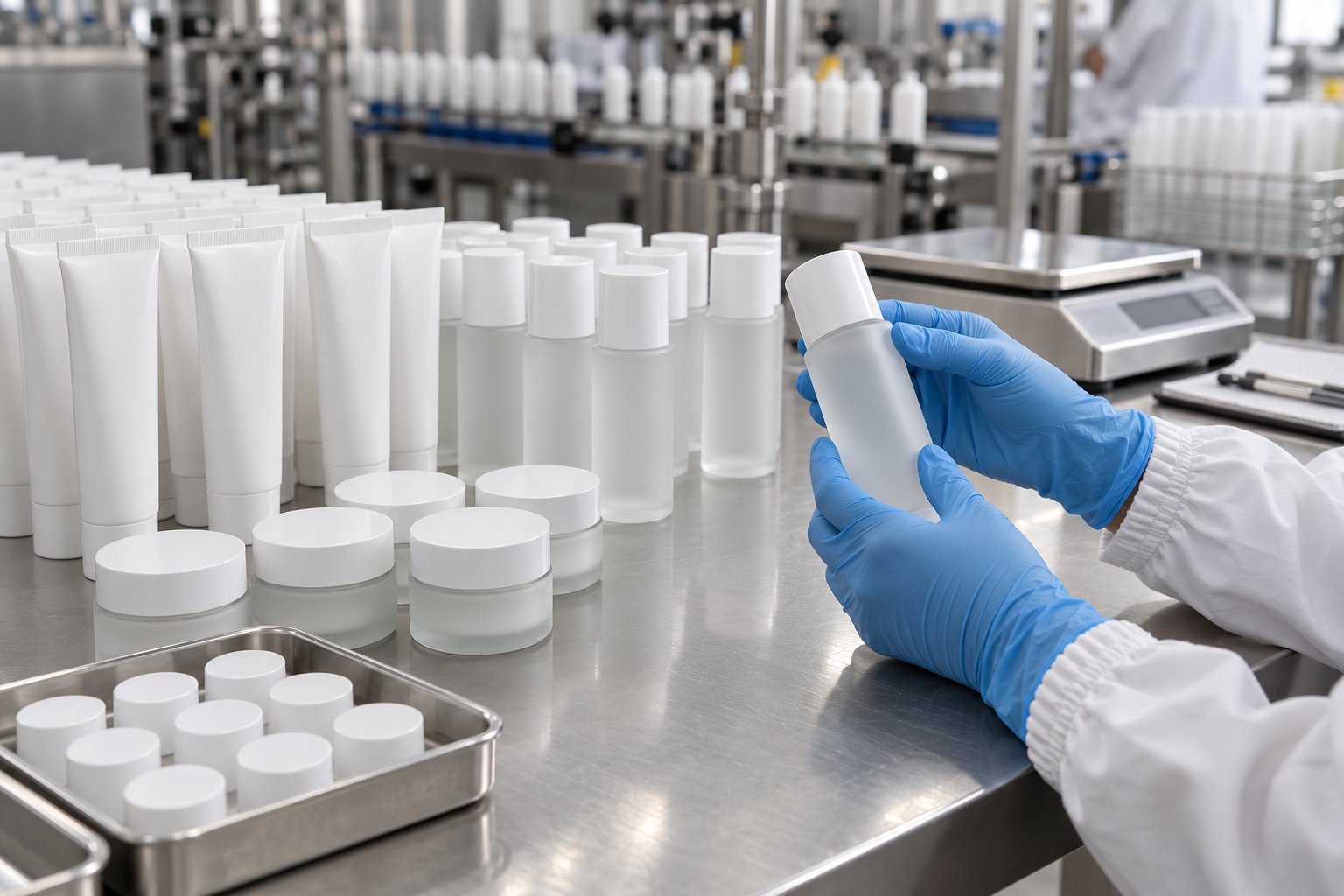
Production and inspection covers compounding, filling, assembly, and the pre-shipment check on a private label mens grooming timeline. The window is 30–35 days (calendar) for both existing solutions and custom formulas, counted from purchase order and deposit, and it scales with your order quantity and the number of components. Inspection takes 1–3 working days at the end of the run and follows cosmetic good manufacturing practice — the ISO 22716 GMP framework covers production, control, storage, and shipment of cosmetics.
Two scheduling realities matter here. Line slots are booked rather than always available — September to December is the congested window for mens grooming factories, and a brief that lands in November for a February launch competes for space with everyone else’s holiday orders. And an inspection failure is not a paperwork event: a rework plus re-inspection cycle typically adds 1–2 weeks, which is why the quality checks agreed in sampling (fill weight, cap torque, appearance, label placement) are repeated at line speed during production instead of assumed.
Stage 6: Shipment, transit and arrival
Shipment, transit, and arrival are three different dates on a private label mens grooming timeline, and conflating them is how launch dates get missed. Departure (ETD) comes 3–7 working days after production release, once booking and loading are complete. Transit is calendar time on the water or in the air: typical sea transit runs 18–25 days to the U.S. West Coast and 30–45 days to the East Coast or Europe, while air freight runs 5–10 days. Arrival adds customs clearance, typically 2–7 days, plus inland delivery to your warehouse.
Plan against the arrival date, not the departure date: when a buyer asks for the private label mens grooming lead time, the arrival date is the honest answer. A shipment that leaves on 22 April is not “in stock in April” — with transit and clearance it is a mid-to-late May warehouse date. Peak season, holiday closures, and customs holds all extend transit, and none of them appear on a factory’s ship confirmation.
Existing solution vs custom development: total windows
Existing solutions and custom developments share the same six stages but differ in what happens inside them. The comparison below is what a procurement conversation about a private label mens grooming timeline should establish before any date is discussed.
| Dimension | Existing solution | Custom development |
|---|---|---|
| Formula | Stock base, scent, texture, and color adjusted to brief | Built to your brief, stability-tested before lock |
| Packaging | Stock components with your label and print | Custom components; tooling cut for bottles, pumps, caps |
| Sampling window | 5–10 wd, 1–2 rounds | 10–20 wd, 2–3 rounds |
| Tooling | None, or print plates only | Molds and tooling for custom components |
| Brief to vessel departure | About 8–12 weeks | About 12–18 weeks |
| Best for | First launch, test SKUs, fixed dates | Differentiated line, retail exclusive, gift sets |
Many brands run a hybrid: launch on an existing solution to hold the date, then phase in custom formula or packaging on the second order. The phased route keeps the first shipment honest while the custom track develops in parallel — our OEM and ODM development guide covers how the two tracks share sampling, documentation, and packaging.
What can run in parallel
A private label mens grooming timeline is not six sequential blocks. These tracks routinely overlap with sampling, and using them is worth two to four weeks on a custom project:
- Quoting overlaps sampling. Base selection and the cost model come from the requirement sheet, so the proposal is costed while the first samples are on the bench.
- Packaging artwork overlaps formula sampling. Component selection, label copy, and print proofs can start before the formula is locked, as long as final claim text waits for the formula’s document set.
- Regulatory documents overlap tooling. MoCRA registration and listing, CPNP notification, and label review are administrative tracks that run while molds are being cut.
- Line slots can be reserved. Once samples are approved and the deposit schedule is agreed, the production window can be held before the purchase order is formally issued.
- Inspection is booked at production start. Booking the pre-shipment inspection when the run starts removes a week of end-of-run waiting.
Where a private label mens grooming timeline slips
Slippage in a private label mens grooming timeline is predictable, and most of it is approval latency on the brand side rather than factory capacity. The table separates the two, because the fixes are different: brand-side delays are fixed by process, factory-side delays by earlier flags.
| Delay cause | Typical impact | Whose move |
|---|---|---|
| Sample feedback outside the 3-wd window | +1–2 wk per round | Brand |
| Artwork proof rounds beyond the first | +5–10 wd per round | Brand |
| Late claim or regulatory text changes | +1–3 wk (relabel, reprint) | Brand |
| Tooling changes after the mold is cut | +2–4 wk (new tooling) | Brand and factory |
| Specialty raw-material lead time | +1–4 wk | Factory, flagged at quote |
| Peak-season line congestion (Sep–Dec) | +1–3 wk slot wait | Factory, flagged at quote |
| Inspection failure and rework | +1–2 wk | Factory |
| Booking or space delays in peak season | +3–10 days on the transit side | Logistics |
The brand-side control is simple: name one approver per stream (formula, artwork, commercial), keep the feedback windows, send one consolidated revision list per round, and confirm every sign-off in writing. A project with a named approver and disciplined feedback typically lands inside the planning windows; a project where “the team” reviews samples does not.
Deliverable, prerequisite and confirmer by stage
This is the private label mens grooming timeline table to hand your own team. Every stage has one deliverable, one prerequisite that must be in hand before it starts, and one confirmer who signs it off. When a project slips, it is almost always because a row was started without its prerequisite or signed off by nobody in particular.
| Stage | Deliverable | Prerequisite | Confirmer | Window |
|---|---|---|---|---|
| 1. Brief | Signed requirement sheet | First brief with market, category, quantity, target date | Brand procurement or development lead | 3–7 wd |
| 2. Quote | Costed proposal with MOQ and sampling plan | Requirement sheet confirmed | Brand commercial owner | 2–5 wd existing / 3–7 wd custom |
| 3. Sampling | Approved samples and sample report | Quote accepted, sampling fee settled | Brand product or R&D approver | 5–10 wd existing / 10–20 wd custom |
| 4. Confirmation | Locked formula, approved artwork, ordered components | Samples approved; claims finalized | Brand product and regulatory approvers | 5–10 wd stock packaging / 20–35 wd custom packaging |
| 5. Production | Inspection-passed production lot | Purchase order, deposit, line slot held | Brand QA or third-party inspector | 30–35 days |
| 6. Shipment | Departure confirmation and arrival ETA | Production released, booking confirmed | Brand logistics and factory shipping | 3–7 wd loading, then transit |
Working backwards from your launch date
Back-planning is the honest way to test whether a fixed on-shelf date is realistic on a private label mens grooming timeline. The example below is a custom development shipping by sea to the U.S. West Coast with a 1 June 2027 on-shelf target. It is an illustrative plan built from the planning windows above, not a quote.
| Milestone | Latest date |
|---|---|
| Goods in your warehouse | 24 May 2027 |
| Vessel arrival at port | 17 May 2027 |
| Vessel departure (ETD) | 22 April 2027 |
| Production complete and released | 12 April 2027 |
| Production start (PO and deposit) | 8 March 2027 |
| Formula and packaging confirmed | 8 March 2027 |
| Samples approved | 18 January 2027 |
| Quote accepted | 21 December 2026 |
| Brief confirmed | 12 December 2026 |
Every date above uses the slow end of its window, and the plan still lands eight days ahead of the on-shelf date. Read the two long gaps: five weeks from brief to approved samples, and seven weeks from approved samples to confirmed packaging — together twelve of the roughly twenty-four weeks in the plan. Move the on-shelf date two months earlier and it no longer fits — that is the moment to switch the first shipment to an existing solution or add air freight for part of the volume. Back-planning also exposes the dates you personally control: the brief date is yours to set, and every date below it moves when it moves.
Frequently asked questions
How long does a private label mens grooming project take from brief to shipment?
As planning windows on a private label mens grooming timeline: an existing solution typically runs about 8–12 weeks from brief to vessel departure, and custom formula plus custom packaging development typically runs 12–18 weeks. Add sea transit and customs clearance on top — roughly 3–6 weeks to the U.S. West Coast and 5–8 weeks to the East Coast or Europe — to get the arrival date. That end-to-end total is the private label mens grooming lead time to plan against. These are planning ranges for a single-category launch under standard conditions, not commitments; a confirmed schedule is issued after the brief review.
When should we start if our launch date is fixed?
On a private label mens grooming timeline with a fixed launch date, work backwards from the on-shelf date, not forwards from today. For a custom development shipping by sea, the brief typically needs to land about four to six months before the on-shelf date; for an existing solution, about two and a half to four months. If the remaining time is shorter, the realistic options are an existing-solution first shipment, air freight for part of the order, or a later on-shelf date.
What causes the most delays in a private label mens grooming timeline?
Approval latency on the brand side: sample feedback outside the 3-working-day window, artwork proof rounds beyond the first, and late claim or regulatory text changes. Factory-side delays are usually flagged at the quote stage — specialty raw materials, peak-season line congestion from September to December, and custom tooling lead times. Inspection failures and rework add one to two weeks and are the main risk you cannot see coming.
Are the day ranges working days or calendar days?
Development windows are working days, Monday to Friday, excluding factory public holidays; production and transit windows are calendar days. Mixing the two is a common planning error — 20 working days is four weeks, while a 30-day production window is a little over four.
Can we launch on an existing formula and customize later?
Yes, and it is the most common way brands protect a fixed date. Launch the first shipment on a stock base with your label and packaging, then run custom formula or custom packaging development in parallel and switch on the second or third order. The phased route costs one transition cycle but keeps the first on-shelf date honest.
What do you need from us to confirm a timeline?
Four things: your target on-shelf date, the sales market and language, the product category and format, and the customization level — existing solution, custom formula, or custom formula and packaging — plus an estimated first-order quantity. With those we can return a stage-by-stage plan with dates; without them any timeline is a guess, which is why we do not quote confirmed dates for a private label mens grooming timeline before the brief review.
Check Your Target Launch Timeline
If you have a target launch date, the fastest way to test it against a private label mens grooming timeline is to send us the date and the shape of the project. We will map your brief against the six stages above and return a stage-by-stage plan with the planning windows, the parallel tracks, and the approval points that sit with your team. What we will not do is promise a ship date before the brief has been reviewed — an unconfirmed date is worse than a late one, because it gets built into retail plans.
To check your timeline, share:
- Your target on-shelf date, and whether it is fixed by retail, a campaign, or internal planning
- Sales market and language, since this sets the regulatory document set
- Product category and format, for example beard oil, hair clay, bar soap, or a multi-SKU set
- Customization level: existing solution, custom formula, or custom formula and packaging
- Estimated first-order quantity, if you have it
As your men’s grooming OEM and ODM development partner, we run this timeline for existing-solution and custom-development projects across men’s categories. For the quantity side of the plan, our private label MOQ guide explains how packaging minimums shape the first order, and our men’s grooming manufacturer guide covers the wider line-build across categories.