The Real Role of Alcohol in Skincare: Pitfall or Science?
In men’s skincare, “alcohol” has long been one of the most debated ingredients.
Some avoid it at all costs when they see Alcohol, Ethanol, or Alcohol Denat. on the label, while others see it as a key component for controlling oil, providing antibacterial benefits, and delivering a refreshing feel.
So, the questions are:
👉 Is alcohol really a skincare hazard, or is it a misunderstood scientific ingredient?
👉 Should alcohol be used in men’s skincare products, and if so, how can it be used safely?
In this article, we will explore the scientific perspective, revealing the true role of alcohol in skincare and its safety boundaries.
1. What Is “Alcohol” in Skincare Products?
In cosmetic INCI lists, common alcohol types include:
-
Ethanol
-
Alcohol / Alcohol Denat. (denatured alcohol)
-
Isopropyl Alcohol (less commonly used in skincare)
In men’s skincare, Ethanol is the most frequent. It is cosmetic-grade, safe, and regulated, not industrial alcohol.
👉 The key point: skin irritation depends on type + concentration + formulation, not the mere presence of alcohol.
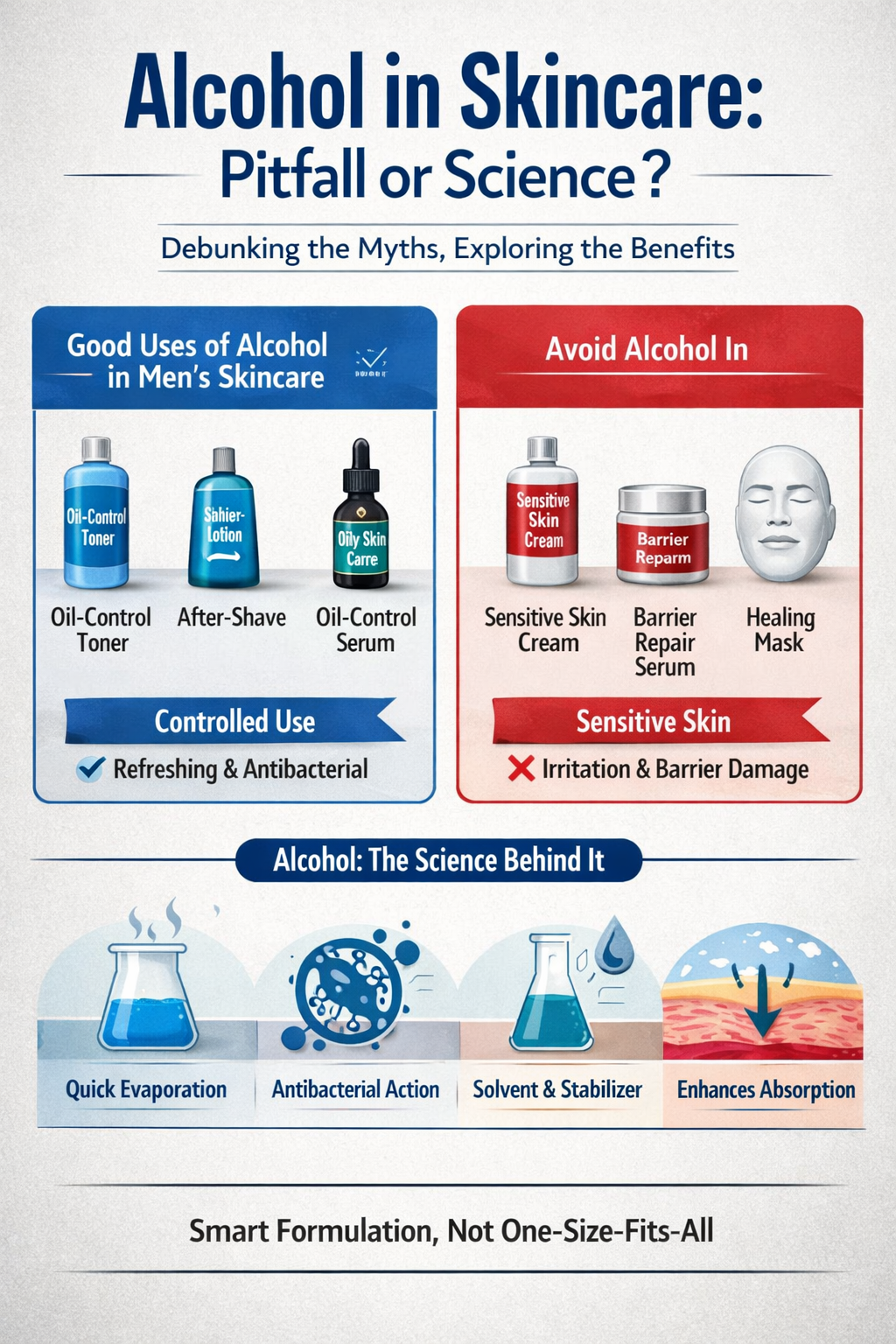
2. Four Core Functions of Alcohol in Skincare
1️⃣ Volatility: Delivering the Refreshing Feeling Men Love
Ethanol evaporates quickly, creating:
-
An instant non-greasy, cooling sensation
-
Reduced oily residue
-
Improved product experience
This is why alcohol remains in:
-
Men’s toners
-
Oil-control serums
-
Aftershaves
👉 For oily or combination male skin, moderate alcohol ≠ harmful.
2️⃣ Antibacterial Support & After-Shave Care
Alcohol provides mild antibacterial effects, important in:
-
After-shave toners
-
Acne-prone skin care
-
Cleansing toners
After shaving, alcohol can temporarily reduce bacterial risk and minimize follicle irritation. This explains its continued presence in traditional men’s grooming products.
3️⃣ Solvent & Formula Stabilizer
Alcohol is not just a potential irritant—it’s a functional solvent:
-
Dissolves plant extracts and active ingredients
-
Improves formula clarity
-
Enhances preservation and stability
Especially in:
-
Transparent serums
-
High-potency oil-control formulas
alcohol significantly improves formulation feasibility.
4️⃣ Enhancing Penetration & Skin Feel
Alcohol can temporarily reduce stratum corneum resistance, allowing some actives to penetrate more efficiently.
In this context, alcohol acts as:
-
A delivery facilitator
-
A texture and skin-feel regulator
—not just a potential irritant.
3. Does Alcohol Really Harm the Skin? The Science
❌ Common Misconception
“All alcohol-containing skincare products thin the skin or cause sensitivity.”
This is an oversimplification.
✅ Scientific Findings
Skin impact depends on three factors:
1️⃣ Alcohol Concentration
-
Low (<5%): Mostly affects texture, very low risk
-
Medium (5–10%): Needs supporting moisturizers
-
High (>10%): Not suitable for sensitive skin long-term
2️⃣ Supporting Ingredients
Well-formulated products include:
-
Humectants like glycerin and butylene glycol
-
Panthenol (Vitamin B5)
-
Allantoin or Centella asiatica
👉 Alcohol + buffering agents ≠ irritation
3️⃣ Intended Use & Skin Condition
-
Suitable: oily skin, acne-prone skin, post-shave care
-
Avoid: sensitive skin, compromised barrier, repair-focused products
4. Men’s Skincare Products Where Alcohol Works Well
✔ Suitable products:
-
Oil-control toners
-
After-shave toners
-
Lightweight serums
-
Summer skincare lines for oily skin
❌ Avoid in:
-
Sensitive-skin lines
-
Barrier repair creams or masks
-
Repair-focused serums
Professional OEM factories often design alcohol strategies per target skin type, not “one-size-fits-all.”
5. Conclusion: Alcohol Is Not the Enemy
From a cosmetic science perspective:
-
Alcohol is not inherently harmful
-
It is a misunderstood functional ingredient
-
Proper concentration + intelligent formulation = safe and effective
For men’s skincare, the real concern is misuse, not alcohol itself.