“We want something woody, fresh and premium.”
That is not a fragrance brief. It is like asking a tailor for “a nice dark suit.” Nice for whom, worn where and at what price? Missing details decide whether the result feels sharp or just wrong.
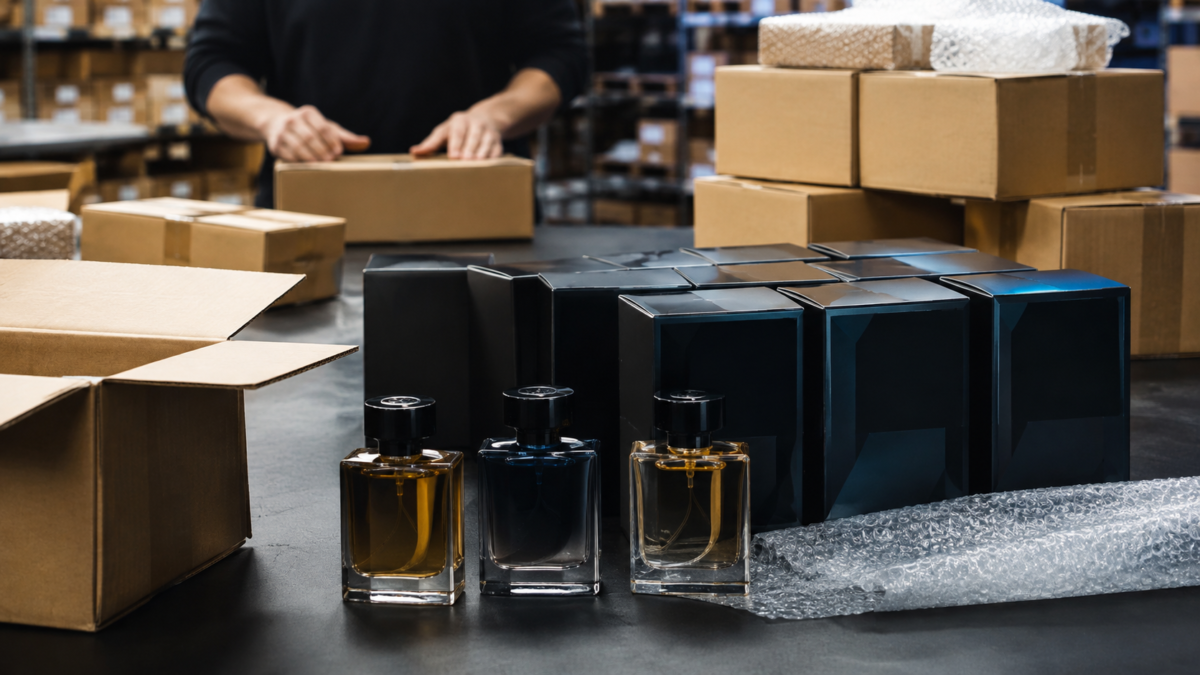
A private label men’s fragrance has the same problem. The scent is creative, but the finished product is also a formula, bottle, atomizer, carton, production process and shipping classification. All of those parts need to agree.
The Associated Press reported, citing Circana, that December accounts for about one-quarter of annual U.S. sales of high-end perfumes, colognes, body mists and other scented beauty products. Miss a holiday delivery by three weeks and the fragrance may have missed the year’s best window. Read the AP fragrance retail report.
This guide follows the real buying path: define the wearer, write the brief, approve a reproducible sample, engineer the pack and then scale with control.
TL;DR
- Private label men’s fragrance means your brand on a manufacturer’s base or custom scent – format first, then notes.
- Build a commercial brief and a scent brief a perfumer can use; concentration (EDP/EDT/cologne) is not the whole story.
- Engineer the bottle around formula and channel; manage IFRA, MoCRA, QC, and freight as design inputs.
What Does Private Label Men’s Fragrance Actually Mean?
Suppliers use *white label*, *private label*, OEM and ODM loosely. Ask what is genuinely yours and what can also be sold to someone else.
| Development route | What you receive | Best fit | Main watch-out |
| White label | Existing fragrance and stock packaging with your branding | Fast, low-risk market test | Low scent and packaging differentiation |
| Semi-custom private label | Existing base or scent direction with controlled adjustments | Growing brand with a defined audience | “Custom” changes may be limited and non-exclusive |
| Full ODM development | Scent, finished base, package and specifications developed from your brief | Brand seeking a signature product | More sample rounds, time and approval decisions |
| OEM or contract filling | Manufacturer produces from buyer-owned specifications or bulk | Experienced buyer with a locked formula | Buyer carries more technical and supply-chain responsibility |
Exclusivity is a contract term. A sample made for your project does not automatically become your formula. Clarify ownership, territories and what happens if you change filling factories.
The same questions apply to a broader private label men’s grooming manufacturer, but fragrance adds a fragrance house, alcohol handling and atomizer performance.
Choose the Product Format Before Chasing Notes
“Men’s fragrance” can mean several different products:
- Alcohol-based eau de cologne, eau de toilette, eau de parfum or extrait
- Perfume oil or roll-on fragrance
- Solid cologne in a jar, tin or stick
- Body mist or body spray
- Aftershave splash or fragranced grooming extension
- Discovery set, travel spray or gift set
Format affects formula, packaging, compliance, freight and cost. A 50 ml prestige EDP is a different project from a pocket solid cologne.
Is this a daily office scent, barbershop signature, evening fragrance or fashion launch? Define the channel and climate too; humid Southeast Asia may need a different sensory target from a cool European winter.
“Masculine” does not have to mean a blue bottle and loud marine notes. A men’s scent can be tea-like, mineral, smoky, botanical, soft-musk or unisex. Define the wearer and occasion so the perfumer does not have to reach for a stereotype.
Build the Commercial Brief First

Before the perfumer smells anything, lock the business boundaries:
- Target wearer and age or lifestyle segment
- Use occasion, climate and expected spray behavior
- Selling market and sales channel
- Target retail price and target landed cost
- Launch size, annual forecast and reorder scenario
- Product format and fill size
- Stock versus custom packaging tolerance
- Intended claims and excluded claims
- Launch date and hard retail deadlines
These boundaries prevent expensive loops. A perfumer cannot meet a concentrate-cost ceiling that nobody mentioned, and a packaging team cannot hit a landed target if custom glass was quietly assumed.
For first launches, one hero is often stronger than a five-scent collection. Extra scents multiply sampling, artwork, inventory and slow sellers before the brand knows what customers reorder.
How to Write a Scent Brief a Perfumer Can Use
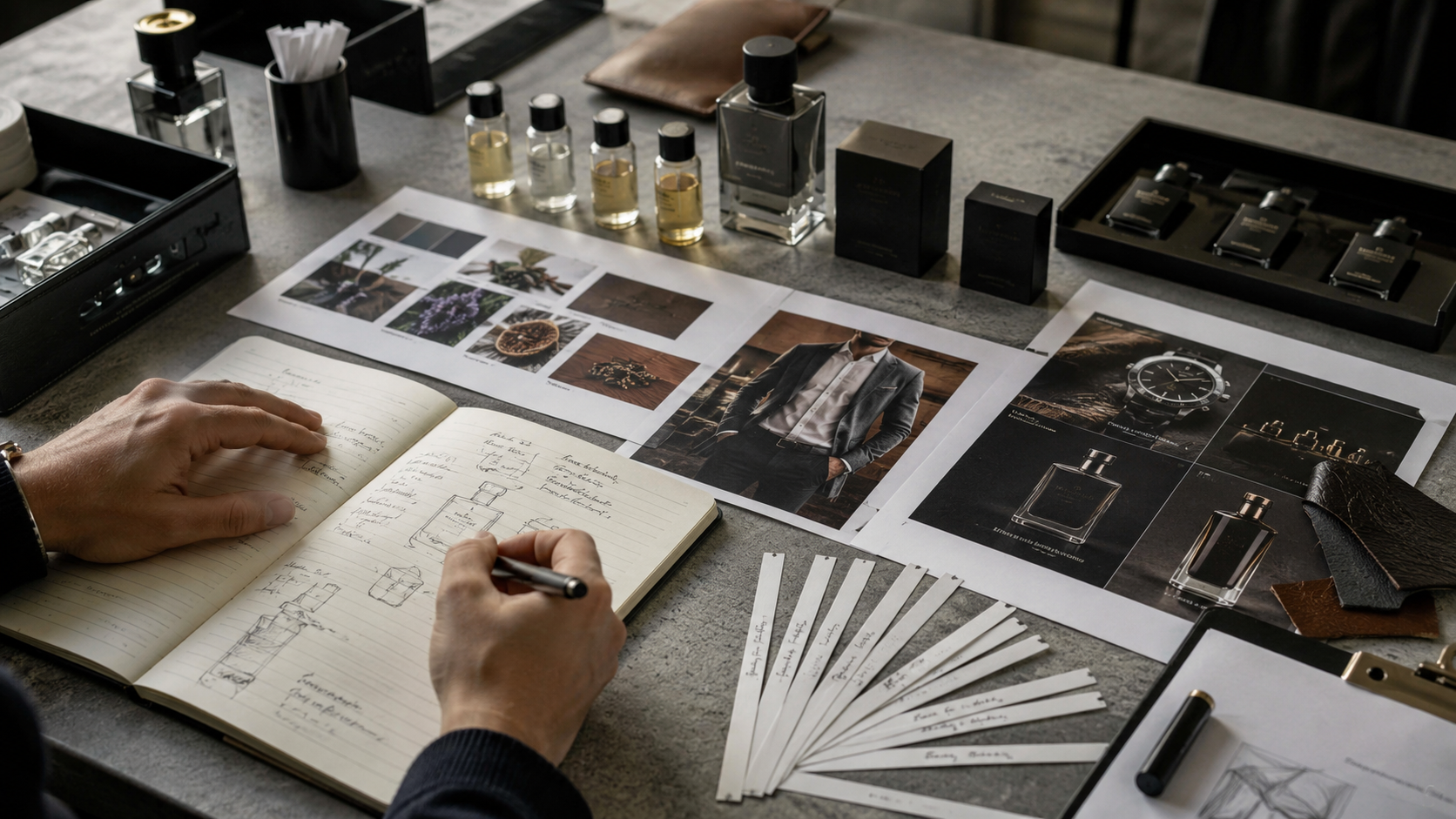
A useful scent brief describes the world around the smell, not only a list of notes.
Brand and wearer
Explain the brand in plain language. Add three personality words and three words that should never describe the result. “Quiet, precise, outdoorsy; never sugary, nightclub-heavy or retro” is more useful than “modern luxury.” Describe where the wearer applies it, what he already buys and whether the scent should feel familiar or unusual.
Olfactive direction
Choose a starting family—aromatic, woody, citrus, amber, leather, fougère, marine, musk or gourmand—then describe the movement:
- Opening: bright citrus, cool herbs, pepper, fruit or something softer
- Heart: aromatic, floral, tea, spice, woods or mineral effects
- Dry-down: clean musk, amber, vetiver, cedar, leather, resin or warm woods
Top, heart and base notes help describe the journey, but they are not a bill of materials. A “cedar note” may be an accord built from several materials.
References and boundaries
Use competitive scents as coordinates. State whether you admire the airy opening, dry woods, quiet projection or smooth finish—and what to avoid.
Do not ask for a disguised copy. Beyond legal and identity concerns, “inspired by” positioning makes the product easy to compare and hard to own.
Performance and cost
Define diffusion, wear time, sweetness, stain behavior, format, dosage, formula cost and destination markets. IFRA describes the brief as the request that gives a fragrance house the product concept and information needed to create a suitable mixture. See how IFRA explains fragrance creation.
| Vague direction | More useful direction |
| “Fresh and expensive” | Fresh aromatic daily scent for an urban professional; dry rather than sweet; subtle woody dry-down; mid-premium DTC price |
| “Lasts all day” | Noticeable at close range after six hours in warm weather, evaluated after four sprays from the approved atomizer |
| “Natural and clean” | State the exact natural-content method, prohibited materials, disclosure needs and sensory trade-offs |
| “Like Brand X” | Identify the admired mood or structure, then define clear points of difference |
Fragrance Materials Without the Marketing Fog
Fine fragrance can combine naturals and synthetic aroma molecules. Neither side is automatically good or bad; both need specifications and safety evaluation.

Natural materials
Essential oils, absolutes, resins, extracts and isolates can provide richness. They also vary with harvest and processing. Some oxidize, darken a formula, affect allergen disclosure or cost more than expected. Even a citrus oil needs specifications, traceability and storage control.
Synthetic aroma materials
Synthetic materials expand the palette, improve consistency and create effects that may be scarce or unstable in nature. They can supply lift, musk, amber, marine or woody character and lasting power.
“Synthetic” does not mean unsafe. “Natural” does not mean non-allergenic. Safety depends on the material, concentration, exposure and intended use.
The finished base
The concentrate is incorporated into the finished base. An alcohol spray may use ethanol, concentrate, water where appropriate and permitted supporting materials. Oil and solid formats need different carriers.
The FDA treats perfumes and colognes marketed for scent as cosmetics; fragrance ingredients face the same safety requirement as other cosmetic ingredients. Review the FDA’s fragrance guidance.
EDP, EDT and Cologne: Concentration Is Not the Whole Story

EDC, EDT, EDP and parfum often suggest increasing concentration, but percentage ranges vary. They are conventions, not universal performance grades.
Two products at the same concentrate percentage can wear very differently because longevity and projection also depend on:
- Volatility of the selected materials
- Structure of the fragrance
- Finished base and solvent system
- Skin, humidity and temperature
- Number of sprays and atomizer output
- Storage and age of the product
Projection is how far the fragrance radiates. Sillage is its trail; longevity is wear time. A long-lasting skin scent may still project modestly.
More concentrate does not automatically fix performance. It can increase cost, cloudiness, staining or restrictions without improving diffusion. Design toward a wear target and test with the real sprayer.
Turn Sampling Into a Controlled Decision
Fragrance feedback gets messy fast: “too masculine,” “not strong,” “more vanilla.” None tells the perfumer precisely what to change.
Keep the first round focused
Start with a small number of clearly different directions. Code the samples rather than presenting them with persuasive names. Evaluate on blotters first, then on skin if suitable.
Use timed checkpoints:
- Immediate opening
- 15–30 minutes
- Two hours
- Four to six hours
- End-of-day dry-down where relevant
Record character, diffusion, off-notes, wear, stain and brand fit. Include a small target-audience group. The founder’s nose matters, but it is not the entire market.
Approve the finished dilution, not just the concentrate
Evaluate the selected concentrate in the actual finished base and dosage. It can behave differently in alcohol, oil or a solid product.
Once approved, create a golden sample with:
- Sample and formula version code
- Concentrate lot and dosage
- Finished-base specification
- Packaging and atomizer reference
- Approval date and authorized approver
- Agreed sensory and physical acceptance criteria
Retain reference material for pilot and first-batch comparison. “Sample three from the box sent in March” is not a quality system.
Engineer the Bottle Around the Formula and Channel
The bottle is part of product performance. It controls how the consumer experiences the scent and how well the formula survives distribution.

Glass, pump and closure
Confirm bottle material, neck finish, crimp or screw system, gasket, dip tube, actuator, collar and cap. Test:
- Spray dose and mist pattern
- Priming and actuation
- Leakage in different orientations
- Evaporation and weight loss
- Formula contact with gaskets and dip tube
- Cap retention and component fit
- Breakage and parcel-shipping protection
A beautiful cap that wobbles makes the product feel cheap. A heavy pump dose can turn a carefully designed fragrance into a room spray.
Decoration and cartons
Labels, screen printing, coating, hot stamping and metallization each bring adhesion, color-tolerance, abrasion and MOQ questions.
Folding cartons suit retail. Rigid boxes suit gifting but add weight. DTC packs need parcel protection, while discovery sets add vial-filling and insert control. Test components, not renderings.
Stock bottle molds are usually the sensible validation route. Custom glass can create a powerful signature, but it adds design, mold, trial, tooling, higher minimums and a longer critical path.
From Golden Sample to Mass Production

A controlled project normally moves through these gates:
- Commercial brief and technical feasibility
- Scent development and structured revisions
- Finished-base sample and documentation review
- Packaging selection and compatibility work
- Pilot or pre-production sample
- Bulk compounding under an approved formula and process
- Controlled resting or maturation where required
- Chilling and filtration where the formula requires them
- Filling, crimping or closing, coding and cartoning
- Finished-product inspection, batch release and retention
Resting, chilling and filtration are processing tools, not magic quality guarantees. Their parameters must match the validated method.
Why the bulk batch can smell different
Lab-to-bulk drift can come from raw-material lots, weighing, sequence, temperature, alcohol strength, filtration, bottle contact or a formula-version mistake.
Approval needs more than a final nose check. Control raw materials, formula version, process parameters and packaging before filling.
Quality Control for a Product Judged With the Nose
Quality control should combine documents, physical checks and sensory comparison. The plan may include:
- Incoming COA, SDS and raw-material identity controls
- Appearance, clarity, color and odor
- Density or specific gravity where relevant
- Fill volume or weight and batch coding
- Comparison against the approved olfactive reference
- Spray output, leakage and closure checks
- Decoration adhesion and carton inspection
- Batch records, traceability and retained samples
Stability asks whether the formula remains acceptable over time. Compatibility asks whether formula and packaging affect each other. A perfume may stay clear yet interact with a gasket or dip tube.
Ask who performs sensory release, how the batch is compared with the reference and what happens when it is close—but not right.
ISO 22716 gives GMP guidelines for cosmetic production, control, storage and shipment. A logo alone does not prove a batch met its specification. Review the ISO 22716 scope.
IFRA, MoCRA and Market Documentation
Compliance is a set of responsibilities tied to the formula, use, claims, label, site and selling market—not one certificate.
What an IFRA Certificate of Conformity does
IFRA Standards can prohibit, restrict or set specifications for materials by intended use. The fragrance-mixture creator prepares a Certificate of Conformity for a stated application and use level.
IFRA is clear on two points: it does not issue those certificates itself, and a Certificate of Conformity does not replace a safety assessment. Read IFRA’s certificate explanation.
The certificate must match the finished-product category and dosage. A rinse-off certificate is not evidence for a fine-fragrance spray.
United States
Under MoCRA, relevant businesses must assign roles and manage safety substantiation, adverse events, facility registration, product listing and labeling as applicable. The label can determine the U.S. Responsible Person.
Use the FDA’s MoCRA overview with qualified project advice. BunJoin’s MoCRA roles and documents guide offers a buyer-oriented starting point.
European Union
An EU launch generally needs a Responsible Person, CPSR, Product Information File, CPNP notification and compliant label. Regulation (EU) 2023/1545 expanded individually labeled fragrance allergens. As of August 2026, its new-product placement deadline has passed, while qualifying older stock has a later transition. Confirm status with the EU Responsible Person rather than copying an old allergen list.
The European Commission’s legislation page summarizes the transition framework.
Core documents to request
- Finished-product specification and ingredient/INCI information through the agreed disclosure route
- IFRA Certificate of Conformity for the intended use
- SDS, COA and fragrance-allergen declaration
- Stability and package-compatibility evidence
- Batch manufacturing and finished-release records
- Label text and destination-market review responsibility
- Change-control and complaint-handling process
Men’s brands developing low-fragrance or fragrance-free extensions should define their exclusions and claims just as carefully as the hero fragrance.
Freight Is Part of Fragrance Design
Alcohol-based perfume can fall within dangerous-goods transport rules. Classification must come from the actual formula and applicable regulations, not a guess based on bottle size or the word *cologne*.
Air shipment may require a trained shipper, approved packaging, marks, labels and documents. IATA’s Dangerous Goods Regulations cover classification, packing, marking, labeling and documentation. See the current IATA DGR overview.
Discuss freight early. A cheap fill can become unattractive after dangerous-goods handling, air freight and breakage protection.
Oil and solid formats differ, but “alcohol-free” is not a blanket exemption. Use the SDS and a qualified provider to classify the shipment.
MOQ, Cost and Lead Time: Follow the Highest Minimum
There is no universal MOQ. A factory may fill 500 units while the pump requires 10,000 pieces or the carton 3,000. The least flexible component—and the leftover-inventory plan—controls the project.
| Cost layer | Typical driver | How the buyer can control it |
| Fragrance development | Custom brief, revisions and exclusivity | Give focused feedback and set approval gates |
| Finished formula | Concentrate cost, dosage and processing | Set cost and performance targets together |
| Bottle and atomizer | Stock versus custom mold, pump and decoration | Validate with production-ready stock components |
| Carton and insert | Structure, print finish, tooling and MOQ | Right-size the pack and limit decorative processes |
| Testing and documents | Markets, claims, format and risk | Define launch markets before sampling |
| Assembly and freight | Filling method, breakage and DG route | Model landed cost using the actual route |
Plan lead time by phase: brief, samples, packaging, testing, documents, components, bulk production and freight. Ordering 5,000 cartons before compatibility testing is not moving fast. It is buying a large bet.
Ask suppliers to quote:
- MOQ per fragrance, size and packaging component
- Sample and revision fees
- Formula or concentrate price and dosage assumption
- Bottle, pump, cap, decoration and carton separately
- Testing, regulatory support, filling and assembly
- Tooling ownership and useful life
- Excess-component storage or disposition
- Reorder lead time and payment terms
Brands needing coordinated formulation, packaging and production can review BunJoin’s manufacturing scope and compare it with qualified alternatives.
How to Evaluate a Fragrance OEM/ODM Partner
A project may involve a fragrance house, compounder, filling factory, packaging suppliers and freight forwarder. One company may control most steps or coordinate subcontractors. Either can work, but the buyer should know the map.
Ask:
- Who creates and compounds the fragrance concentrate?
- Who holds the formula and can it move with the brand?
- Who manufactures and releases the finished product?
- Can the facility handle alcohol storage, mixing, filtration, filling and crimping safely?
- How are sample versions and production formulas controlled?
- What sensory and physical tests release a batch?
- Are retention samples kept, and for how long?
- Can the supplier show component-level MOQs and lead times?
- Who owns artwork, molds, tooling and approved references?
- How are formula, raw-material or component changes approved?
- Who prepares export and dangerous-goods documents?
About BunJoin explains the company’s supply-chain role, but every project should still be evaluated against its specifications and destination markets.
A Practical Men’s Fragrance RFQ Checklist
Give every supplier enough detail to quote the same project:
- Target wearer, occasion, market, channel and price
- One-sentence scent promise and olfactive direction
- Reference scents with specific likes and dislikes
- Product format, fill size and concentration direction
- Wear, diffusion, stain and spray expectations
- Ingredient restrictions, claims and required documents
- Stock or custom bottle, pump, cap, decoration and carton
- Formula ownership, confidentiality and exclusivity expectations
- Sample rounds, golden-sample process and approval authority
- Quantity by scent and size, forecast and reorder plan
- Target landed cost, launch date and shipping route
A capable partner can close missing fields. Expose them before sampling begins.
Conclusion
A good private label men’s fragrance fits a defined wearer, survives its package, meets market obligations and can be reproduced after the first batch sells out.
Begin with the commercial brief. Give the perfumer real boundaries. Approve the finished dilution through a controlled golden sample. Test the actual bottle and atomizer. Then make sure the factory can reproduce the formula, document the batch and ship it through the intended route.
It sounds less romantic than “bottling a memory.” Still, repeatable quality is what lets the memory become a brand.
Start with one clear hero rather than a crowded collection. When the brief, target cost and launch market are ready, discuss the fragrance project with BunJoin.
Frequently Asked Questions
1. How much does it cost to create a private label men’s fragrance?
Cost depends on the scent-development route, concentrate, dosage, bottle, atomizer, decoration, carton, testing, filling, order quantity and freight. Ask for a component-level quote and a landed-cost model. A cheap bottle can become costly after decoration minimums and dangerous-goods shipping.
2. What is the typical MOQ for custom perfume or cologne?
There is no single industry MOQ. Stock-package white label may start in the hundreds, while custom fragrance, decorated glass or bespoke pumps can require thousands. The effective MOQ is set by the highest component minimum and the plan for unused components.
3. How long does fragrance development and mass production take?
A stock-scent launch can move faster than a fully custom project. Bespoke development may require several sample rounds, compatibility work, documentation and packaging production before filling begins. Plan the timeline by phase and allow extra time around major holiday launches.
4. What is the difference between EDC, EDT, EDP and parfum?
The terms usually suggest increasing fragrance concentration, but percentage ranges are not perfectly standardized across brands. They also do not predict performance alone. Material volatility, formula structure, skin, climate and atomizer output influence how a fragrance wears.
5. Can a manufacturer copy a famous men’s fragrance exactly?
A supplier may offer a similar olfactive direction, but building a disguised copy creates legal, ethical and positioning risk. Use competitor scents as references for mood or structure, then develop recognizable differences that belong to your brand.
6. Who owns a custom fragrance formula?
Ownership depends on the contract. Paying for samples does not automatically transfer the formula. Define ownership, exclusivity, territories, confidentiality, reformulation rights and whether the formula or concentrate can move to another approved manufacturer.
7. How many fragrance sample revisions should a brand expect?
There is no perfect number. A clear brief may need only a focused selection and one or two adjustments. An unclear brief can produce endless rounds. Agree on included revisions, feedback timing, extra fees and the point at which the formula is locked.
8. Does an IFRA certificate make a perfume compliant everywhere?
No. It indicates conformity of a fragrance mixture with IFRA Standards for a stated product use and concentration. It does not replace a complete safety assessment, finished-product review, compliant label or destination-market obligations.
9. Why can mass-produced perfume smell different from the approved sample?
Possible causes include raw-material lot variation, scale, weighing, addition sequence, temperature, alcohol strength, resting, filtration, packaging contact or formula-version errors. A golden sample, controlled process and sensory batch release reduce the risk.
10. Can alcohol-based perfume be shipped by air?
Often yes, but it may be regulated as dangerous goods. The shipper must classify the actual finished product and follow applicable packing, marking, labeling, documentation and carrier requirements. Confirm the route and cost with a qualified freight partner before production.
Frequently asked questions
What is the typical MOQ for private label fragrance?
EDP, EDC and solid balm usually start around 1,000–3,000 units; refill and gift formats vary.
Can the scent be customized to a brief?
Yes — we build the accord from your scent brief (woody, fresh, citrus, amber and so on) and set concentration to cost and market.
How long does fragrance production take?
Scent development and samples 1–3 weeks, production 3–6 weeks after approval.