Men’s Bar Soap Trends 2026: Fragrance, Ingredients and Private Label Opportunities
Private label mens soap is drawing fresh attention from brands in 2026, and the timing is backed by real retail data rather than hype. NielsenIQ’s 2025 U.S. men’s grooming overview reports that bar soap sales grew 33% year over year, even as the broader category reached $7.1 billion in tracked sales. That growth is the signal most founders in the men’s body care space have been waiting for.
We write this from the formulation bench, not a catalog. As a men’s soap manufacturer working in private label and ODM, we have taken bar formats from brief to stable production batch, and the trends below are the ones that actually show up in sampling, pilot runs, and shelf-life review. One honest caveat up front: retail sales growth is not the same as search volume. The 33% figure is a sales number; it does not mean keyword search for “private label mens soap” rose by the same amount. Validate search demand for your target market before you commit tooling.
TL;DR — the 2026 men’s bar soap opportunity
- Bar soap is back. NielsenIQ’s 2025 U.S. report shows 33% YoY growth in bar soap sales within a $7.1B men’s grooming market.
- Fragrance is the differentiator. Woodsy, citrus, and clean-fresh families lead, and the scent must stay consistent across the whole line.
- Format sets the claim. Cold-process, milled, and syndet bars each suit a different positioning and price point.
- The three-piece set is the entry bundle. Soap plus shampoo bar plus solid cologne reads as a complete ritual and lifts average order value.
- Private label mens soap is the low-risk hero SKU. It is the fastest way for a body-care brand to add a bar; start with one SKU, then expand the range.
The data: what NielsenIQ’s 2025 report actually shows
NielsenIQ (NIQ) published its U.S. Men’s Grooming Category Overview for 2025, covering the 12 months ending June 2025 across tracked U.S. retail, including mass, grocery, and e-commerce channels. The headline: the U.S. men’s grooming category reached $7.1 billion in sales, up 6.9% year over year. Within bath and shower, body wash led at about $1 billion, but bar soap was the standout, posting 33% growth — a revival driven by natural formats and giftability.
Online sales grew 27.6% and now account for nearly half of category dollar sales, which matters for DTC brands. For context, deodorant rose 11.4%, whole-body formats surged 150%, and shaving rebounded 14.5%. The takeaway for a men’s soap manufacturer: bar soap is no longer a legacy format; it is one of the fastest-growing segments in men’s care, and the market is the United States.
Sales growth is not the same as search volume
NielsenIQ’s 33% is a U.S. retail sales figure, not a count of how many people searched “private label mens soap” or “men’s bar soap trends.” A category can grow on shelves while search interest stays flat in your own region. Read the 33% as a market-opportunity signal, then validate keyword demand for your target market and language before you commit tooling or MOQ.
Fragrance combinations that actually sell in men’s soap
Scent is the single biggest reason a customer rebuys a bar, and it is where private label mens soap can out-differentiate legacy brands. For private label mens soap, the winning families in 2026 are woodsy (cedar, sandalwood, vetiver), bright citrus (bergamot, grapefruit, lime), and clean-fresh (sea salt, eucalyptus, mint). Unscented and sensitive-skin bars remain a steady niche for a fragrance-free positioning that pairs well with dermatological claims.
| Scent family | Mood / notes | Best positioning |
|---|---|---|
| Woodsy (cedar, sandalwood, vetiver) | Grounded, premium, masculine | Premium, natural |
| Citrus (bergamot, grapefruit, lime) | Bright, energetic, fresh | Everyday, gym, value |
| Clean fresh (sea salt, eucalyptus, mint) | Cooling, clinical-clean | Performance, sensitive |
| Unscented | Neutral, fragrance-free | Sensitive, dermatological |
The rule we apply in development: pick one scent family and carry it across every SKU from day one. If the soap is sandalwood, the shampoo bar and solid cologne should echo it, so the line reads as one brand rather than three unrelated products. Because a bar’s denser base throws more fragrance than a thin liquid, we tune the load down in soap to match the rest of the range. Our private-label men’s fragrance guide covers how we build a consistent scent family across a whole line.
Soap bar forms: cold-process, milled, and syndet
For private label mens soap, the format you choose sets your cost, your claim, and your shelf life. Cold-process and hot-process bars are true soap, often marketed as natural with a short, pronounceable ingredient list; they cure slowly and need careful storage. Milled (French-milled) bars are pressed and re-pressed for a dense, long-lasting bar with a premium feel. Syndet and glycerin bars are not true soap — they are milder, clear or translucent, and popular for a face-and-body crossover.
| Form | Texture / feel | Best positioning | Formulation risk | Lead time |
|---|---|---|---|---|
| Cold-process | Rustic, natural lather | Handmade natural | Medium (cure, weeping) | Long (4–6 wk cure) |
| Milled / French-milled | Dense, long-lasting, premium | Premium | Low to medium | Medium |
| Syndet / glycerin | Clear, mild, face-body | Sensitive, crossover | Low | Short |
For most new men’s soap lines, we recommend starting with a milled or syndet base: both scale cleanly, hold fragrance well, and avoid the cure-time and stability variables of cold-process. Cold-process earns its place when “handmade natural” is the core story and you can support the longer lead time and storage discipline it demands.
The three-piece set: the entry bundle for men’s soap
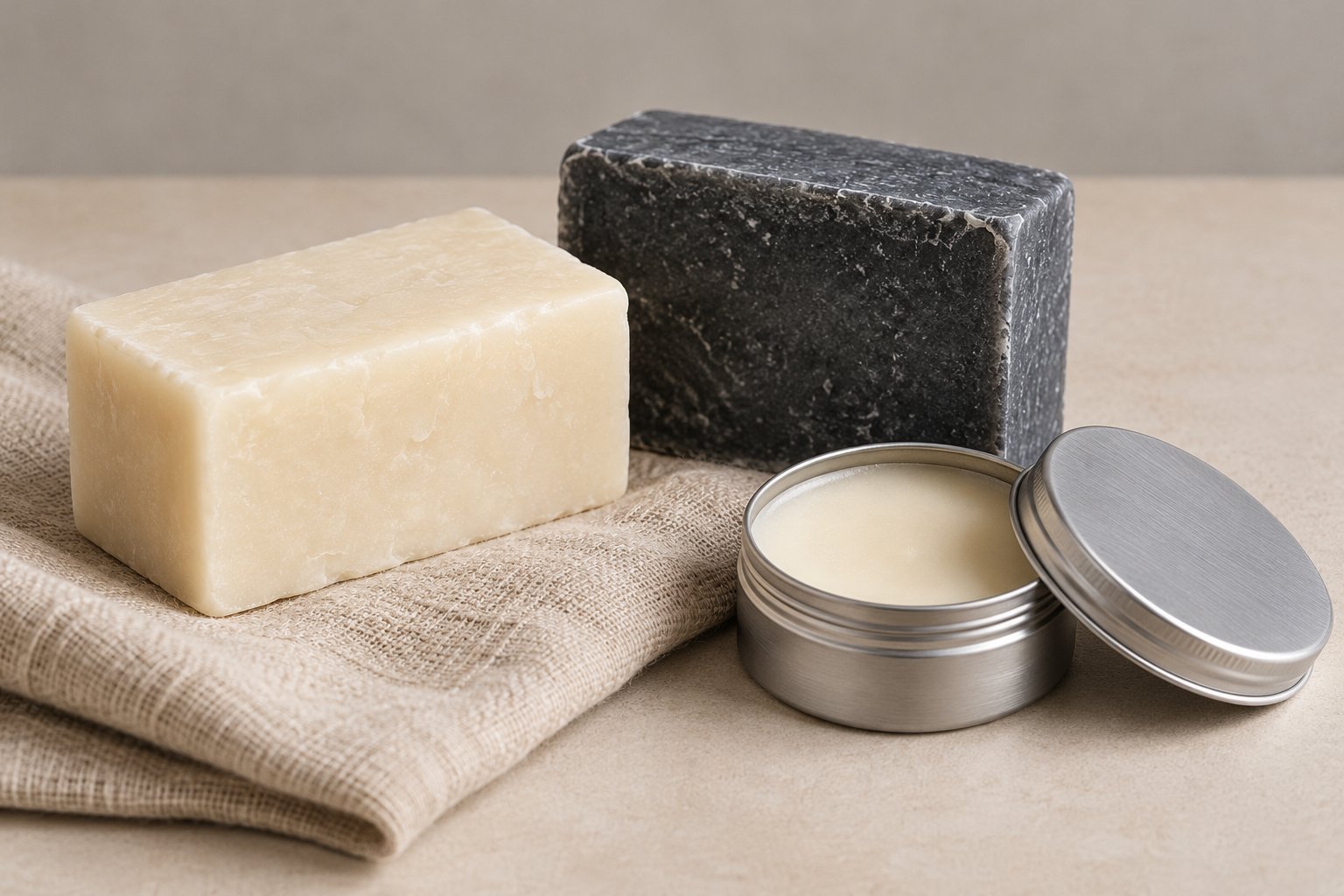
Giftability was called out explicitly in the NIQ data as a driver of bar soap’s revival, and for private label mens soap it maps directly to a bundle. The three-piece set — a cleansing bar, a shampoo or beard bar, and a solid cologne — reads as a complete ritual and lifts average order value versus a single bar. It also gives a new brand a gift and holiday angle from launch day rather than from year two.
From a manufacturing view, the set is efficient: one scent family, three formats, shared packaging and print. It is the lowest-friction way to present a “range” before you actually carry six SKUs. Our men’s grooming kits guide breaks down how bundle MOQs and shared tooling shape your first production run and your cash plan.
Packaging: paper wrap, kraft, and the no-plastic shift
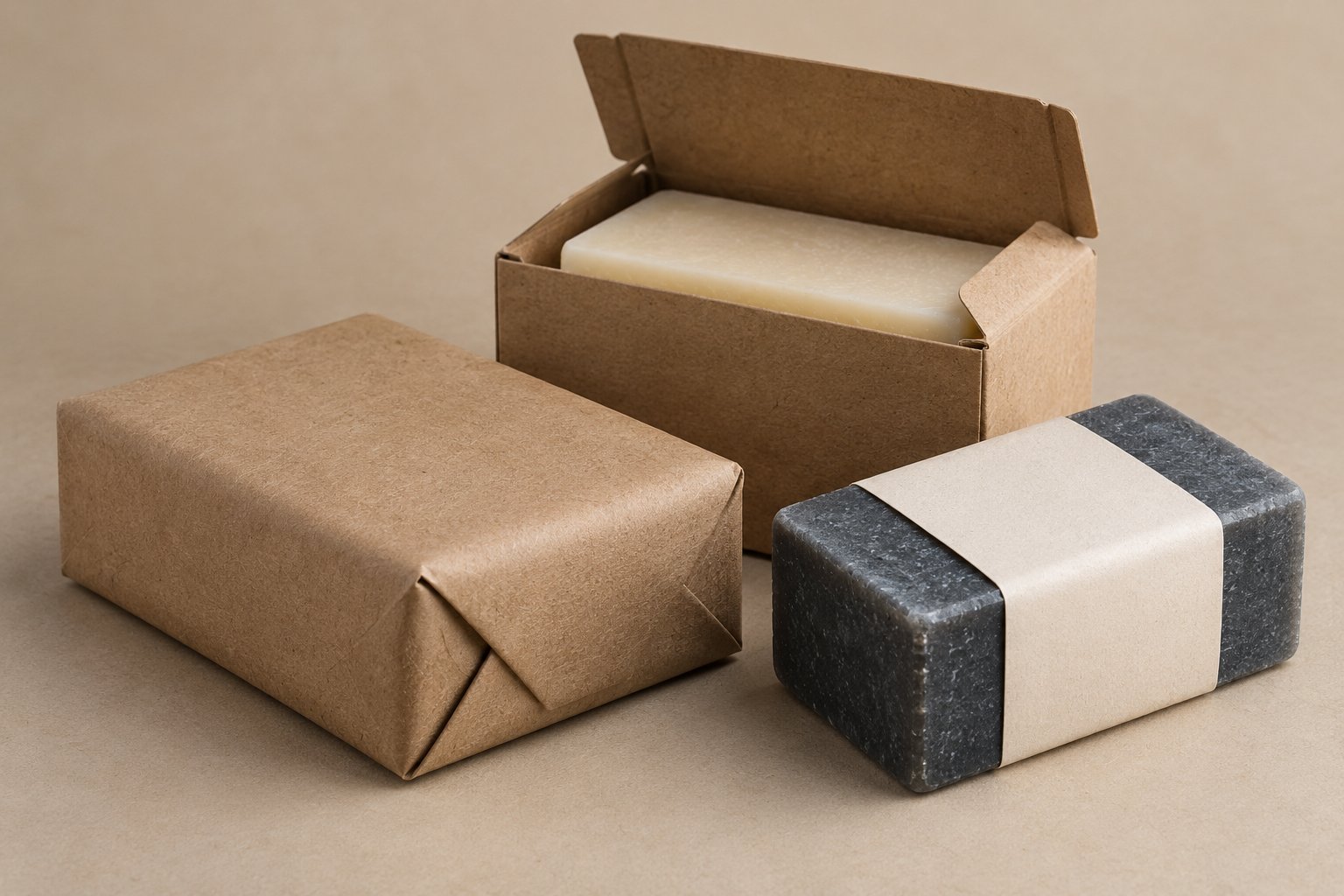
Packaging is where a soap brand wins or loses on the shelf. The 2026 direction is clear: minimal, recyclable, and plastic-light. Paper wrap with a printed band, kraft cartons, and foil-stamped logos read premium without the waste. A die-cut window or a single embossed mark adds tactility that customers remember and that photographs well for e-commerce.
Function still rules: the wrap must protect the bar from weeping and fragrance loss in a steamy bathroom, and the carton must survive shipping. Our packaging minimums guide explains how container and carton MOQs shape your first order, because paper and box tooling often set the real minimums, not the soap itself.
Positioning: natural, performance, premium, or value
Four positions work in men’s bar soap right now. Natural or clean leans on short ingredient lists and “no palm” or “vegan” claims. Performance adds charcoal, clays, or exfoliants for a functional feel. Premium uses milled bars, fine fragrance, and heavy paper stock. Value competes on a multi-bar pack at an everyday price. Your position decides your base, your scent load, and your carton budget — pick one and let it drive the other two.
A body-care brand expanding into men’s lines should match position to its existing audience. If you already sell men’s skincare, a natural or premium bar extends the story cleanly. Our men’s body care guide walks through how to slot a bar into an existing regimen rather than launching it in isolation, which protects both the brand story and the repurchase rate.
Where private label mens soap fits the 2026 opportunity
For a brand planning to expand its men’s body care line, private label mens soap is the lowest-risk hero to add. The category is growing on shelves, the format is cheaper to tool than a pump or aerosol, and a single well-scented bar proves the concept before you invest in a full range. You are not betting on an unproven format; you are entering one that just posted 33% growth in the United States.
The manufacturer side is equally favorable. Bar soap scales on shared lines, fragrance can be tuned to your brief, and packaging can be your own from day one. As a men’s soap manufacturer we flag the real risks early for private label mens soap — weeping, fragrance fade, and carton durability — so they are solved in sampling, not after launch. That is the difference between a draft that ships and a SKU that gets returned to the warehouse.
Decision table: brand profile to soap format to confirmation
Use this table to turn the trends above into a private label mens soap brief you can hand a men’s soap manufacturer. The third column is what to confirm during sampling so nothing surprises you at production or in the warehouse.
| Brand profile | Recommended soap format | Development confirmation items |
|---|---|---|
| New DTC body-care brand, natural focus | Milled or syndet bar, one scent family | Bar hardness, fragrance load, carton MOQ |
| Premium or unisex grooming line | French-milled bar, heavy paper carton | Cure and stability, emboss durability, scent match |
| Gift or holiday brand | Three-piece set: bar + shampoo bar + solid cologne | Shared scent, carton fit, set MOQ |
| Value or mass entry | Multi-bar pack, syndet base | Unit-cost ceiling, wrap integrity |
| Expanding skincare brand | Cleansing bar matched to existing regimen | Scent continuity, claim support |
| Barbershop or salon private label | Single hero bar for live demo | Weeping test, slip feel, label |
Men’s bar soap trends 2026: the bottom line
The 2026 men’s bar soap story is simple: a legacy format is growing fast because it fits natural, giftable, and low-plastic positioning. For private label mens soap, NielsenIQ’s 2025 U.S. data puts bar soap at 33% growth inside a $7.1B category, and that is a market signal worth acting on — provided you confirm search demand for your own region first.
For brands, private label mens soap is the sensible first SKU: low tooling risk, fast to sample, and easy to extend into a three-piece set. Lead with one scent family, choose a format that matches your position, and confirm the packaging and stability risks in sampling before you commit to a production run.
Frequently asked questions
Is men’s bar soap really growing again?
Yes. NielsenIQ’s 2025 U.S. Men’s Grooming Category Overview reports bar soap sales grew 33% year over year, the fastest-growing segment inside a $7.1 billion category. The revival is driven by natural formats, giftability, and a shift toward low-plastic packaging.
What scent should a new men’s soap line use?
Woodsy (cedar, sandalwood), bright citrus (bergamot, grapefruit), and clean-fresh (sea salt, eucalyptus, mint) lead in 2026. Pick one family and carry it across every SKU so the line reads as a single brand. Because a bar throws more scent than a liquid, tune the soap’s fragrance load down to match the rest of the range.
Which soap format is easiest to manufacture?
Milled and syndet bars are the easiest to manufacture at scale: low formulation risk, short lead times, and stable fragrance. Cold-process is true soap with a natural story but needs a 4–6 week cure and tighter storage. Most new lines should start with milled or syndet and add cold-process only if “handmade natural” is the core claim.
Should a brand launch a single bar or a three-piece set?
Launch a single hero bar when you are proving the concept or watching cash. Launch a three-piece set — cleansing bar, shampoo or beard bar, and solid cologne — when you already have an audience, a gift angle, or a retail slot that expects a set. The set lifts average order value and tells a complete ritual story from day one.
Is private label mens soap a good first SKU for a body-care brand?
Yes. Private label mens soap is the lowest-risk hero for a brand expanding into men’s body care: it is cheaper to tool than a pump or aerosol, scales on shared lines, and a single well-scented bar proves the concept before you build a full range. Confirm fragrance, packaging, and stability risks during sampling rather than after launch.
How do I keep fragrance consistent across a soap line?
Choose one scent family at the brief stage and apply it to every SKU, including the bar, shampoo bar, and solid cologne. Because a soap base holds and throws more fragrance than a thin liquid, reduce the bar’s fragrance load to match the line, and confirm the match on skin during sampling rather than trusting the formula on paper.
Inquire about a men’s soap three-piece set and custom development
The fastest way to act on the 2026 men’s bar soap opportunity is to start a private-label men’s soap brief with us. We will propose a men’s soap three-piece set with matching samples, scoped to your market and positioning, so you can test the concept with customers before committing to tooling.
To scope your brief faster, share:
- Your current SKUs and where a soap bar would fit your regimen
- Target positioning — natural, performance, premium, or value
- Sales market and language (so we can validate search and claim fit)
- First-order quantity and target retail price point
As your men’s soap manufacturer we flag the format and packaging risks specific to your market early — including weeping, fragrance fade, and carton durability. Our private-label bar soap buying guide covers what to specify in a supplier brief, and our men’s grooming manufacturer guide covers the wider line-build across categories.