Cosmetics supplier audit checklist discipline is what separates a verified manufacturing partner from a well-designed website. If you are a procurement manager preparing to screen or re-verify cosmetics suppliers in China, the paperwork in front of you — a business license, an ISO certificate, a factory photo set, a sample that performs — proves that documents exist, not that the product you ordered will be made by the entity you paid. This guide works the gap directly: who signs the contract, who actually compounds and fills the product, what the certificates really cover, and who carries production and quality responsibility when a batch goes wrong. Every check below runs from your desk with documents and emails.
TL;DR — what a cosmetics supplier audit checklist must verify
- Verify the contracting entity first. The company on the quotation, the contract, the invoice, and the business license should be the same legal entity. A mismatch between an English trade name and the registered Chinese entity is the most common structural problem in China sourcing.
- Then verify the actual production site. A supplier can be a factory, a trading company, or both. Ask which legal entity holds the manufacturing license and which physical address appears on it — then confirm the two match.
- Read the certificate scope, not the logo. A cosmetics supplier audit checklist treats certificates as scoped documents, not badges: certificates such as ISO 22716 cover named sites, named product categories, and a validity period. No single certificate covers every product or every market — requirements attach to the product category and the destination market, and the applicable set must be confirmed per market.
- Get production and quality responsibility in writing. A quality agreement naming the responsible manufacturer, batch release, deviation handling, and complaint handling is worth more than any certificate on the wall.
- Test traceability and change control before the bulk order. Ask for a complete batch trail against one lot code, and require written notice plus your approval for any change to formula, raw material source, component, or artwork.

What this cosmetics supplier audit checklist covers — and what it does not
A cosmetics supplier audit checklist is a document-verification tool. It confirms who you are contracting with, who produces, what the certificates actually cover, and who answers for quality. It does not replace an on-site audit: a desk review can prove that a system is documented, and only a site visit or a commissioned third-party audit proves the system runs. The honest sequence is to run the checklist first, because it is cheap and it often decides whether the visit is worth booking.
Two framing rules apply to every row of a cosmetics supplier audit checklist. First, evidence beats assertion: “we are a GMP factory” is a claim, a manufacturing license with a matching address is evidence. Second, scope beats presence: a certificate that exists but does not cover your product category, your site, or your market is not verification — it is decoration. Most failed verifications are not fraud; they are documents that were never read closely.
The cosmetics supplier audit checklist at a glance: item, evidence, verification method
The table below is the working core of this cosmetics supplier audit checklist. Each row pairs one verification item with the evidence to request and the method to verify it. The sections that follow explain how to run each row and what a weak answer looks like.
| # | Verification item | Evidence to request | How to verify it | Who supplies it | Risk if unverified |
|---|---|---|---|---|---|
| 1 | Contracting entity | Business license with registered Chinese name, legal representative, business scope; export registration where relevant | Compare the registered name, legal representative, and address across license, quotation, contract, and invoice; check the entity in the public enterprise registry | Supplier provides the license; you run the registry check | You contract with an entity that cannot legally deliver or invoice |
| 2 | Actual production site | Cosmetics production license showing entity and site address; factory layout or recent site photos; recent customer or third-party audit report | Confirm the license address matches the production address on the quotation; ask which entity performs compounding and filling; verify the site exists as described | Supplier provides license and site documents; you cross-check the address | Product is made at an unlicensed site or a different legal person |
| 3 | Qualifications and certificate scope | Full certificate with scope annex pages – not a cover image – naming site, activities, product categories, standard version, validity, certifying body | Read the scope pages against your product category and the producing site; treat any certificate whose scope pages are withheld as unverified | Supplier provides the full certificate; you read the scope pages | Certificate does not cover your category, site or destination market |
| 4 | Production and quality responsibility | Quality agreement or written annex; specification sheet with tolerances; sample certificate of analysis (CoA) showing who signs | Check who is named as responsible manufacturer, who releases batches, who retains samples, and how deviations and complaints are handled | Negotiated between both parties before the first bulk order | No named party answers when a batch fails |
| 5 | Batch traceability | Batch coding scheme; raw material lot records; retained-sample policy with retention period | Pick one lot code from a past shipment and ask for the full trail: raw material lots and their CoAs, production batch record, release record, retained sample | Supplier holds the records; you request one lot trail | A complaint or recall cannot be traced to materials or lots |
| 6 | Change control | Written change-control procedure; contractual clause requiring notice and approval before changes | Check the procedure covers formula, raw material source or grade, components, artwork, process, and site; confirm no change enters production without your written approval | Supplier provides the procedure; the clause sits in your contract | Silent substitutions change the approved product |
| 7 | Subcontracting arrangements | Written statement of which steps are performed in-house and which are subcontracted, with subcontractor names and licenses where regulated | If any step is outsourced, obtain the subcontractor’s license and confirm in the contract that the contracting entity keeps responsibility for the full batch | Supplier discloses in writing; you obtain subcontractor licenses | Quality responsibility gaps at subcontracted steps |
| 8 | Sample-to-bulk consistency | Sealed golden sample of the approved bulk; bulk specification with tolerances; pre-shipment inspection report | Compare bulk against the sealed golden sample on the agreed attributes; book inspection when the run starts, not after it ends | Both parties sign the golden sample; inspection is booked with the run | Bulk goods drift from the approved sample |
1. Verify the contracting entity
Everything else on a cosmetics supplier audit checklist depends on knowing who you are actually contracting with. In China the counterparty can be a manufacturing entity, a trading company, or a group in which the sales office and the factory are different legal persons. Start with the business license: the registered Chinese name is the only name that carries legal weight, and it should appear on the quotation, the purchase order, the contract, and every future commercial invoice. Quoting under an English trade name is normal; contracting under an entity that appears nowhere on the license is not.
Two desk checks settle the entity row of a cosmetics supplier audit checklist in ten minutes. First, read the business license for the legal representative, registered capital, business scope, and establishment date — a scope that does not mention cosmetics manufacturing or cosmetics trading is a conversation to have before any deposit moves. Second, check the registered name against the public enterprise registry, which also shows the entity’s status and public administrative records. Neither check requires more than a translation step, and both cost less than a single wasted sample round. If the bank account on the invoice belongs to a different entity or a different person, stop and get a written explanation before paying.
2. Verify the actual production site
The second row of any cosmetics supplier audit checklist is the physical place where your product will be made. Ask one question in writing: which legal entity holds the cosmetics production license, and at which address is production performed? In China, cosmetics production is licensed to a named entity at a named address, and the license lists permitted product categories — a trading company can hold a valid business license and still produce nothing, with the factory behind it being a separate legal person whose license you should ask to see.
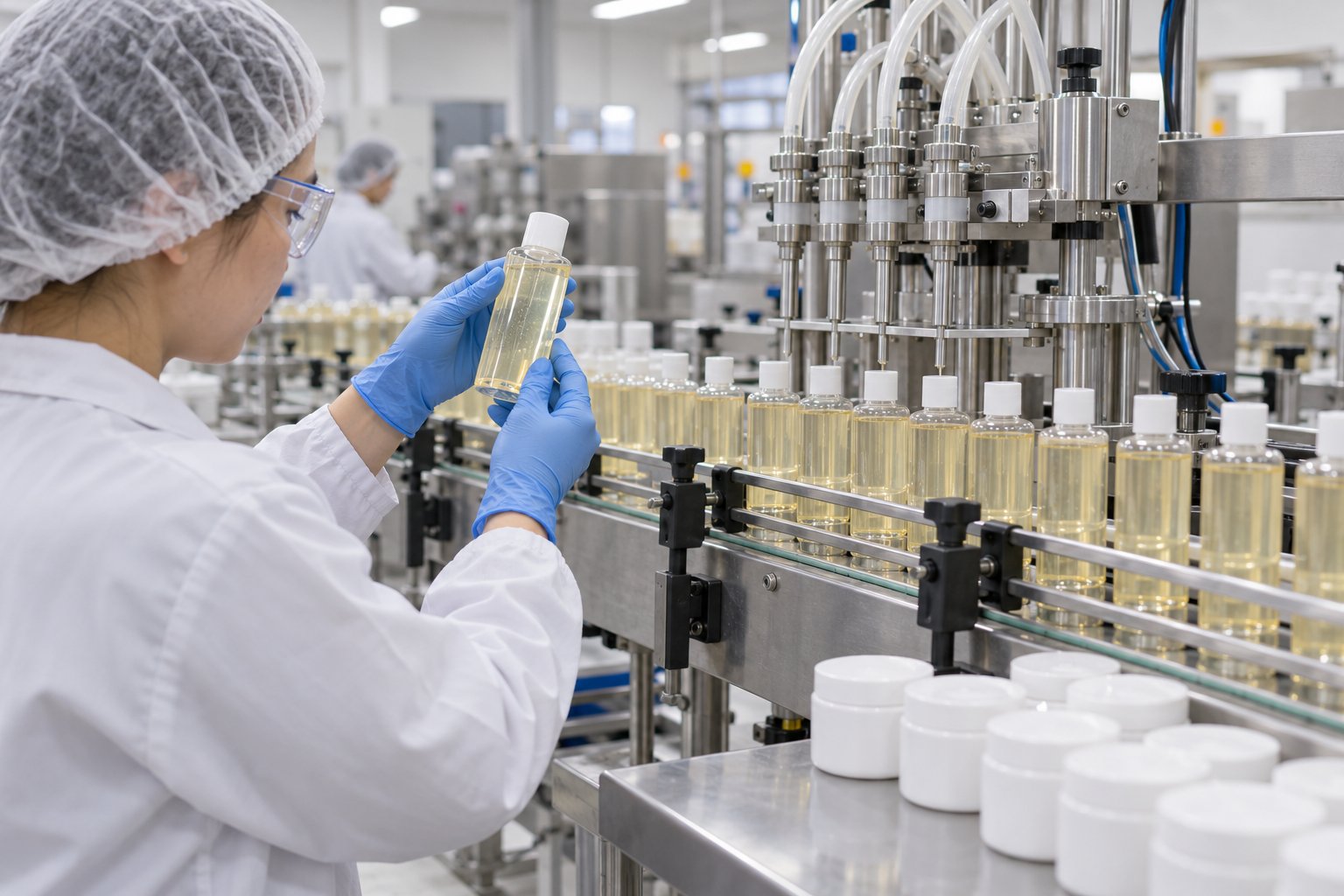
Then close the gap between documents and reality — the step where a cosmetics supplier audit checklist earns its name. The address on the production license should match the production address given in the quotation and on the invoice; a mismatch between a downtown office and an industrial-park factory is common, but it should be explained in writing. Ask for recent site photos or a video walkthrough, a factory layout, and any recent customer or third-party audit report naming the same entity and site. If a supplier will not name the producing entity, treats the question as commercially sensitive, or offers certificates whose scope pages cover a different address, you have your answer without booking a flight.
3. Read the certificate scope, not the logo
Certificates are the most over-read documents in supplier screening, and a cosmetics supplier audit checklist treats them as scoped documents rather than badges. ISO 22716, the cosmetics good manufacturing practice framework covering production, control, storage, and shipment, is a good example: the ISO 22716 GMP framework tells you a site was assessed against a standard — it does not tell you the site is authorized to sell into your market. Read the scope pages, not the cover: the certified site, the activities and product categories covered, the standard version, the validity dates, and the certifying body.
On a cosmetics supplier audit checklist, scope mismatches are the normal failure mode. A certificate held by one site in a group does not cover a second site. A scope limited to skincare does not extend to a hair or colour-cosmetics category. A certificate that expired last quarter is not a certificate. Market compliance is a separate axis again: requirements attach to the product category, its claims, and the destination market, so the applicable document set has to be confirmed per product and per market.
Market examples make the axis concrete. Selling into the EU involves a Responsible Person, notification through CPNP, and a product information file, while in the United States, MoCRA facility registration and product listing obligations sit with the responsible person — typically the brand — rather than with the factory. The UK adds its own responsible person and notification route. These are illustrations of how market requirements work, not a complete map: confirm the applicable set for your product and market, and do not accept any claim that one certificate covers all markets.
4. Production and quality responsibility in writing
A certificate says a site was audited once. A quality agreement says who answers when a batch fails. On a cosmetics supplier audit checklist, responsibility is a document question: which entity is the manufacturer of record, who signs the certificate of analysis for each batch, who holds retained samples, and who leads a deviation or a recall. Put this into a quality agreement, or a written annex to the purchase contract, before the first bulk order — not after the first complaint.
On a cosmetics supplier audit checklist, the minimum clause set is short. A specification sheet with formula identifier, version, and tolerances. Batch release rules stating who releases goods and against what criteria. Deviation and out-of-specification handling with a notification window and joint disposition. Complaint and recall handling naming who leads and how costs split. Records retention: how long batch records and retained samples are kept. And audit rights, so you or a third party can verify the system on site. Check the CoA too: it should be signed by the producing entity’s quality function for the specific batch — a generic letter typed by the sales office is not batch evidence.
5. Batch traceability
Traceability is the item buyers skip and regulators ask about first. A working system means every finished batch can be traced backward to raw material lots and forward to the shipment that carried it. Ask the supplier to describe the batch coding scheme — what the code encodes, typically date, line, and formula version — and then run a live test: pick one lot code from a past shipment and ask for the complete trail. Traceability is also the row of a cosmetics supplier audit checklist that cannot be satisfied by a certificate, because a certificate describes a system while a batch trail demonstrates one.
The complete trail is four documents: the raw material lot numbers used in that batch with their own certificates of analysis, the production batch record naming the line and the responsible operator, the batch release record, and the retained sample. Good suppliers produce this within days, keep retained samples for a stated retention period, and can show it for a reference customer’s code without drama. Weak answers have a recognizable shape: a re-typed summary instead of records, retained samples “not kept for small orders”, or a trail that starts at finished goods and never reaches raw materials. If the trail cannot be produced for one lot code, treat traceability as unverified.
6. Change control
Change control protects the product you approved from quietly becoming a different product. Formula, raw material supplier or grade, component supplier, printing house, and even the filling line are all changes that can alter the finished goods. The requirement in a cosmetics supplier audit checklist is simple and contractual: no change to formula, raw material source, component, or artwork enters production without written notice to you and your written approval, with an agreed lead time for requalification where the change is material.
Ask for the supplier’s written change-control procedure and check that it covers raw materials, components, formula, process, and site — the row of a cosmetics supplier audit checklist most often skipped. A supplier who cannot produce one is managing changes from memory. Watch also for the soft version of the problem: the same formula name on a different raw material grade, the same component from a different mold, the same artwork printed elsewhere. None of those appear in a certificate, and all of them appear in your goods. The clause costs nothing to negotiate at the contract stage and is nearly impossible to retrofit after a bad shipment.
7. Subcontracting arrangements
Subcontracting is common in cosmetics manufacturing and is not disqualifying. Component molding, printing, filling, and assembly can all sit with specialists, and many excellent factories focus on one step. The verification point on a cosmetics supplier audit checklist is disclosure: which steps the contracting entity performs itself, which are subcontracted, and to whom — in writing, with the subcontractor’s name, and with its license where the step is regulated.
Two rules belong in every cosmetics supplier audit checklist contract. First, responsibility does not transfer: the entity you contract with remains responsible for the whole batch, including subcontracted steps, and for producing the subcontractor’s documents on request. Second, no undisclosed subcontracting: adding or changing a subcontractor is a change under your change-control clause. A supplier who answers “everything is in-house” while the license address is a small sales office has answered the question, just not honestly.
8. Sample-to-bulk consistency
The last row of a cosmetics supplier audit checklist closes the loop between the sample you approved and the goods that arrive. Sample-to-bulk consistency means the bulk order is produced to the same formula version, the same raw material grade, the same components, and the same process as the approved sample — and that the comparison is made against a retained reference rather than against memory.
The mechanics are unglamorous. Keep a sealed golden sample of the approved bulk — not the hand-filled lab sample — signed and dated by both parties. Record the bulk specification with tolerances for the attributes that matter: appearance, colour, scent, viscosity, pH, fill weight. Book a pre-shipment inspection against the golden sample when the production run starts, so the check happens while the line is still running. Sampling and revision rounds are where a formula gets approved — the sampling stage of our private label development timeline covers that process — and the golden sample is what carries that approval into production. Where an attribute drifts, the tolerance decides whether the batch passes; a phone call does not.
Manufacturer vs ODM supply-chain partner: who signs, who produces, who answers
The three roles below are often blended together in a sales conversation, and a cosmetics supplier audit checklist keeps them apart. The contracting entity, the producing entity and the party that answers for quality are not automatically the same legal person – in a group structure they frequently are not. None of these models is dishonest by default; the verification point is that the structure is disclosed in writing and the evidence matches it.
| Model | Who signs the contract | Who produces | Who answers for quality | Evidence to request |
|---|---|---|---|---|
| Manufacturer (own factory) | The licensed manufacturing entity itself | The same entity, at the licensed address | The manufacturing entity | Business license plus cosmetics production license naming the same entity and address |
| ODM or development and supply-chain partner | The partner company you brief and pay | Qualified partner manufacturers selected per project | Defined per project in the quality agreement – confirm the responsible manufacturer for your order | Partner factory licenses and certificates, with the producing entity and site named for your order |
| Trading company | The trading entity | A separate factory, often not named on the quotation | Contractually the trading entity; practically whoever the contract names | The producing factory’s license, plus written confirmation of who answers for the batch |
Two habits keep multi-party structures safe. First, ask for the producing entity by name for your order, not for the group in general – a license held by one site does not cover another. Second, when a partner shares documents such as licenses, certificates or audit reports, confirm which legal entity holds each one and which site it covers, and keep that mapping in your supplier file. If a partner will not name the producing entity, that refusal is itself the answer.
The document pack: collect these before the first bulk order
A working cosmetics supplier audit checklist ends in a file, not a feeling. Collect the items below before the first bulk order; each line names the party that normally supplies it, so nothing sits in the gap between you and the supplier.
- Business license of the contracting entity – supplier provides; you verify the registered name in the public registry.
- Cosmetics production license naming the producing entity and site address – supplier provides; you cross-check the address against the quotation.
- Full certificates with scope annex pages – supplier provides; you read the scope against your category, site and market.
- Quality agreement or written annex naming the responsible manufacturer, batch release, deviation and complaint handling – negotiated between both parties.
- Specification sheet with formula identifier, version and tolerances – agreed by both parties.
- Sample batch CoA signed by the producing entity’s quality function – supplier provides.
- Batch coding scheme and one complete lot trail – supplier produces on request.
- Written change-control procedure plus the contractual clause – supplier procedure, your clause.
- Subcontracting disclosure listing outsourced steps and subcontractor licenses where regulated – supplier provides in writing.
- Sealed golden sample and bulk specification signed by both parties – joint.
- Pre-shipment inspection report against the golden sample – booked by you when the run starts.
- Records retention policy covering batch records and retained samples – supplier confirms in writing.
If an item cannot be produced, record it as unverified rather than assumed – the same standard this guide asks you to apply to any supplier, including us.
Red flags that end the conversation
These patterns show up early in a cosmetics supplier audit checklist and are cheap to detect. None of them proves bad intent on its own, but each one should stop the process until it is explained in writing.
| Red flag | What it usually means |
|---|---|
| Quotation entity and contract entity differ, with no explanation | Structural risk — clarify the contracting entity before any deposit |
| Certificate offered as a cover image; scope pages withheld | Scope may not cover your product category or the producing site |
| “Our factory” claimed, but no production license at the quoted address | Trading company, or an undisclosed producing site |
| Refusal to name the producing entity or produce a batch trail | Traceability and site control unverified |
| Price far below comparable quotes, with no explanation of components or formula | Likely downgrade at bulk stage — lock the specification before ordering |
| Hand-finished samples that outperform anything the line produces | Consistency risk — require a bulk-referenced golden sample |
| No written change-control procedure | Changes are managed informally; expect silent substitutions |
| Payment requested to an account belonging to a third entity | Fraud and structural risk — do not pay |
Frequently asked questions
What is the first document to request when verifying a cosmetics supplier in China?
The business license, because it establishes the contracting entity: registered Chinese name, legal representative, business scope, and address. For a factory, the second document is the cosmetics production license showing the licensed entity and site. A cosmetics supplier audit checklist that starts with certificates instead of entities is working backwards — a perfect certificate held by an entity you are not contracting with verifies nothing.
Is ISO 22716 enough to sell my product in the EU or the US?
No. ISO 22716 is a good manufacturing practice framework, not a market authorization. Market obligations attach to the product, its claims, and the destination market: the EU route involves a Responsible Person, CPNP notification, and a product information file, while US MoCRA facility registration and product listing obligations sit with the responsible person, typically the brand. Confirm the applicable document set per product and per market, and treat any supplier claim that one certificate covers all markets as a red flag.
How do I confirm the factory that produces my order is the factory I audited on paper?
Match three things: the entity on the production license, the address on that license, and the site named in recent audit reports or site documentation. This is the row of a cosmetics supplier audit checklist that trading companies fail most often. Then test operationally — ask for a batch trail against one lot code and a signed batch CoA. Documents name the site; only batch records show the site running. Where the stakes justify it, commission an on-site or third-party audit before the bulk order.
What should a change-control clause require?
Change control turns a cosmetics supplier audit checklist from a screening exercise into a standing control. The clause itself requires written notice and your written approval before any change to formula, raw material source or grade, component, artwork, or production site enters production, with an agreed requalification window for material changes. Ask for the supplier’s written procedure as well as the clause: a contract clause without an internal procedure is enforced by memory, and memory is where substitutions live.
Can a supplier subcontract part of the production, and is that acceptable?
Yes, and it is common for steps like molding, printing, or filling. What matters is disclosure and continuity of responsibility: the subcontracting arrangement should be stated in writing, the subcontractor’s license obtained where the step is regulated, and the contract should keep the contracting entity responsible for the full batch. Undisclosed subcontracting should be treated as a change-control breach.
How do I keep the bulk order consistent with the approved sample?
Anchor the comparison to a sealed golden sample of the approved bulk, signed and dated by both parties, and write the specification with tolerances for the attributes that matter. Then verify against that reference: a pre-shipment inspection booked when the run starts, checking fill weight, appearance, colour, scent, and label placement. A cosmetics supplier audit checklist that ends at sample approval has verified half the project.
Discuss Your Supplier Verification Requirements
If you are screening or auditing cosmetics suppliers in China, the fastest way to put this cosmetics supplier audit checklist to work is to send us your situation. Tell us the product category and format, the target market or markets, and where you are in the process — first screening, an active audit, or a re-verification after a problem — and we will return the applicable document list for your product and market, including which items sit with the factory and which with you as brand owner. If quantities are in view, our private label MOQ guide explains how packaging minimums shape the first order, and our OEM and ODM product pages set out what we develop and supply.
One point of transparency, because it is the same point this article asks you to verify in others. BUNJOIN operates as a development and supply-chain partner, not as a factory. We develop formulations and manage production with partner manufacturers, and when we share partner documents — licenses, certificates, audit reports — those documents belong to the partner factory. We will always tell you which legal entity holds each license and which site performs production for your order, and we do not present partner factory certificates as our own factory proof. Where a document must sit with you, for example a responsible person arrangement or a market listing, we will say so plainly rather than implying a certificate covers it.
To discuss your supplier verification requirements, share:
- Product category and format, and any claims you plan to make
- Target market or markets, since this sets the applicable document set
- Your stage: first screening, active audit, or re-verification
- Estimated first-order quantity, if you have it