Private Label Grooming Samples: A Checklist Before Production Approval
Private label sample approval is the decision that turns a sample you like into a bulk order you can sell — and the step most brands run on feel and email instead of records. If you are holding a second- or third-round sample from your supplier, the pattern will be familiar: the texture is right, the scent is close, the jar looks good, and yet nobody can say which formula version was tested, who signed off, or what happens if the pump changes at bulk. This article is the approval layer that sits underneath every grooming category — clay, paste, oil, balm, wash, spray, soap — written for brands that are already in sampling, not teams still choosing a base.
TL;DR — what private label sample approval must record before production
- Confirm eight items in writing: formula version, fragrance, usage experience, net content, packaging and pump, label artwork, necessary testing, and shipping adaptation.
- Every item needs a record, not an opinion: what was checked, the result, the responsible person, and the approval status — “looks good” in an email thread is not a private label sample approval record.
- Sample experience cannot replace safety or compliance work. The applicable testing set is determined by the product and the destination market, not by how the sample feels in the hand.
- Keep a retained sample of the approved bulk — sealed, signed, and dated — and compare production against that reference, not against memory.
- No change ships silently: formula, raw material, component, pump, or artwork changes enter bulk production only with written notice and your approval.

What private label sample approval covers — and what it does not
Private label sample approval is a cross-category decision layer. It does not care whether the product is a wax, an oil, or a wash; it asks one question per item — is this specific version of this specific product confirmed, recorded, and signed? The category-specific work sits underneath it: our hair clay quality testing guide is the worked example of product-level testing, with seven failure modes and the methods that catch them. A cosmetic pre production sample checklist like the one below is what turns those test results into a decision you can defend to a retailer, an auditor, or your own team six months later.
Equally important is what private label sample approval does not do. It is not a safety assessment and not a compliance file: a sample can feel superb and still fail a stability study, a microbiological challenge, or a market’s documentation requirements. It is also not supplier verification — confirming who actually produces your product is a separate exercise, covered in our cosmetics supplier audit checklist. And it is not a marketing sign-off: claims, positioning, and artwork belong inside the process, but the approval record exists so that the product you approved is the product that ships.
The private label sample approval checklist at a glance
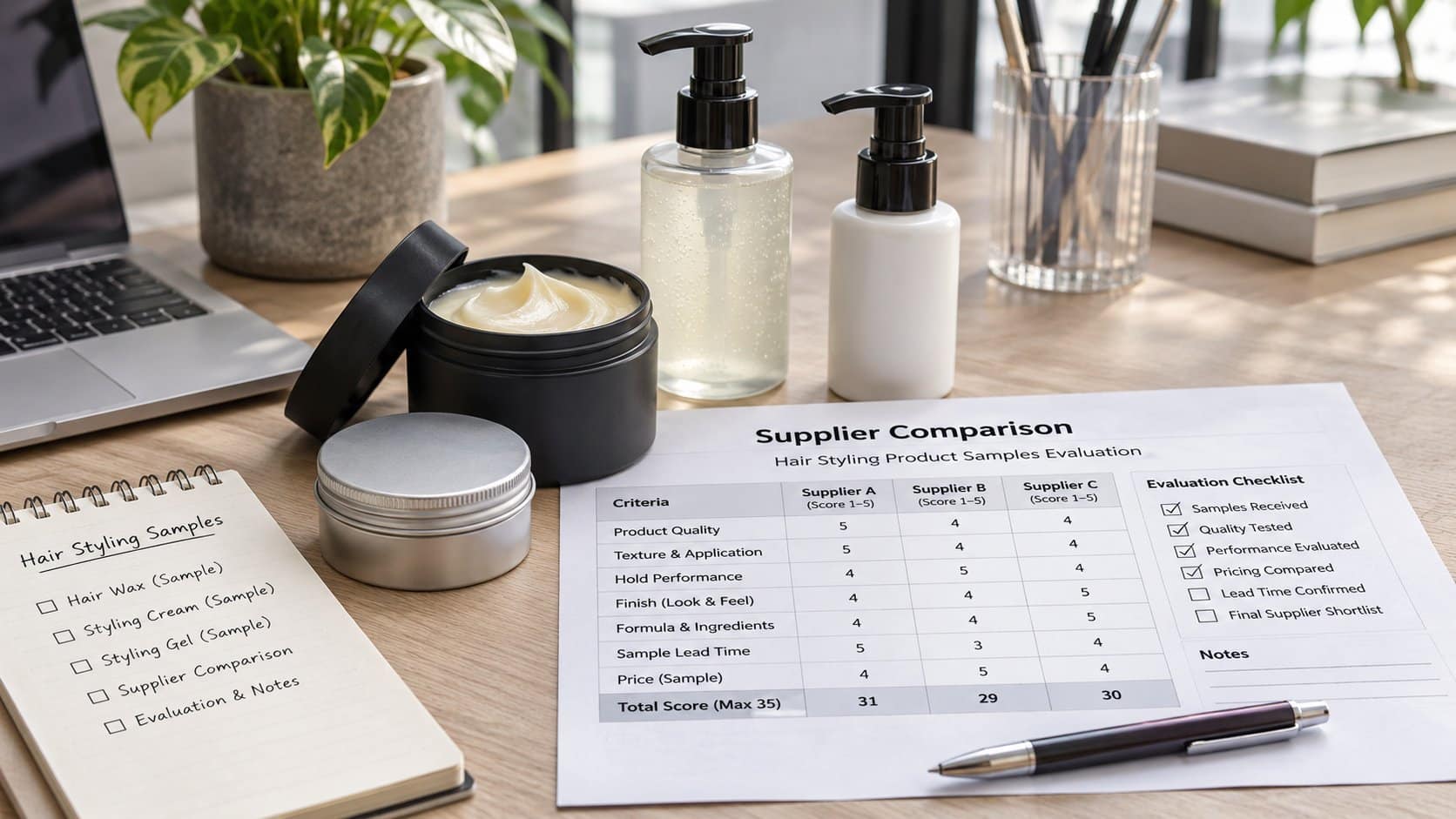
The table below is the working core of this private label sample approval checklist. Each row pairs one confirmation item with what to record, who owns it, and the status it can carry. The sections that follow explain how to run each row, what a weak answer looks like, and which failure each row prevents. Use the status column literally: every item is pending, approved, or rejected on a given date, by a named person — never blank.
| # | Confirmation item | What to record | Responsible | Approval status |
|---|---|---|---|---|
| 1 | Formula version | Formula code and version, round number, sample date, specification sheet reference, who compounded the sample | Brand technical owner + supplier R&D | Pending / Approved / Rejected |
| 2 | Fragrance | Fragrance name or code, dosage in the finished base, allergen-relevant data, fragrance supplier documentation | Brand technical owner + supplier R&D | Pending / Approved / Rejected |
| 3 | Usage experience | Standardized application dose, texture, spread, finish, performance versus benchmark, panel notes | Brand product or marketing owner | Pending / Approved / Rejected |
| 4 | Net content | Declared net content, line-fill target, tolerance, measured fill on the approval sample, fill method | Brand + supplier production | Pending / Approved / Rejected |
| 5 | Packaging and pump | Component specification and supplier, pump model and dosage, closure torque, leakage and drop-test results | Brand packaging owner + supplier production | Pending / Approved / Rejected |
| 6 | Label artwork | Artwork version and date, claim list, ingredient list source, market-required elements, print house confirmation | Brand regulatory or marketing owner | Pending / Approved / Rejected |
| 7 | Necessary testing | Required test scope for the product and market, who runs each test, reports on file, decisions where a test is not required | Supplier QA + brand regulatory owner | Pending / Approved / Rejected |
| 8 | Shipping adaptation | Transport simulation conditions and results, temperature range, leakage and label condition after simulation | Supplier production + brand logistics | Pending / Approved / Rejected |
1. Formula version
Identity is the first gate of private label sample approval: which formula, which version, made when, by whom. A sample without a version identifier is a conversation, not a sample — because round three and round four can differ by a thickener adjustment nobody wrote down, and the difference only shows up after ten thousand units. Require the formula code and version number on the sample container or its accompanying sheet, together with the round number, the sample date, and the specification sheet the sample was made against.
Record also who compounded the sample. A hand-filled lab sample and a line-filled sample from the same formula are different evidence: the first shows what the formula can do, the second shows what the process does. Where the approval sample was made in the lab, note it, and make the final approval round against line-filled product from production components — the same point our supplier audit checklist makes when it asks for a golden sample of the approved bulk rather than the lab original.
2. Fragrance
Scent is the attribute brands judge fastest and document worst. “Same as last time” is unverifiable unless the fragrance carries a name or code and a dosage. Record the fragrance oil’s identity, its concentration in the finished base — not in the neat oil — and the supplier’s documentation for it. Concentration matters because the base changes the scent: a heavier wax or a richer oil masks top notes, so the same oil at the same dosage can read differently between formula versions.
Two documentation items belong in the private label sample approval record here. First, the fragrance’s allergen-relevant data: several markets require declared fragrance allergens on the label above defined thresholds, and the label cannot be drafted without it. Second, the stability expectation — scent drift over shelf life is a testing question, covered in the testing row, not a sensory one. If the fragrance changes between rounds, that is a formula change under your change-control rules, not a detail.
3. Usage experience
Usage experience is what the sample round is for, and it is the item most often recorded as “felt great.” Structure it instead. Fix the application dose, the substrate, and the conditions before anyone comments: a standardized amount on the same hair or skin type, at a stated temperature and humidity, scored by at least three people against the benchmark you named in the brief. Record texture, ease of application, spread, finish, performance over time, and wash-out or removal feel — the same attributes every time, so round two can be compared with round three.
The trap is the hand-finished sample. A lab sample whipped up by a chemist will outperform anything the filling line produces, so a strong demo on a hand-filled jar proves the formula, not the product. This is why the category testing work — the seven clay failure modes in our hair clay quality testing article, for example — exists, and why the approval round in a private label sample approval should run on line-filled units from production components. Sensory approval and tested performance are two different rows in the checklist; do not let one stand in for the other.
4. Net content
Net content is a cost line and a compliance line at once. The label declares a volume or weight; the line delivers a distribution around a target; the tolerance decides what a customer actually receives and what a market inspector sees. Record the declared net content, the line-fill target, the tolerance, the measured fill on the approval sample, and the fill method — volumetric or by weight. A private label sample approval that records only the declared number has recorded the marketing figure, not the product.
Two practical notes. First, overfill is a silent cost: two millilitres of overfill on a 100 ml unit across a 10,000-unit run is 20 litres of product given away, every run. Second, for pump and spray formats, record dosage per actuation as well as total content, because “it ran out too fast” complaints are usually dosage and perceived value rather than fill weight. Where the sample was hand-filled, mark the fill as indicative and re-confirm it on a line-filled unit before approval.
5. Packaging and pump
In a private label sample approval, packaging is half the product, and the pump is where half the packaging risk lives. Record the component specification and its supplier — bottle or jar, material, capacity, wall thickness, colour, closure — and the pump model with its measured dosage and spray or flow pattern. Then record the mechanical results that belong on the approval path: closure torque, leakage upright and inverted, actuation count against declared content, and drop-test outcome on the filled unit.

Compatibility belongs in the same row. The formula must live with the component for the whole shelf life: no swelling, no stress cracking, no corrosion of pump springs or valves — salt-based styling products are a known offender here, as our sea salt spray formulation breakdown documents. And watch the substitution trap: a pump from a different mold, or the same model from a second source, can change dosage and fit without changing its name. Require the production component in the final approval round, and treat any component change as a change under your change-control clause.
6. Label artwork
The private label sample approval record should carry the artwork version and date, the claim list, the source of the ingredient list, and the market-required elements — net content, batch code, period-after-opening or expiry marking where applicable, and responsible-person or importer details for markets that require them. Claims carry their own burden: wording such as “dermatologist tested”, “hypoallergenic”, or “natural” is regulated or scrutinised differently by market, so the claim list should be settled before plates are cut, not after.
The sequencing rule prevents the most expensive artwork failure: freeze the formula version first, then approve the label against that version’s ingredient list, then release printing. A label approved before the formula is frozen will eventually disagree with the ingredient list on the shelf, and reprinting is the cheapest outcome. Record the print house and the plate or cylinder version as well, because “same artwork, different printer” is a change that can move colour, adhesion, and finish.
7. Necessary testing — what sample experience cannot replace
This is the row where a cosmetic pre production sample checklist earns its keep. A sample can feel excellent and still be unstable, contaminated at fill, or unsellable in the destination market. The testing scope is determined by the product and the market — not by how the sample performs in the hand, and not by whatever package the supplier offers by default. Leave-on and rinse-off products, water-containing and anhydrous formulas, emulsions and suspensions, and products with functional claims all sit in different risk classes, and the required set follows from the product’s own characteristics.
Market requirements sit on a separate axis. Selling into the EU involves a responsible person, notification through CPNP, a product information file, and a safety assessment; the United States under MoCRA puts facility registration, product listing, and safety substantiation obligations on the responsible person — typically the brand — with the FDA’s cosmetics resources as the reference point. The UK adds its own responsible person and notification route. These are illustrations of how the axis works, not a complete map: the applicable document set must be confirmed per product and per market, and a claim that one certificate or one test report covers everything is a red flag.
The approval rule is procedural. In a private label sample approval record, the testing row states which tests are required for this product in this market, who runs each one, which reports are on file, and the date. Where a test is genuinely not required, record that decision and its basis too — an empty cell is indistinguishable from an oversight. And “we tested it” is not evidence; the report is. Approval may be conditional on outstanding reports, but the condition and its owner must be written down, with a date.
8. Shipping adaptation
Shipping adaptation is the private label sample approval row that fails latest — after the bulk order, when the cost of fixing it is highest. The product has to survive the lane, not the shelf: containers see temperature swings a warehouse never will, plus vibration, stacking pressure, drops in handling, humidity, and — on air freight — altitude effects on sealed or pressurised packs. Record the transport simulation conditions and results for the final package: product, component, closure, and label together, because failures happen at the interfaces. Leakage after vibration, label lift after humidity exposure, and scuffed or cracked components after drop testing are the three that most often surface after the bulk order, not before.
Match the simulation to the actual lane. A summer sea-freight route to a tropical port is a different test from a winter air-freight run, and the approval record should name the lane — or the worst-case lane — the pack was qualified against. Where a retail display or secondary carton is part of the sale, include it: the unboxing experience is part of shipping adaptation, and a crushed carton undoes a perfect jar.
Approval records: modifications, approver, retained samples
A private label sample approval is only as good as its records, and a complete record has five fields per item: what was checked, the result, the responsible person by name and role, the date, and the status with its evidence — a photo, a report, a specification, a measurement. Add a modification log across rounds: what changed since the previous version, why, who requested it, and which version the change produced. Six months later, that log is the only way to answer “which sample did we approve?” without guessing.
The approver is a named person with authority, not a department. Brand-side and supplier-side countersignature on the final approval round is the practical standard: the brand confirms the product is what it ordered, the supplier confirms it is what it will produce. Approval attaches to a version, not to a product line — round three approved does not mean round four approved.
Retained samples close the loop. Keep the approved sample sealed, signed, and dated, stored under stated conditions, and retained through the product’s shelf life plus a buffer — retention periods vary by market and by your own quality system, so confirm the applicable requirement rather than assuming. The retained sample is the reference the bulk order gets compared against; without it, sample-to-bulk consistency is a matter of opinion, as the supplier audit checklist notes when it asks for a sealed golden sample rather than a memory.
Bulk change rules
A private label sample approval holds only if the product stops changing. The bulk change rule is one sentence: no change to formula, raw material source or grade, component, pump, artwork, or filling line enters production without written notice to the brand and the brand’s written approval, with an agreed requalification window where the change is material. Put it in the purchase contract or the quality agreement — the sampling stage of our private label development timeline is the natural place to negotiate it, and it is nearly impossible to retrofit after a bad shipment.
Watch for the soft versions of change, because they do not look like changes: the same formula name on a substituted raw-material grade, the same component from a second mold, the same artwork printed at another house, a “minor” pump tweak to solve a leakage problem. Each one can move the product away from the approved sample while every document still matches. Ask for the supplier’s written change-control procedure alongside the clause — a clause without a procedure is enforced by memory, and memory is where substitutions live.
Red flags in sample approval
These patterns show up early in a private label sample approval and are cheap to detect. None proves bad intent on its own, but each should stop the process until it is explained in writing.
| Red flag | What it usually means |
|---|---|
| Sample approved by a “looks good” email with no records | The approval cannot be repeated, defended, or compared against bulk |
| No formula version on the sample or its sheet | Later rounds can drift invisibly; identity is unverifiable |
| Label artwork approved before the formula version is frozen | Ingredient-list mismatch at print; reprint or mislabeling risk |
| Pump or component swapped between sample and bulk without notice | Dosage, fit, and leakage risk — a change-control breach |
| Net content declared from the hand-filled sample only | Overfill cost or underfill exposure once the line runs |
| Testing deferred until after the purchase order | Compliance risk lands after money is committed |
| No retained sample kept after approval | No reference for sample-to-bulk comparison at production |
Frequently asked questions
What is private label sample approval?
Private label sample approval is the documented decision that a specific version of a product — formula, fragrance, packaging, label, and tested performance together — is confirmed for production. It converts “the sample feels right” into a record with confirmation items, results, responsible persons, and approval statuses, so the product that ships is the product that was approved. It is the decision layer above product testing and supplier verification, not a replacement for either.
Can I approve a sample based on usage experience alone?
No. Usage experience is one row of the private label sample approval checklist, and it cannot substitute for the safety or compliance work a product needs before sale. A sample that feels excellent can still fail stability, microbiological, or compatibility testing, and the applicable testing set is determined by the product and the destination market rather than by sensory results. Sensory approval and tested performance are recorded separately, and both must reach an approved status before production.
What records should a private label sample approval include?
For each confirmation item: what was checked, the result, the responsible person by name and role, the date, and the approval status with its evidence. Across rounds: a modification log stating what changed, why, who requested it, and which version resulted. And physically: a retained sample of the approved product, sealed, signed, and dated. If the record cannot answer “which version was approved, by whom, on what evidence,” it is not an approval record.
How long should retained samples be kept?
Common practice is to retain the approved sample through the product’s shelf life plus a buffer, so the reference still exists while product is on the market, but retention obligations vary by market and by your own quality system — confirm the requirement that applies to your product and market rather than assuming a number. Store retained samples under stated conditions, because a sample stored in a hot warehouse is a poor reference for a stability question.
What changes require re-approval before bulk production?
Any change to formula, raw material source or grade, component, pump, artwork, or filling line should trigger written notice and re-approval before it enters production, with a requalification window where the change is material — at that point the private label sample approval no longer covers the product, and a new round is required. The soft versions count too: a substituted raw-material grade under the same formula name, a component from a second mold, artwork moved to a different print house. If a change can move the product away from the approved sample, it is a change.
How does private label sample approval differ from product testing such as hair clay quality testing?
Product testing asks whether the product performs and survives — the seven clay failure modes, stability, compatibility. Private label sample approval asks whether the decision was made properly: which version, confirmed by whom, on what evidence, with what status, and what happens when something changes. The two work together: the testing results are evidence inside the approval record, and the approval record is what carries the tested sample into production.
Request a Sampling Plan
If you have samples in hand — or a sampling round about to start — the fastest way to put this private label sample approval checklist to work is to send us your situation. Tell us the product category, the target effect you are after, your packaging requirements, and the market or markets you are selling into. We will return a sampling plan that applies this checklist to your category: the confirmation items to run, the testing scope your product and market require, the records template, and the change-control rules for the bulk order.
One point of transparency, because it is the point this article asks you to apply to others. BUNJOIN operates as a development and supply-chain partner, not as a factory. We develop formulations and manage production with partner manufacturers, and testing scope is confirmed per product and per market — where a document must sit with you as brand owner, for example a responsible-person arrangement or a market listing, we will say so plainly rather than implying a certificate covers it. If quantities are coming into view, our private label MOQ guide explains how packaging minimums shape the first order, and our OEM and ODM product pages set out what we develop and supply.
To scope your sampling plan faster, share:
- Product category and format, and the target effect (matte, natural, shine, hold level)
- Packaging requirements: component type, pump or closure, and any existing tooling
- Target market or markets, since this sets the testing and documentation scope
- Where you are now: first sample, revision round, or pre-production approval