Private label hair products fail at the supplier decision more often than they fail at the formula. A brand that picks its hair styling product manufacturer on portfolio size and unit price discovers the real cost later: samples that never quite match the bulk, packaging minimums that double the first order, compliance documents that surface only after the purchase order, and a quality system nobody on the call can describe.
The six-factor checklist below is built for the moment before any of that happens. It scores a supplier on what they can prove in writing — not on what they show you — and it ends with the two numbers that turn a shortlist into a real quote: your SKU list and your estimated quantity per SKU. It is written for hair, but the same six factors score any private label grooming products supplier; only the weights move.
TL;DR — what to ask before choosing a private label hair products supplier
- Score six factors, not impressions: formula capability, samples, packaging, compliance documents, batch QC, and supply responsibility — each rated on written evidence, never a sales answer.
- Ask for documents, not assurances: formula version control, sample sheets, component specifications, certificate scope, batch records, and the change-control clause.
- Compliance documents are the deal-breaker factor: a supplier who plainly names what stays with you as brand owner is safer than one who promises “everything is handled”.
- Weight the scorecard: 25% formula capability, 20% compliance documents, 15% each for samples, packaging, and batch QC, 10% supply responsibility — with a minimum score per factor.
- Close with numbers: submit your SKU list and estimated quantities; a private label hair products supplier who cannot quote against that is telling you something.
What this private label hair products checklist covers — and what it does not
This is a supplier-selection checklist. It answers one question: which of the suppliers on your shortlist should receive your first order. It sits before formulation work starts, and it is deliberately narrower than the other guides on this site. Our complete OEM/ODM guide to hair styling products covers the category and the project — how a brief becomes a shipment, what moves a quote, which product to launch first. This article assumes you have read that, or something like it, and now have three to five supplier names to separate. For private label hair products, this is the gate with the highest leverage: sampling, packaging, and compliance all inherit the supplier you pick here.
It is also not the cosmetics supplier audit checklist, which verifies a supplier you have already engaged — certificates, production claims, on-site evidence. And it is not the private label sample approval checklist, which governs the decision to release bulk once samples exist. Sequence matters: a supplier weak on formula capability cannot fix that at the sampling stage, and a supplier weak on compliance documents cannot retrofit them after the purchase order. Separating private label hair products suppliers is where those failures are still cheap to catch: a supplier chosen well turns the audit and the approval rounds into formalities, and a supplier chosen badly turns them into archaeology.
One definition before the questions. A “hair styling product manufacturer” here means the party that will actually compound and fill your product — whether they call themselves a factory, a manufacturer, or a development partner. Trading companies and brokers can be legitimate intermediaries, and many good private label hair care projects run through one. But in private label hair products every question below must eventually be answered by the party that owns the mixing tanks and the filling line, and you should know which of the two you are scoring. A contact who will not say whether they compound in-house has already answered the question.
The supplier comparison checklist at a glance
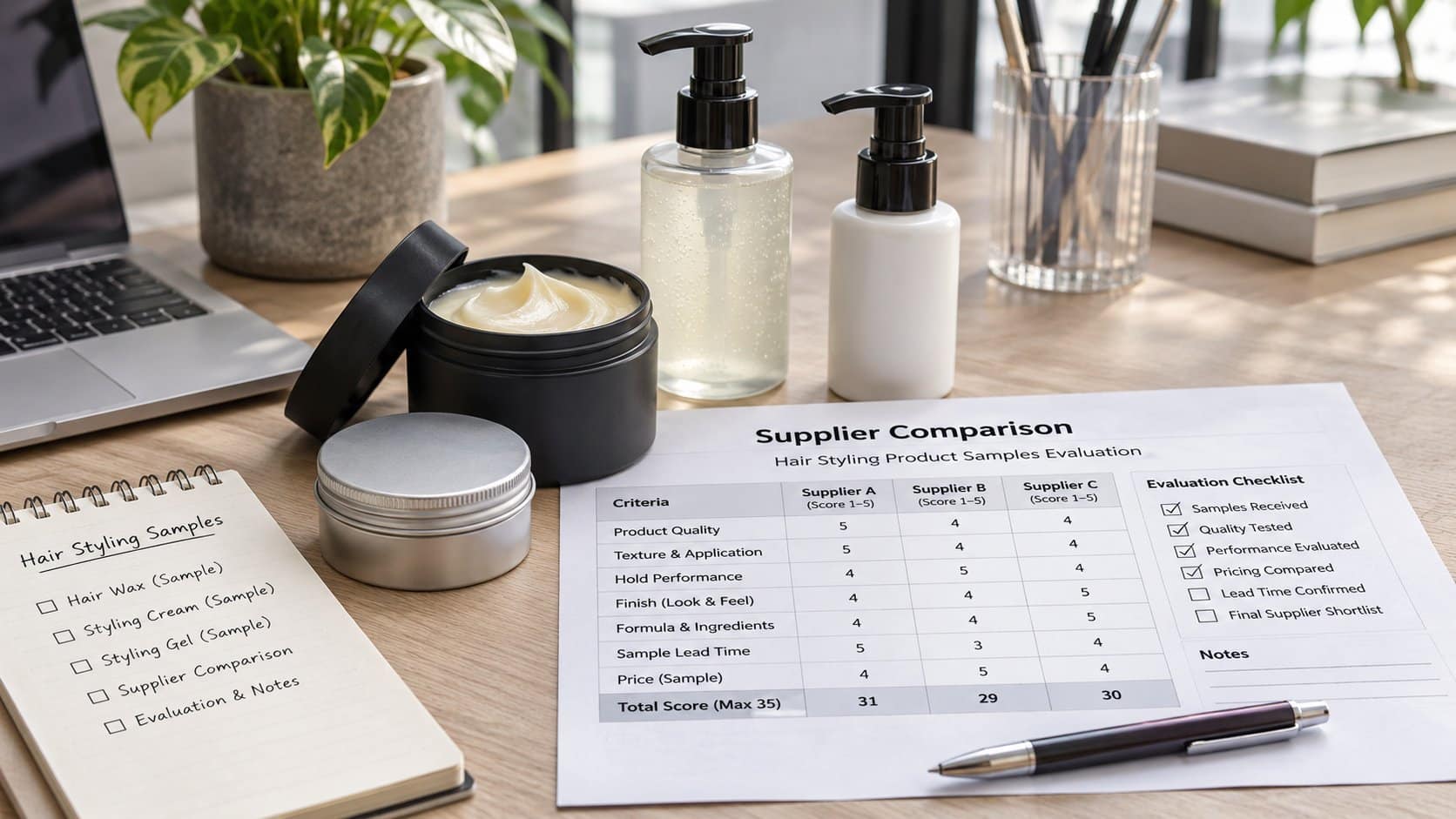
The table below is the working core of this private label hair products supplier checklist. Each factor carries a weight, and each supplier is scored 0 to 3 per factor on written evidence: a 3 means the answer arrived as a document, a procedure, or a named person; a 0 means the answer was a reassurance. The sections that follow give the exact questions to ask under each factor, what a strong and a weak answer sound like on a private label hair products shortlist, and which failure each factor prevents. Use the evidence column literally — a factor scored without a document on file is a factor scored on impression.
| # | Factor | Weight | Score 3 — strong | Score 0–1 — weak | Evidence to request |
|---|---|---|---|---|---|
| 1 | Formula capability | 25% | In-house chemists, a proven hair base portfolio with performance data, documented customization rounds | A generic cosmetics catalogue, “we can copy anything”, no named formulator | Base list with hold and finish data, one customized-round example, R&D roles |
| 2 | Samples | 15% | A defined sampling procedure, version-coded sample sheets, a line-filled final round | “Free samples” with no formula code, unlimited revisions, lab-only demos | Sampling procedure, sample sheet template, sample timeline and cost |
| 3 | Packaging | 15% | Component specifications with sources named, decoration methods and MOQs stated, compatibility testing | Stock catalogue only, unknown component sources, no compatibility data | Component spec sheets, decoration MOQ list, compatibility test method |
| 4 | Compliance documents | 20% | Certificate scope explained honestly, per-batch COA offered, market documents mapped | “We handle everything”, certificates nobody can produce, market duties blurred | Certificate copies, a sample COA, a market-document matrix |
| 5 | Batch QC | 15% | A QC plan across incoming, in-process, and finished stages, batch traceability, retained samples | “We check quality”, no batch records shown, audit access refused | QC plan, one redacted batch record, retained-sample policy |
| 6 | Supply responsibility | 10% | Capacity stated against your volume, a change-control clause, a named escalation contact | Lead times quoted from memory, substitution never mentioned, no quality agreement | Capacity statement, quality agreement template, escalation chart |
Two rules make the checklist work on any private label hair products shortlist. First, no factor scores on a call: whatever the sales contact says must arrive as a file, a photo of a record, or a clause in a draft agreement before it counts. Second, the weights are not decoration — formula capability and compliance documents carry 45% between them because those are the two failures that cannot be corrected once the order is placed.
1. Formula capability — can they build hair products, or just cosmetics?
Hair styling is its own discipline inside cosmetics. A supplier excellent at body wash can still be lost on a private label pomade, because the performance targets — hold without flaking, matte finish without drag, restyleability, wash-out with ordinary shampoo — are judged on hair, on live heads, in ways a skin-care stability panel will never show. The questions below establish whether the hair work behind your private label hair products is real.
Ask: Which hair bases do you currently run, and what hold level and finish does each deliver? A strong answer is a list — water-based pomade, wax, clay, paste, cream, gel, spray, powder — with the performance profile of each and, ideally, the client categories they were developed for. A weak answer is “whatever you need”, because a base that does not exist cannot have been tested. For private label hair products, the base list is the first document to request — before pricing, before samples, before anything else. Follow up by asking which bases were developed in-house versus bought as a finished formula, and who the formulating chemist is by name and role.
Ask: Show me one customization round, start to finish. In private label hair products, customization is the actual product you are buying: the difference between a catalogue base and your brand’s product is the adjustment loop — hold raised, whitecast removed, fragrance swapped, thickener rebalanced. A capable supplier can walk you through one round with the sample versions, what changed, and why, including the round that went backwards. A supplier with no customization story is selling you their base with your label on it, which is a legitimate product — but it is not development, and you should price it accordingly.
Ask: How do you test hair performance, not just stability? Hold, flaking, residue, shine level, and washability are measured by methods, not opinions: standardized application on defined hair types, hold-hour scoring, gloss readings, combing-force or residue assessments. Stability and microbiological testing are table stakes and sit in the compliance factor below; what you are probing here is whether anyone has held the product in their hands and scored it against a benchmark. The seven failure modes in our hair clay quality testing guide are a useful reference list for private label hair products — a supplier who recognizes them has done this work before.
Finally, ask about raw-material transparency: which grades and suppliers sit behind the key functional materials — the waxes, the fixative polymers, the texturizing powders — and whether a grade can change without notice. Grade substitution is the quiet way a private label hair products formula changes while every document still matches, and it is the same issue the change-control clause in the supply factor exists to catch.
2. Samples and the sampling process — what the process tells you before you commit
Samples are where supplier quality becomes visible, and the sampling process is itself a scored factor: how a supplier runs samples predicts how they will run your bulk order. Private label hair products brands that skip this factor usually pay for it at the first bulk delivery. The questions below separate a sampling operation from a sample giveaway.
Ask: What does your sampling procedure look like, and what does each round cost? In private label hair products, free samples sound generous and usually mean one thing: no formulation work, no records, a jar of the catalogue base with your name on it. A supplier who charges for customization rounds and can itemize what the charge covers — chemist time, raw materials, filling, documentation — is describing a process. Ask how many revision rounds are included, and what happens when a round fails: re-work within the quoted scope, or a new quote each time.
Ask: Is the approval sample lab-filled or line-filled? A hand-filled lab sample proves what the formula can do; only a line-filled sample from production components proves what your product will be. The honest version of this question — “which rounds are line-filled, and when does the line-filled round happen” — separates suppliers who plan for the transition from suppliers who hope you will not notice it. Our sample approval checklist exists because, in private label hair products, this boundary is where most sample-to-bulk disputes live.

Ask: What documents travel with a sample? The minimum set is a formula code and version, the sample date, who compounded it, and a specification sheet the sample was made against. A sample that arrives with a version number and a sheet is a sample you can approve; a sample that arrives with a compliments slip is a souvenir. Ask to see their sample sheet template — for private label hair products the template tells you how they think.
3. Packaging capability — the factor that quietly sets your MOQ
Packaging is half the product and most of the first-order cost. A supplier’s packaging capability is not the size of their catalogue; it is whether they can specify, source, decorate, and qualify the exact pack your SKU needs — and whether they will tell you the minimums before you fall in love with a component. In private label hair products, packaging capability decides both the launch timeline and the first-order minimum.
Ask: Stock or custom, and what are the component MOQs? Stock jars, tins, and pump bottles with existing decoration options are the right first order for most private label hair products launches: lower minimums, proven components, faster to market. Custom tooling is the right answer eventually — a distinctive jar is a real asset — but it carries tooling costs, longer timelines, and higher minimums that must be understood before they are committed. The mechanics of how packaging minimums interact with formula and total order value are covered in our private label MOQ guide and our packaging MOQ and cost breakdown; what you are establishing here is whether this supplier will give you those numbers in writing, unprompted.
Ask: Who supplies the components, and can you name them? A supplier who names their jar, pump, and cap sources — and can show specification sheets — is managing a supply chain. A supplier who says “our own factory” for every component may be telling the truth, or may be reselling without saying so; neither is disqualifying, but you need to know which, because component substitution risk and requalification duties differ. The same applies to pumps and sprays: dosage per actuation, spray pattern, and fit are component-level properties, and “same model, second mold” is a classic silent change.
Ask: How is decoration handled, and who owns the artwork files? Screen print, hot stamp, label, and shrink sleeve each carry different MOQs, durability profiles, and artwork requirements. Ask for the decoration MOQ list per method, how proofs are approved, and — the question brands forget — who holds the final artwork and dieline files. In private label hair products you should leave the relationship owning your own artwork; a supplier who cannot release the files is a supplier you cannot leave.
Ask: Is formula-to-package compatibility tested? Salt-based and clay-based styling products are hard on components: swelling, stress cracking, corroded pump springs. For private label hair products, compatibility testing — the formula living in the actual component at temperature for the shelf life — is a document you should request the method for, not just a yes, especially for salt- and clay-based formats. Our sea salt spray formulation breakdown documents how component incompatibility shows up in the field, usually as a leakage complaint after the bulk order.
4. Compliance documentation — what they can provide, and what only you can
This is the factor with the highest failure cost and the highest information value, because the way a supplier talks about documents reveals how they think about liability. The goal is not to collect certificates; it is to map which document exists, who holds it, and what it actually covers. For private label hair products, this is where the cheapest conversations prevent the most expensive failures.
Ask: What comes with every batch? A per-batch certificate of analysis — batch number, manufacture date, tested parameters, results against specification, the person who released it — is the baseline document of a functioning quality system. Ask to see a real COA from a real batch, redacted as needed. A supplier who has never produced a COA does not have batch records in a form anyone can check.
Ask: Which certificates do you hold, and what is the scope of each? GMP and ISO certificates are common and useful, but scope is everything: an ISO 9001 certificate for a management system is not a product safety certificate, and a certificate held by a parent company or a different site may not cover the line that will fill your product. Ask which site and which scope each certificate covers, and whether it is current. Certificates are starting points for questions, not finish lines.
Ask: Which test reports can you provide per product? The set that matters for hair products typically includes stability studies, microbiological testing where the formula contains water, heavy-metals and restricted-substance testing, and safety assessment support. The exact scope depends on the formula and the destination market, not on a standard package — for private label hair products, a supplier offering one fixed certificate as a catch-all is a red flag, not a convenience.
Then the question that does the most work: which obligations stay with us as the brand? Selling into the EU involves a responsible person, notification through CPNP, a product information file, and a safety assessment, with the EU Cosmetics Regulation as the reference framework. In the United States, MoCRA puts facility registration, product listing, and safety substantiation duties on the responsible person — typically the brand — with the FDA’s cosmetics resources as the reference point. Our MoCRA roles and documents breakdown maps which duties sit with the brand and which a supplier can legitimately hold on your behalf.
A supplier who explains this split plainly — here is what we document, here is what only you can hold — is safer than one who promises “full compliance handling”, because the promise is usually undeliverable and always vague. For private label hair products, score the honesty, not the assurance: the documents you cannot see are the ones that will matter at customs, at retail onboarding, and on the day a customer complains.
5. Batch QC — how batch 500 stays the same as batch 1
Formula capability wins you the sample; batch QC wins you the second order. Complaints about private label hair care products are rarely about the formula and almost always about drift: the hold that weakened, the pump that started leaking, the colour that shifted between cases. The questions below test whether drift in private label hair products would be caught before it reaches your customer.
Ask: Where are the QC checkpoints? The pattern that works is three stages: incoming materials checked against specification before release to production, in-process checks during compounding and filling — pH, viscosity, fill weight, closure torque — and finished-batch inspection before release, with the results recorded. “We check quality” is not an answer; a named plan with parameters and limits is.
Ask: How is a batch traced? Batch numbering that links raw material lots, production date, filling line, and the QC release is what makes a private label hair products complaint investigable instead of anecdotal. Ask what a trace looks like for one finished batch, and how far back it reaches into raw materials. Then ask about retained samples: are they kept, for how long, and under what conditions — because a retained sample is the only reference a drift complaint can be judged against. Our breakdown of hair styling product complaints shows what these traces get used for once product is in the market.
Ask: What happens when a batch fails? In private label hair products, non-conformance handling is the most revealing question in this factor. A supplier with a real system describes segregation, a documented disposition decision, root-cause work, and a corrective action with an owner and a date. A supplier without one says they would “sort it out”. Also ask whether third-party testing is used periodically, and whether you may audit — access can be arranged and chaperoned, but outright refusal is a signal.
6. Supply responsibility — capacity, changes, and what happens when something goes wrong
In private label hair products, the last factor covers everything that happens after the good sample: whether the supplier can actually deliver, at volume, on time, and with a straight answer when something changes. It carries the lowest weight because it is the easiest to fix by contract — but only if it is in the contract.
Ask: What is your capacity, and what is our volume against it? A supplier running at 90% utilization will deprioritize your reorder the moment a larger client needs the line; a supplier at 50% will answer your emails. Ask for the capacity of the specific line your product would run on, not the factory total, and ask what happens to lead time when they are busy — then judge whether the answer was a number or a shrug.
Ask: What is your change-control rule? The clause you want for private label hair products is one sentence: no change to formula, raw material grade, component, pump, artwork, or filling line enters production without written notice and your approval, with a requalification window where the change is material. Ask for it in the quality agreement, not in an email. Then ask for their internal change-control procedure — a clause without a procedure is enforced by memory, and memory is where substitutions live.
Ask: Who owns a problem, and who do I call? Quality agreements exist to answer this: liability for a non-conforming batch, recall cost sharing, and a named escalation path with response times. Ask who your day-to-day contact is, who covers when they are unavailable, and how a quality issue escalates. A supplier who names people and response windows is describing a relationship; one who names a shared inbox is describing a queue.
Scoring the shortlist: from answers to a decision
With answers in hand, the scoring itself is mechanical. Rate each supplier 0–3 per factor, multiply by the weight, and compare — but apply three rules before the totals decide anything on a private label hair products shortlist.
Minimum per factor. A supplier scoring 2 overall but 0 on compliance documents does not get the first order regardless of the total; that failure surfaces after payment. Set floors: compliance documents must be 3 to proceed at all, and formula capability, samples, and batch QC must each be at least 2. A low total with all floors met is a coachable supplier; a high total with a floor missed is an expensive lesson.
Deal-breakers sit outside the score. No formula version control, no batch records in any form, refusal to name the compounding site, and a promise that one certificate covers every market are not low scores — they are exits. Two of these are usually visible in the first meeting, which is the cheapest place to find them.
Re-score after the first order. The scorecard predicts; only a delivered order confirms. Run the same six factors as a post-delivery review after the first private label hair products production run — did the bulk match the approved sample, did the COA arrive with the shipment, did anything change without notice — and keep the supplier on the same scale you hired them on. Many brands keep a second qualified supplier warm for exactly this reason; the cost of dual qualification is small next to the cost of a single-source failure mid-launch.
Red flags in supplier conversations
These patterns show up early in private label hair products supplier conversations and are cheap to detect. None proves bad intent on its own, but each should stop the process until it is explained in writing.
| Red flag | What it usually means |
|---|---|
| “We can make whatever you need” with no base list | Nothing has been developed yet; customization claims are untested |
| Free samples with no formula code or version | No records; later rounds can drift invisibly |
| “Full compliance handling” with no document matrix | Liability is being absorbed by a promise nobody can deliver |
| Certificates offered but scope never discussed | The certificate may not cover your product, line, or market |
| No batch records shown, or audit access refused | No way to investigate drift or complaints after the order |
| Component substitution never mentioned in change control | Soft changes will move the product away from the approved sample |
| Lead times and MOQs quoted verbally, “approximately” | Numbers will move; first-order cost is unknown until it is committed |
| Cannot say whether they compound in-house | You may be scoring a broker, not a manufacturer |
Frequently asked questions
What is the most important factor when choosing a private label hair products supplier?
Formula capability, at 25% of the score, with compliance documents close behind at 20%. Those two carry the most weight because they are the failures that cannot be corrected after the order is placed: a supplier without real hair formulation work cannot fix it at sampling, and missing market documents cannot be retrofitted at production. Samples, packaging, and batch QC matter enormously, but their failures are usually visible and negotiable earlier.
What compliance documents should a private label hair care supplier provide?
At minimum: a per-batch certificate of analysis, current GMP or ISO certificates with scope and site stated, and product-level test reports — stability, microbiological where applicable, restricted substances — matched to your formula and destination market. The equally important answer is which documents cannot come from the supplier: the EU responsible-person arrangement, CPNP notification, and product information file, or the US MoCRA registration and listing duties, sit with you as brand owner. A supplier who explains that split is safer than one who claims to hold it all.
How many suppliers should a new brand shortlist and score?
Three to five is the practical range: fewer and you have no comparison, more and the evaluation itself becomes the project. Score all of them on the same six factors with the same evidence requests, then place the first order with the highest scorer that meets every floor. Keeping the runner-up warm — a periodic check-in, an occasional sample quote — costs little and gives you a qualified alternative if the first relationship drifts.
What should I ask specifically about private label pomade?
Pomade is the most base-sensitive category in hair styling: water-based and wax-based versions behave differently on hold, shine, and wash-out, and the same marketing word covers very different products. Ask which base family the supplier runs, what hold and finish each delivers, how the product restyles through the day, and how it washes out with ordinary shampoo. Our private label hair styling products range shows what a finished pomade spec looks like in practice — those hold, finish, and wash-out targets are exactly what a supplier should be answering against.
Then ask for the same customization-round walkthrough as for any private label hair products category — pomade is where “we can copy anything” fails fastest, because performance is judged on hair within hours, not months.
How do I know whether a supplier’s samples represent bulk production?
Ask directly which rounds are line-filled from production components and when that round happens. Lab-filled samples prove the formula; line-filled samples prove the product. The transition point should be a planned, documented round with its own approval status, not a hope — and the change-control clause should require written notice if any component, pump, or filling line differs between the approval sample and the bulk run.
Does a lower unit price mean a supplier scored the shortlist wrong?
Usually it means the scorecard is missing a cost. Cheap unit prices are often cheap because batch records are thin, components are unspecified, or compliance documents are minimal — costs that arrive later as complaints, reprints, or market rejections. Price the shortlist on total landed cost of the first order including packaging minimums, testing, and the risk-adjusted cost of the documentation gaps, and compare suppliers on that number instead.
Submit Your SKU List and Estimated Quantities
If you have a shortlist forming — or a first order taking shape — the fastest way to put this private label hair products checklist to work is to send us the project. Tell us the SKUs you are planning, the format and target effect for each, your packaging direction, and the market you are selling into. We will come back with how the six factors apply to your list: the bases worth sampling, the packaging options that fit your quantities, the documents your market requires, and the realistic first-order shape.
One point of transparency, because it is the point this article asks you to apply to others. BUNJOIN operates as a development and supply-chain partner for private label hair products, not as a factory: we develop formulations and manage production with partner manufacturers, and we will tell you plainly which documents sit with you as brand owner rather than implying a certificate covers them. If you are still choosing a product direction, our OEM/ODM guide and product pages set out what we develop and supply across private label grooming products.
To scope your first order faster, share:
- Your SKU list: product, format, and target effect (hold level, finish, scent direction) per SKU
- Estimated quantity per SKU for the first order, and your 12-month outlook
- Packaging direction: stock components, custom tooling, or still open
- Target market or markets, since this sets the document set
- Where you are now: shortlisting suppliers, sampling, or ready to quote