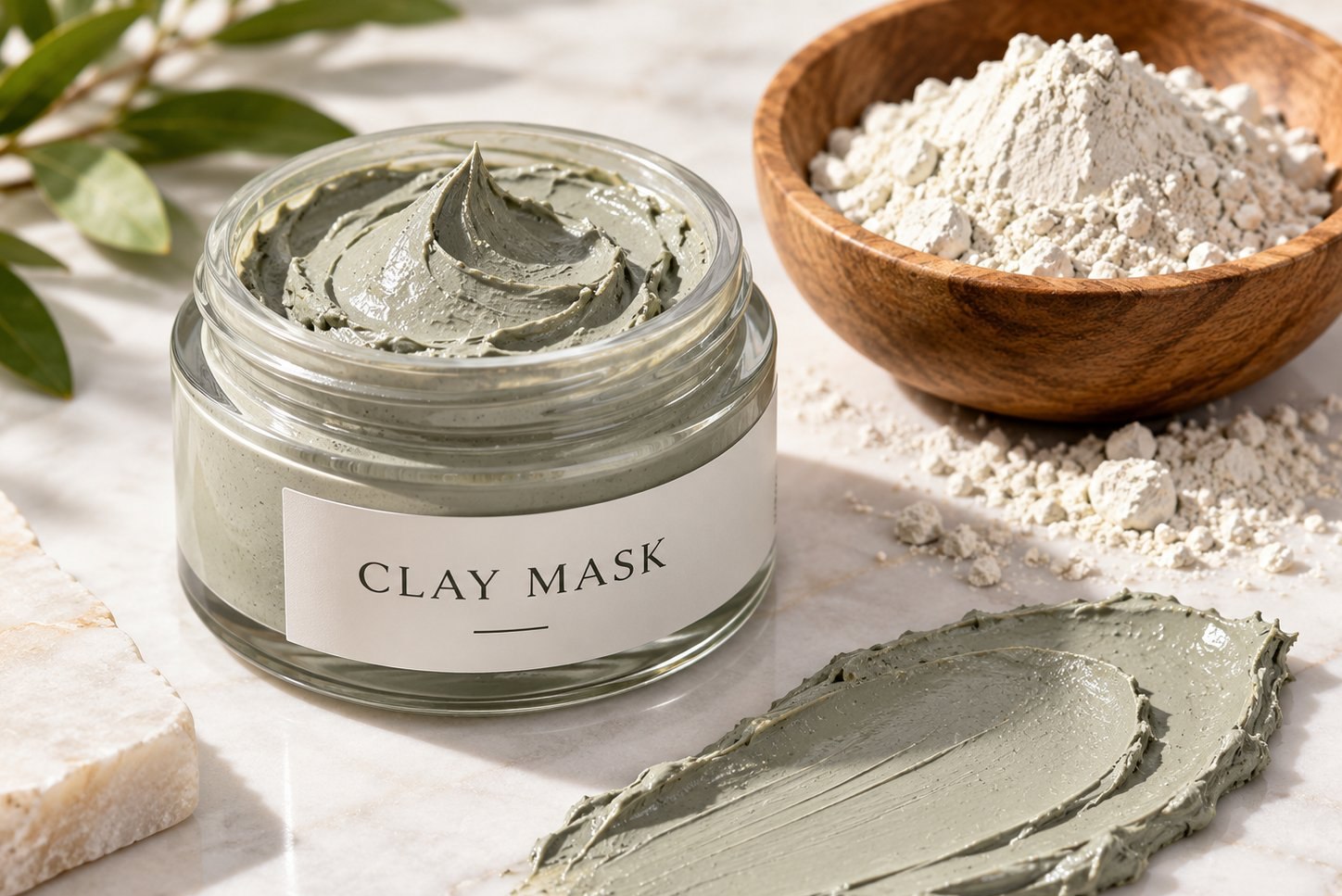
Clay mask use in an oily-skin routine can absorb surface oil and leave the skin feeling cleaner for a period after rinsing. It does not permanently stop oil production, replace daily cleansing, or treat every cause of breakouts. The best results come from using the right mask at a sensible frequency and supporting it with a consistent routine.
This guide explains how men can use a clay mask without over-drying the skin and how the mask fits alongside cleanser, exfoliation, and moisturizer.
What this guide covers
- Why Men with Oily Skin Need a Balanced Routine
- How Clay Masks Work
- Choosing a Clay for Oily Skin
- How to Use a Clay Mask for Oily Skin
- How Often Should Men Use a Clay Mask?
- A Complete Oily-Skin Routine for Men
- Common Clay Mask Mistakes
- Developing a Men’s Clay Mask for a Brand
- Frequently Asked Questions
- Build the Routine Around the User

TL;DR
- Men with oily skin need a balanced routine; clay masks control excess sebum without stripping the barrier.
- Choose the clay (kaolin, bentonite, etc.) by strength and skin tolerance, and use 1-2x/week, not daily.
- Build the full oily-skin routine around the user, with development and quality checks via BUNJOIN.
Why Men with Oily Skin Need a Balanced Routine
Oily skin produces enough sebum to create visible shine and, in some cases, contribute to clogged pores. Sweat, sunscreen, environmental residue, and heavy grooming products can add to the problem. Aggressive cleansing may leave the skin tight and uncomfortable without solving the underlying pattern.
A balanced routine has three jobs:
- Remove excess oil and daily residue without unnecessary stripping;
- Use targeted products, such as a clay mask or exfoliating product, at an appropriate frequency;
- Maintain hydration with a moisturizer suited to the user’s skin feel and climate.
How Clay Masks Work
Clay-based formulas can bind or absorb oil and impurities from the skin surface. The finished experience depends on the clay type, particle properties, formula base, humectants, emollients, rinse-off behavior, and how long the product remains on the skin.
More drying is not automatically better. A mask that leaves the face excessively tight may be uncomfortable and difficult to use consistently. For men who shave, timing also matters because using a strong mask immediately after shaving may increase discomfort on already stressed skin.
Choosing a Clay for Oily Skin
The clay type shapes the experience as much as the rest of the formula. The table below compares the three directions most often used in men’s clay mask development.
| Clay type | Typical feel | Best positioning |
|---|---|---|
| Kaolin | Smoother, gentler, more approachable | Routine cleansing and lighter daily oil control |
| Bentonite | Stronger absorption and tightening sensation | Intensive rinse-off mask for oilier skin |
| Green or mineral clay | Purifying, distinctive natural color | Visual identity and a purifying product story |
Kaolin
Kaolin is often used for a smoother, more approachable clay-mask experience. It can suit routine cleansing and oil-control positioning when the formula is balanced with the desired after-feel.
Bentonite
Bentonite can create a stronger oil-absorbing and tightening sensation. It may suit users seeking a more intensive rinse-off mask, but the complete formula and use directions should prevent an unnecessarily harsh experience.
Green and Mineral Clay Directions
Green or mineral-rich clay concepts can create a recognizable visual identity and a purifying position. Color consistency, odor, dispersion, viscosity, and rinse-off performance should be evaluated in the finished formula. Scent and fragrance direction should follow IFRA standards so the documentation supports the intended markets.
How to Use a Clay Mask for Oily Skin
- Cleanse first. Use a suitable facial cleanser to remove sweat, sunscreen, and surface residue.
- Apply an even layer. Follow the product directions and avoid the eye area, lips, and visibly irritated skin.
- Do not wait for extreme cracking. Leaving a mask on longer than instructed does not guarantee better results.
- Rinse gently. Use lukewarm water and avoid aggressive scrubbing.
- Moisturize. Apply a suitable moisturizer to support a comfortable after-feel.
How Often Should Men Use a Clay Mask?
Frequency depends on the formula, skin condition, climate, and the rest of the routine. Many users begin with occasional use and adjust according to the product instructions and skin response. Using several strong exfoliating or oil-control products on the same day can increase dryness or irritation.
Men who shave regularly may prefer to use a clay mask on a non-shaving day. Anyone with persistent irritation, painful breakouts, or a diagnosed skin condition should seek advice from a qualified healthcare professional rather than relying on a cosmetic mask.

A Complete Oily-Skin Routine for Men
Morning
- Gentle facial cleanser;
- Lightweight moisturizer;
- Appropriate sun protection.
Evening
- Cleanser to remove the day’s residue;
- Targeted treatment or exfoliation according to the product directions;
- Moisturizer.
Occasional Step
Add a clay mask on selected days rather than treating it as a replacement for cleansing or moisturizing. A face mask designed for men can also be positioned around oil control, post-workout use, travel, or weekly grooming.
Common Clay Mask Mistakes
- Using the mask every day without considering the formula;
- Leaving it on far longer than the instructions;
- Combining it with several strong exfoliating products at once;
- Scrubbing hard during removal;
- Applying immediately after shaving;
- Skipping moisturizer because the skin is oily;
- Assuming a tingling or burning sensation proves the mask is working.
Developing a Men’s Clay Mask for a Brand
For a private label or ODM project, the clay type is only one part of the brief. Brands should also define:
- Target skin type and desired after-feel;
- Level of oil absorption and tightening sensation;
- Rinse-off speed and residue expectations;
- Jar, tube, sachet, or kit packaging;
- Color, scent, and visual identity;
- Target market and required product documentation;
- Claims that need appropriate support;
- Whether the mask will launch alone or in a complete men’s face-care range.
The finished formula should be assessed for stability, viscosity, spreadability, microbial quality, packaging compatibility, and user directions. Claims should describe the demonstrated cosmetic effect rather than promise a medical treatment. In the United States, the FDA’s MoCRA framework explains that cosmetic manufacturers are responsible for product safety and required records.
Developing a Clay Mask with BUNJOIN
BUNJOIN is a men’s grooming product development and supply chain partner founded in 2013 and based in Guangzhou, China, supplying brands in the USA, Europe and other global markets. Capabilities cover product development, formulation, packaging, compliance documentation, manufacturing, quality control and logistics.
For a clay mask, the development decisions are the clay type and ratio, the humectant level that keeps the film from over-drying, preservation, fragrance limits, and whether the formula will be packed in a jar, tube or sachet. Each of those choices changes the stability work and the documents the destination market expects, so they belong in the brief rather than in a revision round.
Related reading: do men need eye cream and beard oil vs beard balm.
Frequently Asked Questions
Is a clay mask good for oily skin?
It can be a useful occasional step for absorbing surface oil and supporting a cleaner feel. The formula, use frequency, and complete routine determine whether the experience is balanced or overly drying.
Can a clay mask replace facial cleanser?
No. Cleanser supports daily removal of sweat, oil, and residue. A clay mask is an additional rinse-off treatment used less frequently.
Should men moisturize after a clay mask?
Yes. A suitable moisturizer can restore comfort and support the skin barrier after rinsing.
Can men use a clay mask every day?
No. Daily use is more likely to leave the skin feeling tight and uncomfortable than to produce better results. Most routines place a clay mask once or twice a week, adjusted to how the skin responds.
Should a clay mask cover the whole face or only the T-zone?
It depends on the skin type. Oily skin can usually tolerate full-face application, while combination skin often does better with the mask applied only to the T-zone and a lighter product elsewhere.
Build the Routine Around the User
A good oily-skin routine does not try to remove every trace of oil. It manages shine and buildup while maintaining comfort and consistency. Brands developing clay masks, cleansers, and moisturizers for men can contact BUNJOIN with their target skin type, product format, market, packaging, and launch requirements.

Frequently asked questions
What is the typical MOQ for private label men's skincare?
Most skincare SKUs start at 1,000–5,000 units; sets and kits vary with their components.
Can the formula and actives be customized?
Yes — we adjust texture, key actives (for example niacinamide or glycerin) and fragrance to your brief and claims plan.
How long does skincare development take?
Feasibility and samples 1–3 weeks, production 3–6 weeks after approval, plus freight.