Men’s grooming products for Asia-Pacific markets are not one uniform opportunity. A formula that works in a humid, price-sensitive e-commerce channel may need a different texture, fragrance, pack size, and claim strategy from a premium product sold through a department store or specialty retailer. Brands planning an Asia-Pacific launch should define the destination country and channel before choosing the formula.
Short answer: Men’s grooming products for Asia-Pacific markets succeed when the brief starts with one country and one sales channel instead of the region as a whole. Three decisions drive most outcomes: a texture that fits the local climate, packaging that survives the chosen channel, and documentation prepared for the destination market before the formula is locked.
This guide explains how to turn a broad regional opportunity into a practical brief for men’s grooming products across skincare, hair styling, beard care, shaving, body care, and fragrance. It is written for brands, distributors, and sourcing teams working with an ODM manufacturer.
What this guide covers
- Start with a Country, Customer, and Sales Channel
- Choose Men’s Grooming Products That Fit the Use Case
- Translate Climate and Routine into Testable Specifications
- Build for E-Commerce and Distributor Handling
- Check Market Requirements Before Freezing the Formula
- A Practical Asia-Pacific Product Brief
- From Regional Idea to ODM Sample
- How BUNJOIN Supports Asia-Pacific Men’s Grooming Projects
- FAQ
TL;DR
- Start any men’s grooming range from a country, customer profile, and sales channel before choosing products.
- Translate climate and routine into testable specifications, then check market requirements before freezing the formula.
- BUNJOIN supports Asia-Pacific projects from regional idea to ODM sample, covering compliance and logistics.
Start with a Country, Customer, and Sales Channel
“Asia-Pacific” is useful for regional planning, but it is too broad for product development. The first brief should name the launch country or countries, target customer, retail channel, expected price, pack size, and product claims. These decisions affect formulation, packaging, labeling, testing, and documentation.
- Country: Identify the first sales market and any markets planned for the same formula.
- Customer: Define age range, grooming habits, desired finish, fragrance preference, and common product complaints.
- Channel: State whether the product is for marketplaces, social commerce, barbershops, specialty retail, distributors, or direct-to-consumer sales.
- Price and pack size: Set the target retail price, fill weight, packaging format, and estimated order quantity.
- Launch claim: Choose a small number of supportable cosmetic claims instead of building the concept around broad promises.
Choose Men’s Grooming Products That Fit the Use Case
Each category serves a different routine, and the right men’s grooming products depend on the local habit more than on a regional average. Start with the formats that match the customer’s daily routine before expanding the SKU list.
Men’s Skincare
A simple line can begin with a face cleanser and moisturizer, then expand into an eye cream, anti-aging cream, exfoliating pads, face scrub, or a coordinated face care kit. In warm or humid target markets, buyers may request fast absorption, a lightweight after-feel, and packaging that is easy to use without exposing the formula repeatedly. These preferences should be confirmed for the actual customer group rather than assumed for the whole region.
Hair Styling
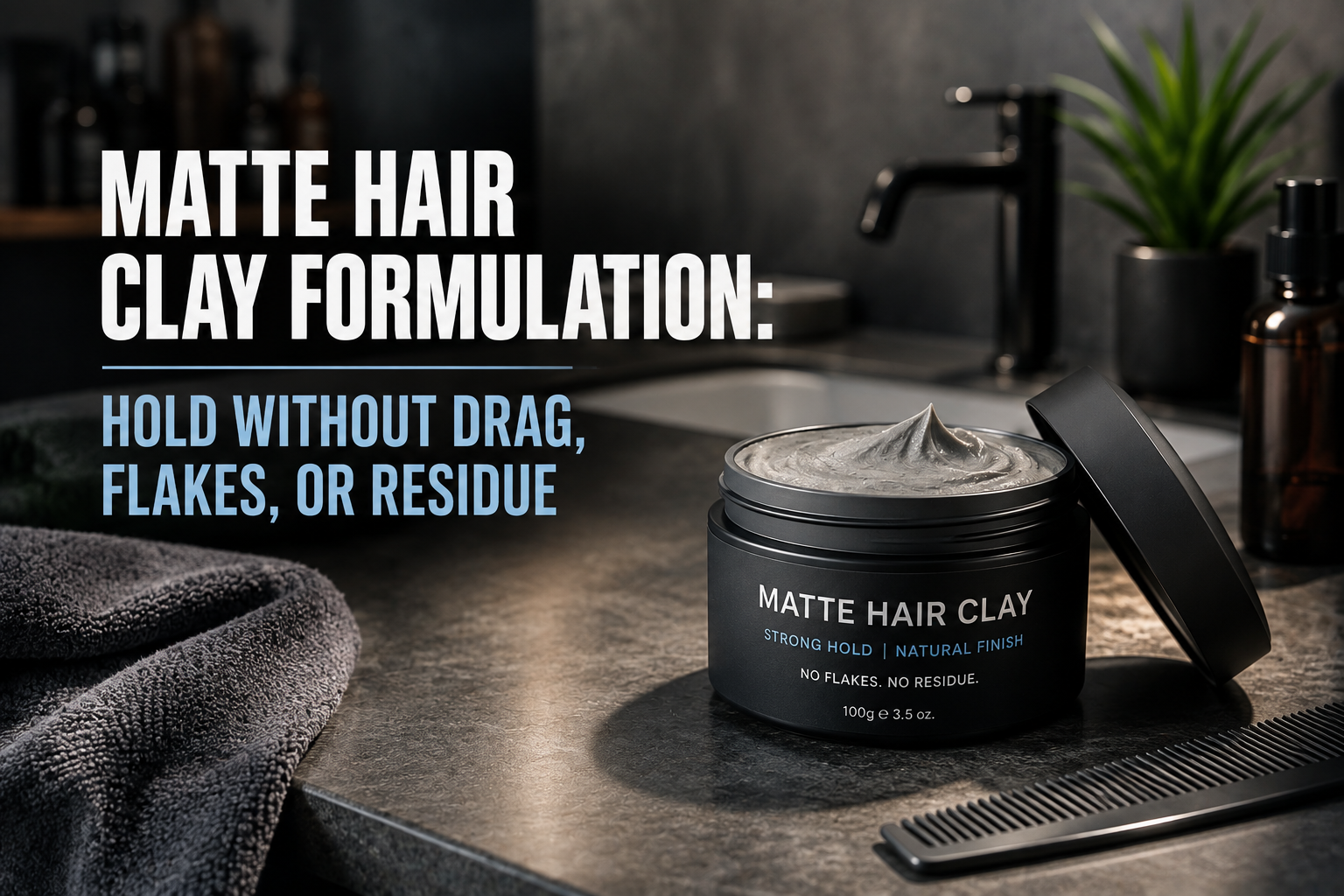
Hair styling products need a clear performance brief. A clay, pomade, wax, styling powder, or sea salt spray should specify hold, shine, texture, restylability, residue, washability, and fragrance. Channel also matters: a barber-focused product may prioritize control and professional pack sizes, while an e-commerce launch may need a simple demonstration and a package that survives parcel delivery.
Beard Care and Shaving
Beard oil, beard balm, beard wax, shaving cream, pre-shave oil, and after-shave products serve different routines. Before adding multiple SKUs, brands should confirm whether facial-hair density and grooming habits support a complete beard line in the target market. Where beard care is a narrower category, shaving or facial skincare may provide a clearer starting range.
Body Care and Fragrance
Body wash, deodorant, body lotion, hand cream, solid cologne, and eau de parfum can share one scent direction while using different fragrance levels and formula systems. A coordinated range can improve brand recognition, but each finished formula still requires its own compatibility, stability, packaging, and market review. Fragrance choices should follow IFRA standards so the documentation supports the intended markets.
Translate Climate and Routine into Testable Specifications
Climate should be converted into a formula requirement instead of used as a marketing stereotype. Men’s grooming products that perform well in one climate may fail in another, so the brief should state measurable targets rather than vague promises.
For a hot or humid target market, a buyer might request a lighter emulsion, lower tack, quicker absorption, reduced residue, or packaging suited to frequent use. For a dry or air-conditioned environment, the same category might require a richer after-feel or stronger moisture retention.
The brief should use measurable or reviewable language such as “absorbs within the agreed application test,” “matte finish after application,” “no visible flakes during the use test,” or “maintains the agreed viscosity during stability testing.” This gives the manufacturer and buyer a shared approval standard.
| Climate or routine factor | What to specify | Example testable target |
|---|---|---|
| Hot and humid | Lighter emulsion, lower tack, faster absorption | Absorbs within the agreed application test; matte finish after application |
| Dry or air-conditioned | Richer after-feel, stronger moisture retention | Maintains agreed viscosity through stability testing |
| Daily reapplication | Packaging that limits repeated exposure | Pump or tube preferred over open jar |
| Parcel delivery | Leakage, cap security, carton strength | Passes drop and leak checks for the shipping route |
Build for E-Commerce and Distributor Handling
Online sales place extra demands on packaging and product communication. Packaging for men’s grooming products sold online must survive parcel handling, while the product page must explain the format, finish, scent, size, use method, and intended customer without relying on unsupported claims.
- Confirm whether jars, tubes, pumps, droppers, sticks, or bottles are suitable for the formula and shipping route.
- Review leakage, cap security, label adhesion, carton strength, and scuff resistance.
- Prepare clear product directions and visual demonstrations for unfamiliar formats.
- Plan barcodes, carton marks, language versions, and distributor information before artwork approval.
- Align delivery terms with the distributor using clear Incoterms rules so the responsibility for freight and risk is documented.
- Avoid selecting a large SKU range before the first products have validated demand.
Check Market Requirements Before Freezing the Formula
Cosmetic requirements, ingredient restrictions, notifications, responsible-party arrangements, and labeling rules differ by destination market and product category. Documentation for men’s grooming products varies by country, so the brand or importer should confirm the applicable route for each market before the formula is locked.
Common buyer requests may include the full INCI list, product specifications, safety data where applicable, stability or compatibility information, microbiological testing, packaging details, and fragrance documentation. The exact document set depends on the formula, product type, claims, and destination.
A Practical Asia-Pacific Product Brief
Use this checklist to specify men’s grooming products before sampling. A complete brief reduces revision rounds and helps the manufacturer prepare an accurate first sample.
| Decision | Information to provide |
|---|---|
| Market | First launch country, later expansion countries, and importer or distributor model |
| Customer | Target user, routine, desired finish, fragrance direction, and key complaints |
| Products | Launch SKUs, required performance, pack size, and product hierarchy |
| Channel | Marketplace, social commerce, retail, barbershop, distributor, or DTC |
| Commercial target | Target price, order quantity, launch timing, and packaging budget |
| Compliance | Destination requirements, claim limits, artwork languages, and requested documents |
From Regional Idea to ODM Sample
A strong Asia-Pacific project begins with a narrow first market and a product brief that can be sampled and tested. BUNJOIN’s men’s grooming manufacturer guide explains the wider development process. Brands can then contact BUNJOIN to develop men’s grooming products for their target Asia-Pacific market, sharing the target country, initial SKU list, packaging direction, expected quantity, and launch schedule to prepare the next ODM development step.
How BUNJOIN Supports Asia-Pacific Men’s Grooming Projects
BUNJOIN is a men’s grooming product development and supply chain partner founded in 2013 and based in Guangzhou, China. The team supplies brands in the USA, Europe, Asia-Pacific and other global markets, with capabilities covering product development, formulation, packaging, compliance documentation, manufacturing, quality control and logistics.
For an Asia-Pacific brief, the practical sequence is: agree the launch country and channel, convert climate and routine habits into testable specifications, select packaging that suits both the formula and the delivery route, then confirm the documentation set for the destination market before sampling. See the related men’s grooming product development case study and the face wash vs soap guide for how those decisions are worked through in practice.
FAQ
Which men’s grooming products should launch first in Asia-Pacific?
Start with daily-use formats that match local habits — typically a cleanser, a lightweight moisturizer and one styling product. There is no reliable regional average; confirm the routine with your distributor or channel data for the specific country before committing SKUs.
Do formulas need to change for humid climates?
Often yes. Humid markets usually call for a lighter emulsion, lower tack, quicker absorption and less residue. State these as measurable targets rather than adjectives so both sides can approve the same sample.
What documentation is required before launch?
Typically the full INCI list, product specification, stability and compatibility data, microbiological testing, packaging details and fragrance documentation. The exact set depends on the destination market, product type and claims, so confirm it before freezing the formula.
How many SKUs should the first order include?
Two or three core SKUs is usually enough to test demand. Sharing one packaging component across those SKUs keeps the component minimum workable and reduces the cash tied up in a first run.
Frequently asked questions
What is a typical private label MOQ for men's grooming?
Most SKUs start at 1,000–5,000 units; formats that need custom tooling or filling run higher. We confirm the exact minimum after your brief.
How long does private label production take?
Feasibility and samples usually take 1–3 weeks, then full production 3–6 weeks after approval, plus freight. We give a date range in the quote.
Can the formula, scent and packaging be customized?
Yes. Scent profile, active level, bottle or jar, label and carton are all adjustable, and we check claims against MoCRA/FDA before sign-off.