Sea Salt Spray Formulation Problems: How to Prevent Clogging, Stickiness and Residue
Sea salt spray formulation looks deceptively simple: water, salt, a humectant, and a spray pump. In practice it is one of the most complaint-prone products a styling brand can launch. The same brine that creates beachy texture also recrystallizes inside the nozzle, leaves a white film on the hair, feels tacky to the touch, and behaves differently depending on the pump and the bottle. This article breaks down the five failure modes we see most often in competitor teardowns and client submissions — nozzle clogging, salt crystallization and residue, stickiness, uneven atomization, and packaging incompatibility — and explains the testing methods we use to catch them before production.
TL;DR
- Sea salt spray formulation is one of the most complaint-prone products a styling brand can launch despite looking simple: the five failure modes are nozzle clogging, salt crystallization and residue, stickiness, uneven atomization, and pump and packaging corrosion.
- Each failure mode needs a dedicated test before production — actuation cycling, evaporation-dish, probe-tack, spray-pattern and accelerated storage — not a fix applied after complaints arrive.
- Prevention is a formulation-and-packaging discipline, not a correction once the product is on the shelf: control the solubility budget, specify a wider orifice, and choose a chloride-resistant pump.
1. Nozzle clogging — the complaint that kills repeat purchase
Sea salt spray formulation teams underestimate clogging because the problem rarely shows up in a single lab spray. It appears after weeks of partial use, when droplets evaporate at the orifice and leave behind a ring of dried salt. Over dozens of actuations that ring narrows the exit hole until the spray weakens, spits, or stops entirely.
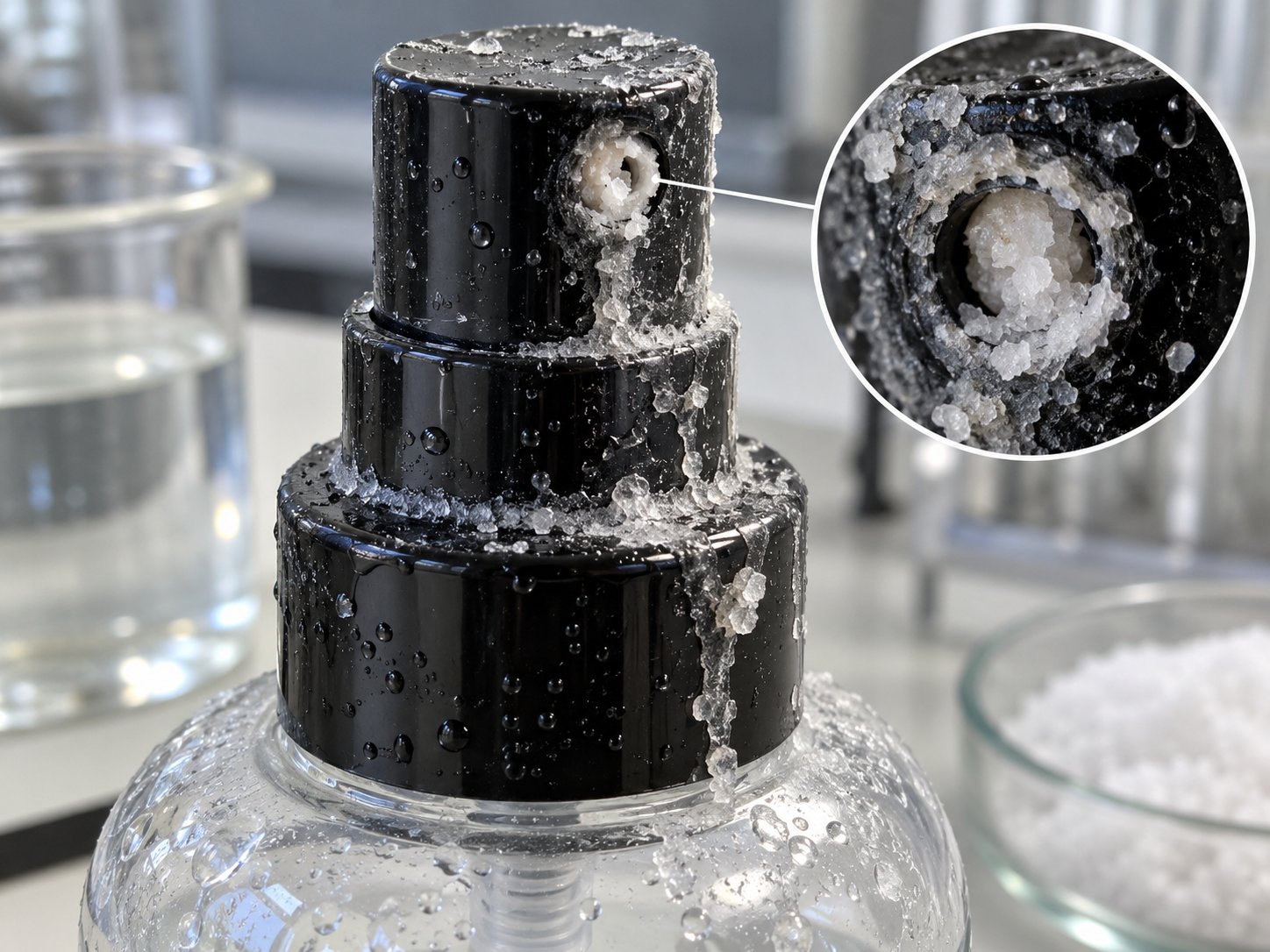
Three mechanisms drive it. First, recrystallization: brine that wicks to the tip evaporates and deposits salt. Second, precipitation: cationic conditioning agents or polymers can react with anions in hard water or with certain salts, forming insoluble flocs that lodge in the orifice. Third, viscosity: a formula that is too thick simply cannot pass a fine hole cleanly.
Our standard clogging test is an actuation-cycling protocol. We mount the filled bottle on a rig that fires a set number of sprays per day — typically 20 to 40 — at fixed intervals, then stores the bottle tip-up or tip-down to mimic real handling. After two to four weeks we disassemble the pump, photograph the orifice under a microscope, and score deposit severity on a 0 to 5 scale. We also weigh output per actuation to catch gradual flow loss before it is visible.
The method has limits. A rig sprays on a schedule; a real user pumps halfway, stores the bottle upside down, and forgets it in a hot car. We therefore run a second, abusive variant at 40°C to surface failures a gentle test hides. No single cycle count predicts field life, so we treat the score as a relative ranking between candidate pumps rather than an absolute expiry date.
Prevention starts with the brine. Keep total dissolved salt within the solubility window for the chosen package, favor salts that stay dissolved at low humidity, and add a small amount of a soluble humectant to keep the orifice film mobile. Specify an orifice diameter of at least 0.4 mm for salt-forward formulas, avoid incompatible cationic conditioners, and ask your pump supplier about anti-clog tip geometries. A dip-tube strainer also catches flocs before they reach the orifice.
2. Salt crystallization and white residue
White powder on the hair is the second most common complaint, and the easiest to reproduce in the lab. A sea salt spray formulation that relies on a high salt load deposits crystals as the water evaporates. On dark hair the effect reads as dandruff-like flaking; on the hands it feels gritty. This is where sea salt spray residue stops being a cosmetic nuance and becomes a returns risk.
Root causes are solubility and balance. Oversaturated brine precipitates once solvent leaves. Salts built on calcium or magnesium are especially prone because their chlorides are less soluble than sodium chloride and because they interact with anionic surfactants. A film former that does not dry clear compounds the problem by trapping crystals in a hazy matrix.
We use two complementary tests. The evaporation-dish method weighs a known sample, drives off the water, and records the dry residue as a percentage; we then inspect the crystals under a microscope to judge morphology — fine, uniform crystals feel less abrasive than coarse needles. The hair-swatch method applies a fixed dose to standardized swatches, dries them at controlled humidity, brushes them, and scores flaking on a visual scale. Together they tell us both how much deposits and how it looks.
Both tests under-predict real conditions in opposite ways. A petri dish evaporates faster than a warm scalp, so the dish can overstate residue; a swatch has different porosity and oil load than live hair, so it can understate it. Humidity is the wildcard: the same formula that is clean at 50% relative humidity flakes at 30%. We always score swatches across at least two humidity set points.
The fix is a solubility budget. Reduce total solids, swap calcium- or magnesium-heavy salts for more soluble alternatives, and add a chelating agent such as EDTA to mask hardness ions. A co-solvent like ethanol widens the solubility window and speeds even drying, which reduces crystal growth time. Choose film formers specifically rated to dry clear and tack-free at low addition rates.
3. Stickiness and tackiness
Stickiness is subtler than clogging because the product can pass every visual test and still feel wrong in the hand. A sea salt spray formulation built on a heavy glycerin or propylene-glycol load, or on sugars and natural extracts, tends to feel tacky — hair clumps, the fingers squeak, and the style collapses in humid weather.
We quantify feel with a probe-tack test on a texture analyzer: a flat probe contacts the dried film, pulls away, and records the peak adhesive force. It is objective but cold, so we pair it with a trained sensory panel that rates tack at 50% and 80% relative humidity. Humidity matters because humectants pull water from the air; a formula that is fine in winter goes sticky in summer.
The panel method has a real limitation: sensory scores need a calibrated panel and a reference scale, and individual tolerance for tack varies. We anchor every panel to a known-good benchmark sample so that a “3 out of 5” means the same thing across sessions. Without that anchor the numbers drift and the test loses its value for comparing formulas.
Reduction strategies are straightforward. Trim the humectant load, balance glycerin with ethanol so the film sets rather than stays fluid, and select film formers that build a dry, flexible network. Where a natural extract is the culprit, move it to a low-addition solubilized form or drop it. A small amount of a high-molecular-weight polymer can also reduce the perception of tack by changing how the film flows under the finger.
4. Spray uniformity and atomization
Even a clean, non-tacky formula fails if it does not spray well. Atomization quality depends on viscosity, surface tension, and the pump. A sea salt spray formulation that is too viscous or too high in surface tension throws coarse droplets that land as wet spots instead of an even mist, so the texture is patchy and the salt lands unevenly.
Our spray-pattern test is low-tech and revealing. We fire the bottle at a fixed distance onto a card treated to show wet marks, then measure cone width and the evenness of the deposit across the cone. We also weigh ten consecutive actuations to confirm shot-to-shot consistency — a good pump delivers within a few percent; a weak one wanders. Where equipment allows, laser diffraction gives a true droplet-size distribution.
The limitation is that pattern cards are qualitative and laser diffraction needs capital equipment many contract labs lack. Temperature also shifts results: a formula tuned at 22°C sprays differently at 35°C because viscosity drops. We therefore specify the pump and the viscosity range together, because changing one without the other is the usual cause of a “why does this batch spray differently” complaint.
To improve atomization, lower surface tension with a small, salt-compatible surfactant and keep ethanol in the range that thins the brine without destabilizing the salts. Match the orifice to the viscosity rather than forcing a fine mist from a thick liquid. Finally, qualify the pump on the actual formula — not on water — because suppliers’ spray claims are almost always measured on neat water.
5. Packaging compatibility
Packaging is where sea salt spray formulation meets corrosion. Chloride ions are aggressive toward many metals, and the spring inside a standard pump is often the first casualty. A corroded spring weakens return force, so the spray degrades months after launch — long after the formula has been signed off.
Our compatibility protocol stores filled bottles at 40°C and 75% relative humidity for eight to twelve weeks and inspects them at intervals. We pull pumps, photograph the spring under magnification for pitting, measure pH shift in the formula, and check the bottle for haze or stress cracking. Cap-liner swelling and label adhesive failure show up here too, and both erode shelf appearance.
The hard limit is time. Twelve weeks at 40°C accelerates but does not fully equal eighteen months on a warehouse shelf, and some chloride-driven failures only appear after six months of real storage. We mitigate by specifying chloride-resistant materials up front — stainless grades, plastic springs, or bag-on-valve systems — rather than discovering the weakness after a field recall.
Prevention is a materials decision, not a fix applied later. Choose a pump with a chloride-resistant spring or a springless design, verify the PET grade resists stress cracking at the salt load, and confirm the induction seal and cap liner are inert to the formula. A short extractables study on the chosen package closes the loop and protects both the product and the brand.
6. How we actually test a sea salt spray formulation
No single test predicts a sea salt spray formulation’s real-world behavior, so we run them as a battery. A typical program starts with three replicate batches, then layers the clogging cycle, the residue dish and swatch work, the tack panel, the spray-pattern check, and the packaging storage study onto the same samples where possible to save material.
We score every test on a shared 0 to 5 matrix and weight them by the brand’s stated priorities — a salon brand may tolerate slightly more tack for stronger hold, while a mass-market brand may prioritize zero flaking above all. The output is a pass or a ranked shortlist of candidate formulas, each with its failure modes documented, so the brand can make an informed call rather than a hopeful one.
The honest limitation is that lab conditions are a compression of reality. Heat, humidity, usage frequency, and storage angle all vary in the field, and no acceleration factor captures all of them. We are explicit with clients about which risks remain after testing, and we recommend a small production pilot before a full run whenever the formula pushes any limit we have discussed above.
Quick reference: problem, cause, test, first fix
| Failure mode | Primary root cause | Key test | First fix |
|---|---|---|---|
| Nozzle clogging | Salt recrystallization at orifice | Actuation-cycling + orifice microscopy | Widen orifice; add soluble humectant |
| White residue | Oversaturated / low-solubility salts | Evaporation dish + hair-swatch scoring | Cut total solids; add chelator + co-solvent |
| Stickiness | Heavy humectant or sugar load | Probe tack + sensory panel at 50/80% RH | Balance humectant with ethanol |
| Uneven spray | High viscosity / surface tension | Spray-pattern card + weight-per-shot | Lower surface tension; match pump |
| Packaging failure | Chloride corrosion of spring | 40°C / 75% RH storage + spring check | Chloride-resistant or springless pump |
7. Bring us your brief
If you are developing or reformulating a sea salt spray formulation, the fastest path is a concrete brief. Tell us the competitor products you want to match or beat, the nozzle type you plan to use, and the performance requirements that matter most to your customers — hold level, finish, feel, and climate. We will translate that into a test plan and a sampling program.
We have walked many styling brands through exactly this process, from first brief to stable production batch, and the formulation lessons above apply directly to related products. If you also work with clays or pastes, our breakdown of matte hair clay formulation and residue control covers the same residue problem from a different angle.
Spray mechanics themselves have a long industrial history worth understanding; the fundamentals of how pump and aerosol hair sprays atomize underpin the pump-matching advice in this article. As a private label hair styling manufacturer, we build these tests into every sea salt spray development program.
Submit your competitor targets, nozzle type, and performance requirements through our sampling inquiry form, and we will return a feasibility read and a proposed starting point for your sea salt spray formulation within a few working days.
Frequently asked questions
What is the typical MOQ for private label hair styling products?
Wax, clay, spray and cream usually start at 1,000–5,000 units per SKU depending on format and packaging.
Can you customize hold, finish and fragrance?
Yes — we tune hold, matte versus shine finish, wash-out and scent to your brief, then verify with samples.
How long does hair product production take?
Samples 1–3 weeks, production 3–6 weeks after approval, plus shipping.