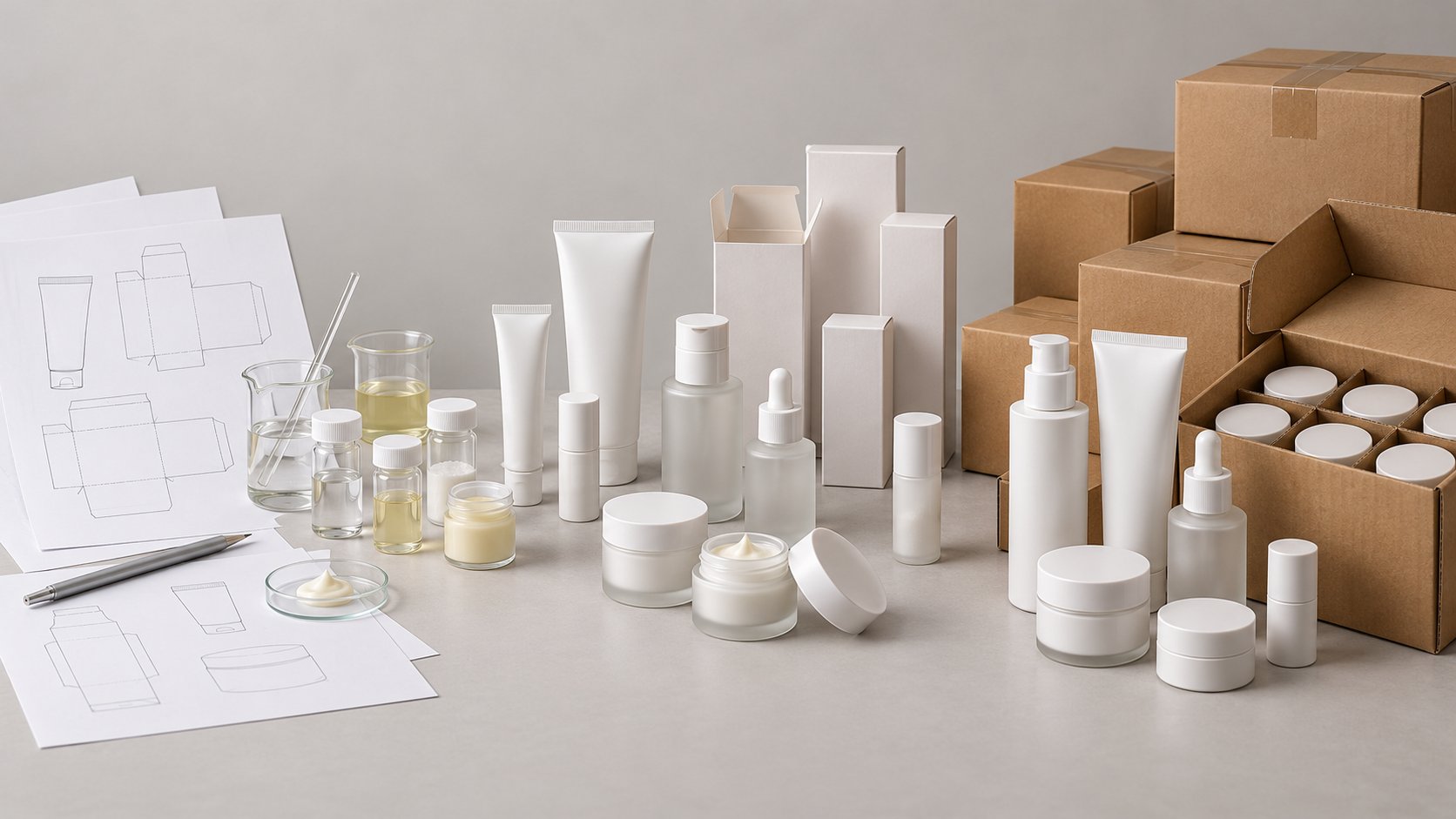
Starting a grooming brand with a manageable order quantity requires more than simply finding a supplier with a low MOQ. It involves a clear development process, from formula sampling and packaging selection to production planning and quality control. By understanding these stages, new brands can make informed decisions, manage their initial investment, and build a product range that is ready to grow with their business.
This guide walks you through the four stages, from free product sampling and packaging evaluation to trial production and full-scale manufacturing. It also explains how stock packaging, custom packaging, and different printing methods influence MOQ, helping you plan a suitable starting point for your brand. At the end, you will find a practical requirements form to help you communicate your product needs and receive a tailored production recommendation.
TL;DR — how a new grooming brand starts small with low moq private label cosmetics
- There is no single MOQ — there are four gates: free formula sampling, packaging sampling, small-batch trial production, and formal mass production. Each gate of a low moq private label cosmetics project has its own requirements, and planning each stage carefully helps brands avoid unnecessary costs and production mistakes.
- Free sampling supports product development: Review product texture, fragrance, performance, and packaging options before confirming your production plan. At BUNJOIN, free samples help brands evaluate suitable product directions.
- Packaging plays a major role in determining MOQ: Stock components, custom packaging, label printing, and specialized finishing each have different production requirements. Choosing the right combination helps brands manage their initial order quantities more effectively.
- A trial production run helps validate the product: Where suitable, a trial run helps evaluate filling performance, product consistency, packaging compatibility, and initial market response before larger-scale manufacturing.
- Every project has different MOQ requirements: Formula, packaging, printing methods, and production conditions all influence the final quantity. A detailed product brief helps determine a suitable production plan for your brand.
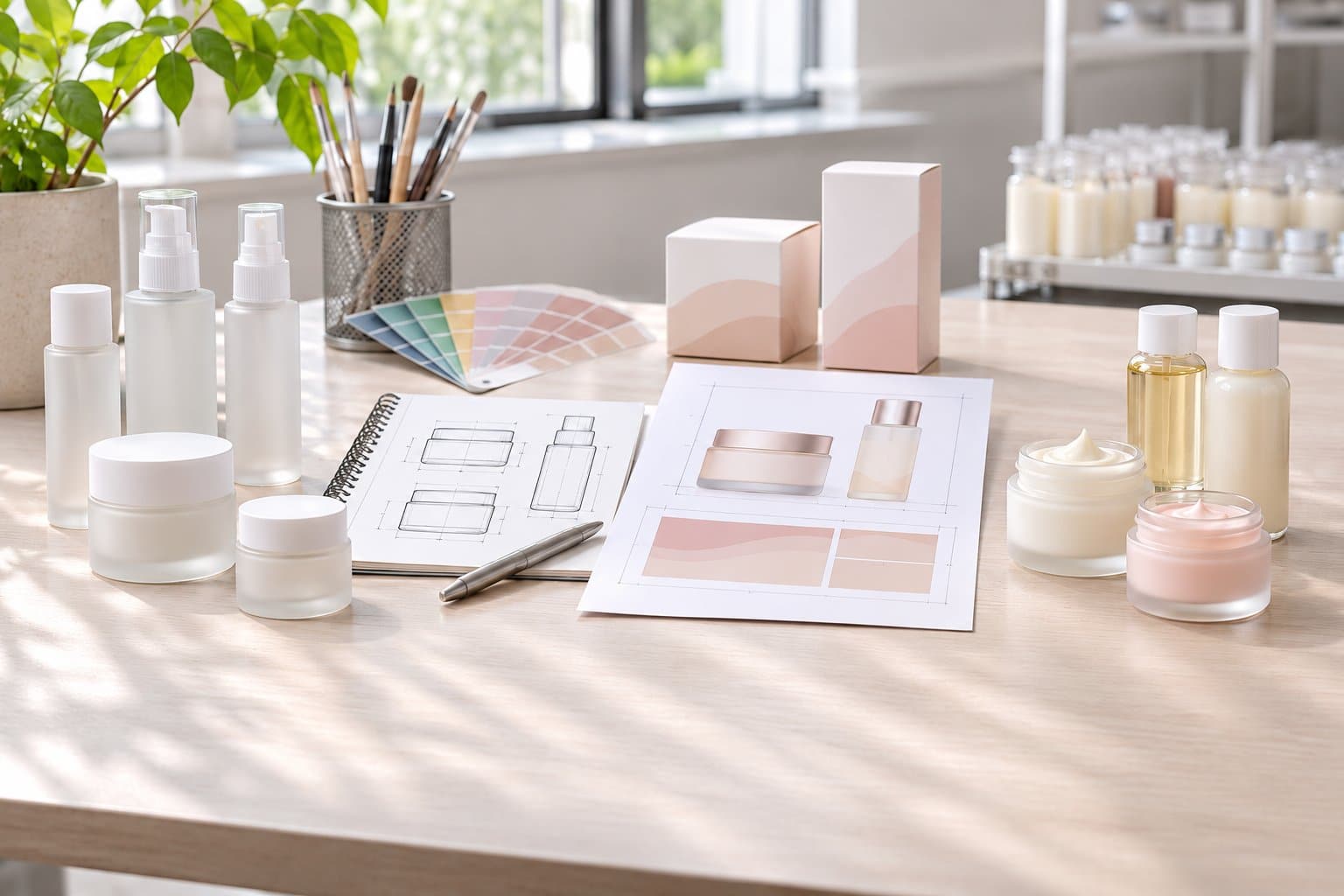
What “low MOQ” really means: four gates, not one number
Every supplier conversation about starting small goes wrong in the same place: the brand asks “what is your MOQ?” and the supplier answers with one number that means nothing on its own. The honest answer is that a low MOQ private label cosmetics project passes through four gates before a single unit is sold, and each gate has its own minimum. Formula samples decide whether the product is worth making. Packaging sampling decides what it will live in. A small-batch trial run decides whether the line, the pack, and the market agree. Formal mass production is the only stage where the word “MOQ” in its usual sense — the reorder minimum — truly applies.
The table below is the map. Read it as a sequence: the minimum at each gate is what you pay to earn the right to the next one, and the cost column tells you what kind of expense it is — a fee you can walk away from, or inventory you now own. A brand that skips gates in a low moq private label cosmetics project does not save the fees; it pays them later as obsolete packaging, reprints, and bulk that never matches the approved sample.
| Gate | What happens | Typical minimum | What it proves | Cost behavior |
|---|---|---|---|---|
| 1. Formula samples | Free product samples; formula adjustments based on project requirements | Free samples available; adjustments depend on project requirements | Whether the formula family fits your brief | Supports product evaluation before production |
| 2. Packaging sampling | Empty components, decoration proofs, formula-in-component compatibility | Depends on packaging type and supplier requirements | The pack your product will actually live in | Depends on stock components, decoration, and tooling |
| 3. Small-batch trial run | Trial production where suitable, with production-line filling and quality records | Depends on formula, components, and production conditions | Filling, yield, QC records, and market response | Helps evaluate production feasibility and product consistency |
| 4. Formal mass production | Reorder at real component, print, and batch minimums | Depends on formula, packaging, printing, and order specifications | Velocity and reorder economics | Production costs depend on order quantity and specifications |
Two structural points sit behind the table. First, the four gates stack on top of the four minimums that make up any private label quote — formula batch, component run, printing setup, and development recovery — and our private label MOQ guide breaks that stack down in full. Second, the binding minimum at each gate is almost never the formula. For grooming products it is usually a component or a print setup, which is why the packaging sections of this guide carry the most weight for any low moq private label cosmetics project: the decisions that move your minimum are made in the packaging conversation, not the formulation conversation.
Gate 1: Formula Samples — Evaluating Product Fit Before Production
Free sampling is an important part of the product development process. It allows brands to evaluate product texture, fragrance, performance, and overall suitability before confirming a production plan. Depending on your requirements, you can start with an existing formulation or discuss adjustments to specific product characteristics. At BUNJOIN, we provide free samples to help customers explore suitable product directions and evaluate their preferred formulations.
Once you have reviewed the initial sample, our team can discuss any adjustments needed to better match your product brief. This may include changes to texture, fragrance, hold, or other product characteristics. The goal is to help you refine the formulation and confirm the product direction before moving on to packaging evaluation and production planning.
Two questions decide whether the sampling stage is worth its cost in a low moq private label cosmetics project. First: is the round lab-filled or line-filled? A hand-filled lab sample proves what the formula can do; only a line-filled sample from production components proves what your product will be, and the transition should be a planned, documented round — our sample approval checklist governs exactly that decision. Second: what documents travel with the sample? A formula code and version, the date, who compounded it, and the specification it was made against. A sample without a version is a souvenir; you cannot approve against it, and round three and round four become indistinguishable.
For private label hair products specifically, sample the base against performance you can feel, not just stability data. Hold, flaking, shine, and wash-out are judged on hair within hours, and a base that passes a stability panel can still fail on a live head. Our private label hair styling products range shows the kind of finished spec — hold level, finish, restyle behaviour, wash-out — that a capable supplier should be answering against when they hand you a sample.
Gate 2: packaging sampling — the stage that sets your floor
Packaging sampling is where the abstract side of low moq private label cosmetics becomes physical. Three different things get sampled here, and brands routinely confuse them. Empty component samples are the jar, bottle, pump, or cap itself — off the shelf for stock components, or a T1 trial shot for custom tooling. Decoration proofs are how your artwork will appear: a digital proof first, then a printed or labelled sample on the actual component. Compatibility samples are the formula living in the actual component, at temperature, for the shelf life — the document brands skip and then discover as a leaking pump three months after launch.
Stock components make this stage almost free: samples arrive in days, cost little or nothing, and can be shared across every SKU in your range.Custom tooling involves tooling investment, mould sampling, and additional development time— which is why tooling is a gate-4 decision in low moq private label cosmetics, not a gate-1 one. The mechanics of each route, including one-time fees and lead times, are broken down in our cosmetic packaging MOQ and cost guide; what matters at this gate is simply that you sample the pack before you commit to a run of it.
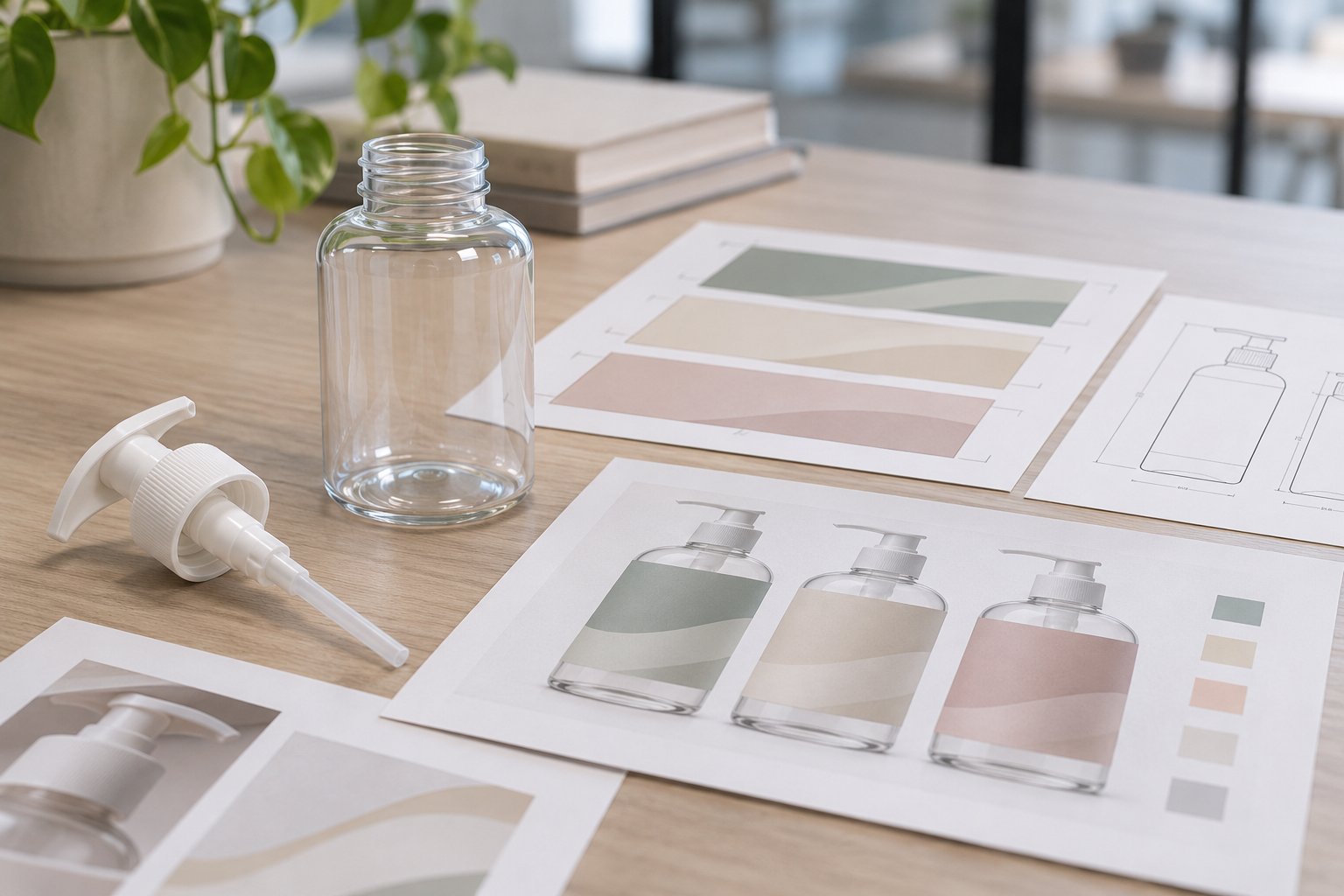
Three checks make the packaging sampling stage worth its time for any low moq private label cosmetics project. Does the component actually dispense your formula — dose per actuation, spray pattern, closure torque? Does the decoration survive contact — print adhesion on a curved surface, label placement through a shower or a gym bag? And does the filled unit survive the journey — drop, transit, and temperature testing at trial scale? Each check is cheaper here than at any later gate, and each failure found here is a component swap instead of a scrap run.
Gate 3: the small-batch trial run — the real test of a small start
A small-batch trial run, where suitable, allows brands to evaluate the product and production process before moving into larger-scale manufacturing. The appropriate quantity depends on the formula, packaging components, filling requirements, and production conditions. This stage can help assess product consistency, filling performance, packaging compatibility, and initial market feedback.
The purpose of a trial run is to evaluate product quality, production feasibility, and market response before moving into larger-scale manufacturing. The appropriate production quantity and cost depend on the selected formula, packaging components, and production requirements. A well-planned trial can help identify potential adjustments early and support more informed production decisions.
Use the trial run deliberately in a low moq private label cosmetics launch. Give the units to your first customers, a retail pilot, or a market test, and watch three things: repeat purchase intent, complaints by type, and the actual cost per unit landed. Then decide the production quantity from evidence instead of optimism. The schedule from this gate to a full production run — typically 4–8 weeks for a semi-custom project — is mapped in our private label grooming timeline.
Gate 4: formal mass production — where “MOQ” starts to mean MOQ
Formal mass production is the reorder stage, and it is the only stage where the word MOQ is used precisely: the minimum the factory, the component supplier, and the printer will each accept for a repeat run of your low moq private label cosmetics project. By this gate the trial run has answered the open questions, and the numbers that bind are the four stacked minimums — the formula batch, the component run, the printing setup, and development recovery. The route you chose back at gate 2 largely determines them: stock components reorder at component-supplier minimums, dedicated printing adds plate and screen recovery, and custom tooling reorders at the lowest unit cost of any route but the highest commitment.
Two things change character at this gate. Component tiers become real — the price you paid for 500 units is not the price for 5,000, and for a low moq private label cosmetics range, sharing components across SKUs is often the difference between a 3,000-unit minimum and a 1,000-unit one. And change control becomes the contract that protects the product you approved: no change to formula, raw material grade, component, artwork, or filling line without written notice and your approval. A first production run that drifts from the approved sample is a gate-3 failure that surfaced at gate 4, and the fix is always more expensive here.
How packaging and printing choices move your low moq private label cosmetics MOQ
This is the section to reread before any quote conversation, because packaging decisions — not formula decisions — set the floor for most low moq private label cosmetics projects. Every private label cosmetics moq conversation is really a packaging conversation in disguise. Three routes exist, and the route decides the minimum: ready-made (stock) components from moulds that already run, custom-moulded components that belong to you alone, and the decoration method layered on top of either. The numbers below are typical ranges, not quotes, and they are consistent with the component-by-component breakdown in our packaging MOQ guide.
| Dimension | Ready-made (stock) components | Custom-moulded components |
|---|---|---|
| Typical minimum | Depends on available stock and supplier requirements | Depends on mould development and production requirements. |
| One-time fees | Standard sampling and decoration costs may apply | May involve mould tooling and development costs |
| Lead time | Depends on stock availability and decoration | Depends on tooling, sampling, and production coordination |
| Sampling cost and risk | Existing components can be evaluated before production | Requires evaluation of custom tooling and packaging samples |
| Best gate for a new brand | Suitable for initial launches and product testing | Suitable for established products with specific packaging needs |
Printing and decoration behave the same way in low moq private label cosmetics — each method carries its own floor, and the method is usually what binds. Labels are the escape hatch: digital label printing has almost no tooling, which is why a stock container plus a custom label is the industry-standard first launch. Direct printing on the container looks more integrated and costs a screen, plate, or die per colour before a single unit exists.
The MOQ ranges above are indicative industry references for planning purposes, not fixed requirements. Actual minimums vary depending on packaging materials, component suppliers, printing specifications, artwork complexity, and production arrangements. For new grooming brands, stock packaging combined with customized labels is often a practical way to balance brand presentation and initial order quantities. A supplier can help identify the most suitable option based on your product specifications and target volume.
| Decoration method | Typical minimum | One-time setup | What it means for a small start |
|---|---|---|---|
| Digital label | 100–1,000 | Artwork and proofing only | The standard first-launch route: brand identity at trial-scale quantities |
| Screen print on container | 1,000–5,000 | Screen per colour | Raises the floor; each colour is another pass and another charge |
| Pad print | 1,000–5,000 | Plate per colour | For small decoration areas; same floor as screen printing |
| Hot stamp / foil | 1,000–5,000+ | Die per design | Premium look, premium minimum; postpone to the first reorder |
| Plated / UV direct print | 5,000–10,000 | Plates and plating setup | A volume route; the wrong tool for a first order |
For a new brand, the label route is the difference between a low moq private label cosmetics launch that starts at a few hundred units and one that starts at ten thousand. Three habits keep the floor low while the brand is unproven: share one bottle, closure, and label size across as many SKUs as possible; keep the colour count at one or two; and accept standard closure colours, because custom closure colour carries its own component minimum. Decoration upgrades — foil, direct print, custom tooling — are reorder decisions, and they land better once velocity has paid for them.
How to Determine the Right MOQ for Your Grooming Brand
MOQ can vary significantly between private label cosmetics projects. The actual quantity depends on several factors, including the formula, packaging selection, printing method, number of SKUs, and production requirements. For new grooming brands, starting with stock packaging and customized labels can be a practical way to manage initial order quantities while maintaining a professional brand appearance. Discussing your product specifications with the manufacturer is the best way to determine a suitable starting point.
What determines the real minimum for your low moq private label cosmetics project is knowable in advance: the formula status (stock base, tweak, or new development), the packaging route (stock, stock-plus-label, or tooling), the decoration method, the number of SKUs sharing components, and the document set your market requires. For example, a private label beard oil project using a stock dropper bottle with a digital label may have different MOQ requirements from the same product using a custom bottle with screen printing. Comparing these packaging options helps brands identify a suitable starting quantity and balance packaging costs with their initial production plans. The cost side of that comparison is broken down in our private label beard oil cost guide.
Market documents add a floor of their own, and it is a floor worth respecting. Selling into the EU means a responsible person, CPNP notification, a product information file, and a safety assessment under the EU Cosmetics Regulation; in the United States, MoCRA puts facility registration, product listing, and safety substantiation on the responsible person — typically you, the brand — with the FDA’s cosmetics resources as the reference point. Our MoCRA roles and documents breakdown maps which duties sit with the brand. These costs are largely fixed per SKU, which quietly raises the sensible minimum for a one-SKU launch and argues for launching a coherent small range — our private label grooming kits page shows how brands structure one.
The requirements form: how to get a realistic minimum in writing
Instead of a promised MOQ, here is the instrument that actually produces one for a low moq private label cosmetics project. Fill in the form below — it takes ten minutes — and send it to any supplier you are considering, including us. A supplier who returns a specific plan against a completed form is showing you their process; a supplier who answers a completed form with a brochure is showing you something else. Copy the table into an email or a document, fill the right-hand column, and send it with your market and timeline.
| Field | Your entry |
|---|---|
| Brand / company and target market(s) | |
| Product category and format (e.g., hair styling pomade, beard oil, face wash) | |
| SKU list: product, format, and target effect per SKU (hold, finish, scent) | |
| Estimated quantity per SKU — first order | |
| Estimated quantity per SKU — 12-month outlook | |
| Formula status: stock base / tweak to a base / new development | |
| Samples already completed: free base samples / paid rounds / approved sample | |
| Packaging direction: stock components / stock + label / custom tooling / open | |
| Decoration preference: digital label / screen print / hot stamp / pad print / open | |
| Components you already own or have sourced (if any) | |
| Documents needed for your market (EU responsible person and CPNP, US MoCRA listing, other) | |
| Target launch date and current stage (research / sampling / ready to quote) |
What a complete answer looks like when it comes back: the realistic minimum at each of the four gates for your exact low moq private label cosmetics project; the packaging options that work at your quantity, with unit prices at one, two, and five times the minimum; the decoration method that fits your first order; the document set your market requires and who holds each item; and a timeline from samples to trial run to production. If any of those five is missing from the reply, the quote is not ready to be compared.
Your five first steps
If you remember nothing else from this guide, follow these five steps to move from researching low MOQ private label cosmetics to planning your first product launch. One: request free samples to evaluate product quality, texture, fragrance, and performance. Two: sample packaging before committing to it, including stock components, decoration proofs, and compatibility checks. Three: evaluate whether a small-batch trial run is suitable for your project and determine the quantity according to your product and packaging requirements.
Four: keep labels and stock components for the first order, and reserve tooling and direct printing for SKUs with proven velocity. Five: fill in the requirements form above and send it to two or three suppliers — the answers, compared side by side, are your real MOQ.
Frequently asked questions
What is a realistic low MOQ private label cosmetics first order for a grooming brand?
For new grooming brands, an initial order can typically range from 500 to 3,000 units per SKU when using stock packaging with customized labels. A small-batch trial run may involve around 100–500 units where production conditions allow, while fully custom packaging with new moulds may require 5,000–10,000+ units. These figures are indicative planning references rather than fixed requirements. Actual MOQs depend on the formula, packaging materials, printing methods, number of SKUs, and production arrangements. Starting with stock packaging and customized labels is often a practical way to balance initial investment and brand presentation.
Are free samples worth requesting for private label cosmetics?
Yes. Free samples allow brands to evaluate product texture, fragrance, performance, and overall suitability before confirming a production plan. At BUNJOIN, we provide free samples and support formula adjustments based on your product requirements, helping you explore suitable product options before moving forward with production.
How does the packaging route change private label cosmetics MOQ?
Packaging can have a significant impact on MOQ. As general planning references, stock plastic bottles and jars may require around 500–3,000 units, digital labels around 100–1,000, screen printing on containers around 1,000–5,000, and custom mould tooling may involve 10,000+ units. These figures are indicative rather than fixed requirements, as actual minimums depend on packaging materials, component suppliers, printing specifications, and production arrangements. For new brands, combining stock packaging with customized labels is often a practical way to achieve a professional appearance while managing initial order quantities.
Can I launch with private label hair products before adding beard care?
Yes, and most new brands should. One category, one or two SKUs, on shared components keeps every minimum in a low moq private label cosmetics launch at its lowest and gives you real performance feedback — hold, finish, wash-out — within weeks. Beard care and shaving SKUs can join the range at the first reorder, when component and print minimums are already covered by proven volume; our private label beard care products range is a typical second category. Our hair styling OEM/ODM guide maps that first-category decision in detail.
What does a small-batch trial run cost compared with mass production?
More per unit — often significantly more — because pilot lines run slower and fixed setup, cleaning, and component minimums spread across fewer units. The trial run is not a cheaper production method; it is a priced experiment that answers whether the line, the pack, and the market agree before you commit to a full run. Treat its cost as part of launch research, and size the production order from what it proves.
Which documents do I need before my first private label beard oil order?
At minimum: a per-batch certificate of analysis, stability and microbiological test reports for the formula, and restricted-substance testing matched to your market. For the EU, add a responsible person, CPNP notification, a product information file, and a safety assessment; for the US, MoCRA facility registration and product listing sit with you as brand owner. The supplier can hold manufacturing-side documents, but the brand-side documents are yours by law, and they are largely fixed per SKU.
Send the form: get your realistic minimum, not a headline number
If you are planning a first order — or still deciding which category to launch — fill in the requirements form above and send it to us. Tell us the SKUs you are planning, the format and target effect for each, your packaging direction, your target market, and the gate you are at right now. We will come back with the realistic minimum at each gate for your low moq private label cosmetics project: the samples worth running, the packaging options that fit your quantities, the documents your market requires, and the first-order shape that matches your evidence rather than your optimism.
BUNJOIN is an ODM product development and global supply chain partner focused on men’s grooming. Since 2013, we have supported grooming brands with product development, formulation, packaging coordination, manufacturing, and global supply chain services. If you are still choosing a product direction, our OEM/ODM guide and product pages set out what we develop and supply across private label cosmetics.